







Question: 20. From Calculus, we know that a function can be approximated as a line at some point (a, b) by f (x) ~ f (a)
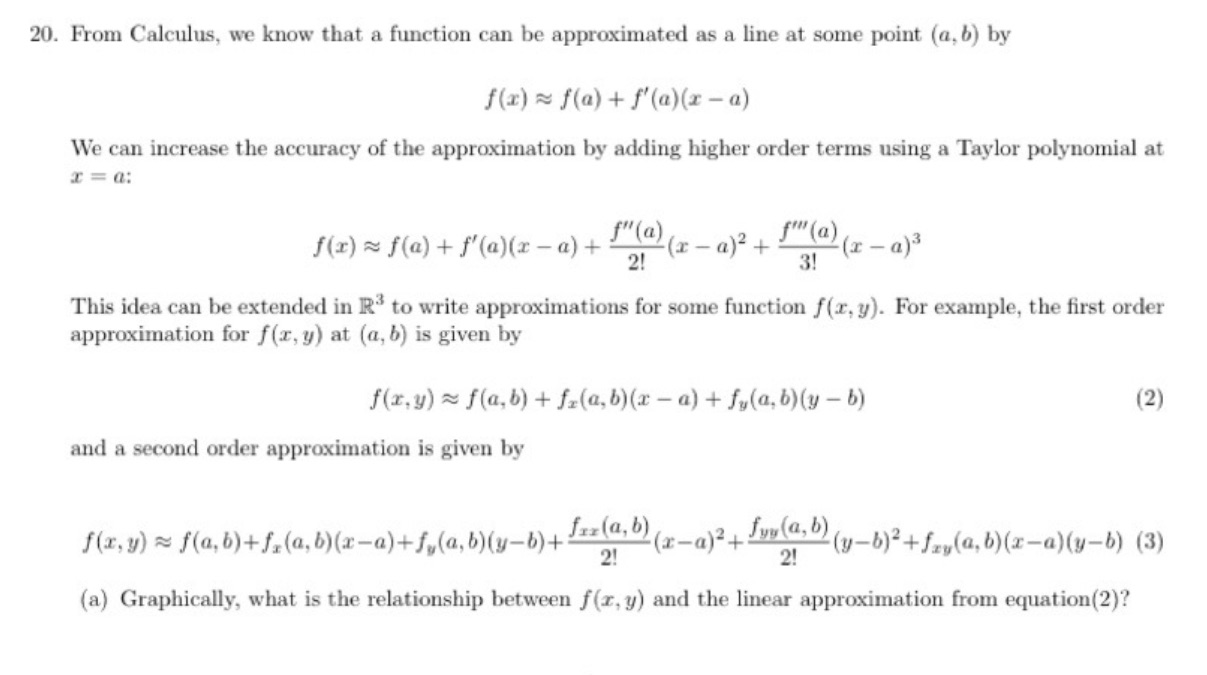
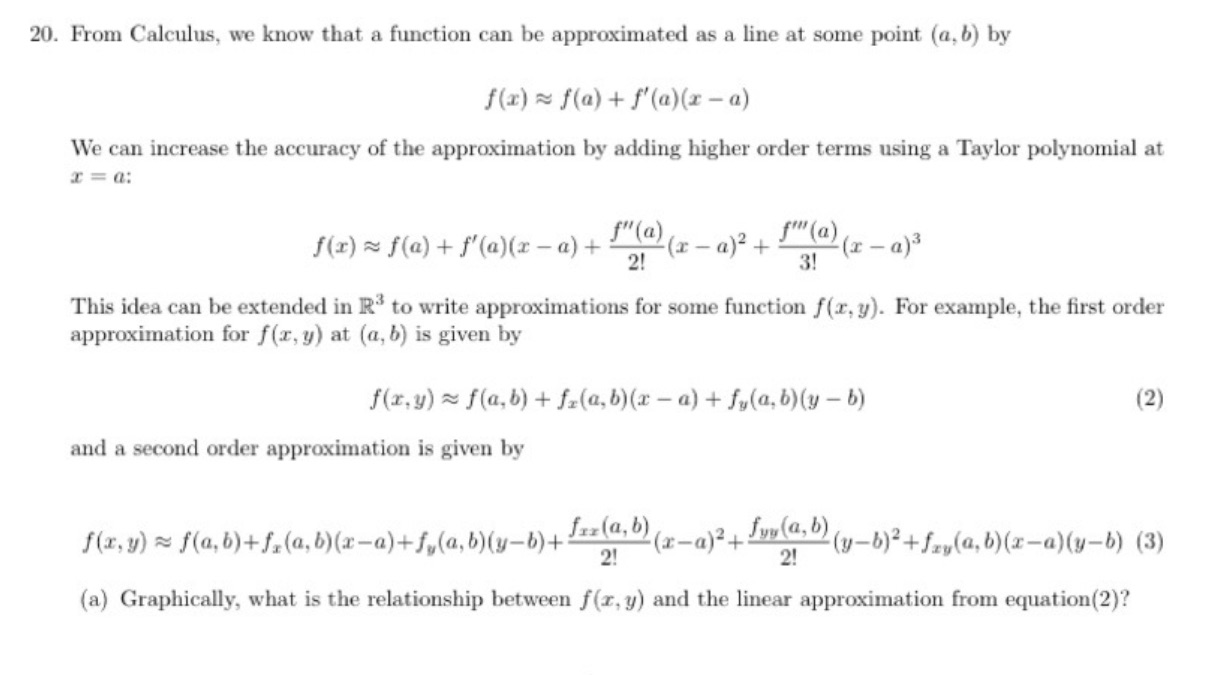
20. From Calculus, we know that a function can be approximated as a line at some point (a, b) by f (x) ~ f (a) + f' (a)(x - a) We can increase the accuracy of the approximation by adding higher order terms using a Taylor polynomial at I = Q: f (x) ~ f (a) + f' (a)(x - a) + 5"(a) (x - a)2 + 5" (a) 2! (x - a)3 3! This idea can be extended in R3 to write approximations for some function f(x, y). For example, the first order approximation for f(x, y) at (a, b) is given by f(x, y) ~ f(a, b) + fz(a, b)(x - a) + fu(a, b)(y -b) (2) and a second order approximation is given by f(x, y) ~ f(a, b)+fx(a, b)(x-a)+ fy(a, b)(y-b)+ Jzz(a, b) (x-a)2 4 Jus(a, b) 2! 2! (y-b)? + fry(a, b)(x-a)(y-b) (3) (a) Graphically, what is the relationship between f(r, y) and the linear approximation from equation(2)
Step by Step Solution
There are 3 Steps involved in it

Get step-by-step solutions from verified subject matter experts
 Study Help