







Question: (20 marks) A used computer store, JunkComputer has just started up on the University of Melbourne campus, and is looking to sell used laptops to
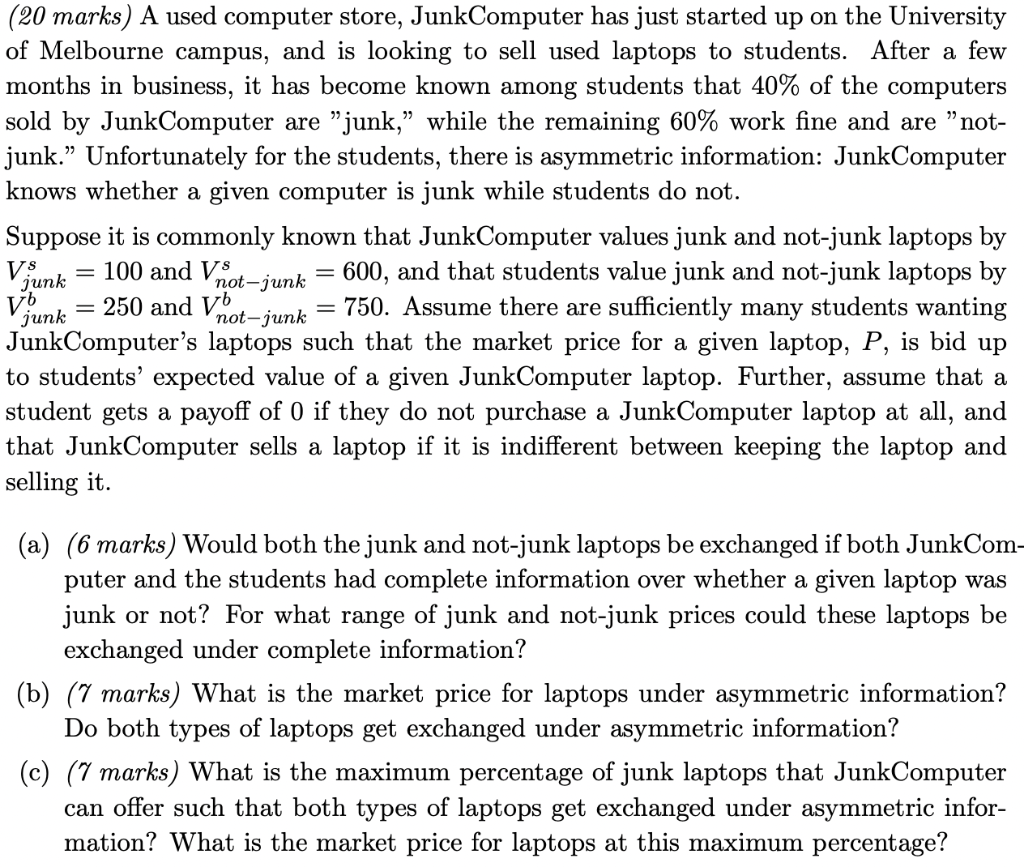
(20 marks) A used computer store, JunkComputer has just started up on the University of Melbourne campus, and is looking to sell used laptops to students. After a few months in business, it has become known among students that 40% of the computers sold by JunkComputer are "junk," while the remaining 60% work fine and are "notjunk." Unfortunately for the students, there is asymmetric information: JunkComputer knows whether a given computer is junk while students do not. Suppose it is commonly known that JunkComputer values junk and not-junk laptops by Vjunks=100 and Vnot-junks=600, and that students value junk and not-junk laptops by Vjunkb=250 and Vnot-junkb=750. Assume there are sufficiently many students wanting JunkComputer's laptops such that the market price for a given laptop, P, is bid up to students' expected value of a given JunkComputer laptop. Further, assume that a student gets a payoff of 0 if they do not purchase a JunkComputer laptop at all, and that JunkComputer sells a laptop if it is indifferent between keeping the laptop and selling it. (a) (6 marks) Would both the junk and not-junk laptops be exchanged if both JunkComputer and the students had complete information over whether a given laptop was junk or not? For what range of junk and not-junk prices could these laptops be exchanged under complete information? (b) (7 marks) What is the market price for laptops under asymmetric information? Do both types of laptops get exchanged under asymmetric information? (c) (7 marks) What is the maximum percentage of junk laptops that JunkComputer can offer such that both types of laptops get exchanged under asymmetric information? What is the market price for laptops at this maximum percentage? (20 marks) A used computer store, JunkComputer has just started up on the University of Melbourne campus, and is looking to sell used laptops to students. After a few months in business, it has become known among students that 40% of the computers sold by JunkComputer are "junk," while the remaining 60% work fine and are "notjunk." Unfortunately for the students, there is asymmetric information: JunkComputer knows whether a given computer is junk while students do not. Suppose it is commonly known that JunkComputer values junk and not-junk laptops by Vjunks=100 and Vnot-junks=600, and that students value junk and not-junk laptops by Vjunkb=250 and Vnot-junkb=750. Assume there are sufficiently many students wanting JunkComputer's laptops such that the market price for a given laptop, P, is bid up to students' expected value of a given JunkComputer laptop. Further, assume that a student gets a payoff of 0 if they do not purchase a JunkComputer laptop at all, and that JunkComputer sells a laptop if it is indifferent between keeping the laptop and selling it. (a) (6 marks) Would both the junk and not-junk laptops be exchanged if both JunkComputer and the students had complete information over whether a given laptop was junk or not? For what range of junk and not-junk prices could these laptops be exchanged under complete information? (b) (7 marks) What is the market price for laptops under asymmetric information? Do both types of laptops get exchanged under asymmetric information? (c) (7 marks) What is the maximum percentage of junk laptops that JunkComputer can offer such that both types of laptops get exchanged under asymmetric information? What is the market price for laptops at this maximum percentage
Step by Step Solution
There are 3 Steps involved in it

Get step-by-step solutions from verified subject matter experts
 Study Help