







Question: 20. Nyquist rate is the minimum sample rate per second required to avoid drops and distortion when sampling a continuous signal (Select only one) This
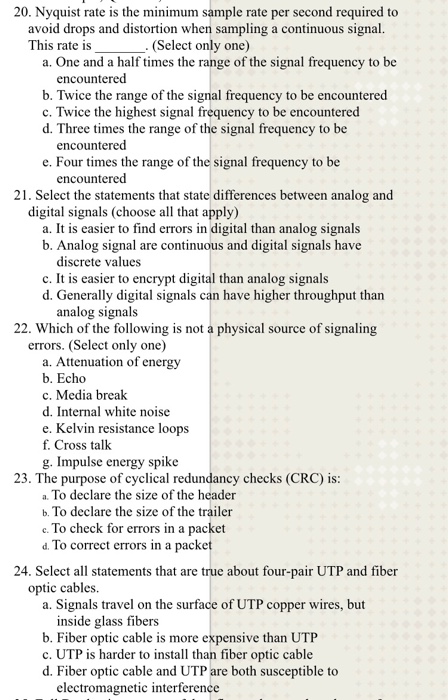
20. Nyquist rate is the minimum sample rate per second required to avoid drops and distortion when sampling a continuous signal (Select only one) This rate is a. One and a half times the range of the signal frequency to be encountered b. Twice the range of the signal frequency to be encountered c. Twice the h d. Three times the range of the signal frequency to be ighest signal frequency to be encountered encountered e. Four times the range of the signal frequency to be encountered 21. Select the statements that state differences between analog and digital signals (choose all that apply) a. It is easier to find errors in digital than analog signals b. Analog signal are continuous and digital signals have discrete values c. It is easier to encrypt digital than analog signals d. Generally digital signals can have higher throughput than analog signals 22. Which of the following is not a physical source of signaling errors. (Select only one) a. Attenuation of energy b. Echo c. Media break d. Internal white noise e. Kelvin resistance loops f. Cross talk g. Impulse energy spike 23. The purpose of cyclical redundancy checks (CRC) is: a. To declare the size of the header b. To declare the size of the trailer e. To check for errors in a packet d. To correct errors in a packe 24. Select all statements that are true about four-pair UTP and fiber optic cables. a. Signals travel on the surface of UTP copper wires, b inside glass fibers b. Fiber optic cable is more expensive than UTP c. UTP is harder to install than fiber optic cable er optic cable and UTP are both susceptible to electromagnetic interference
Step by Step Solution
There are 3 Steps involved in it

Get step-by-step solutions from verified subject matter experts
 Study Help