







Question: 20. Passes through P = (3,5, -9) and is parallel to the xz-plane 39 In Exercises 21-24, find an equation of the plane passing through
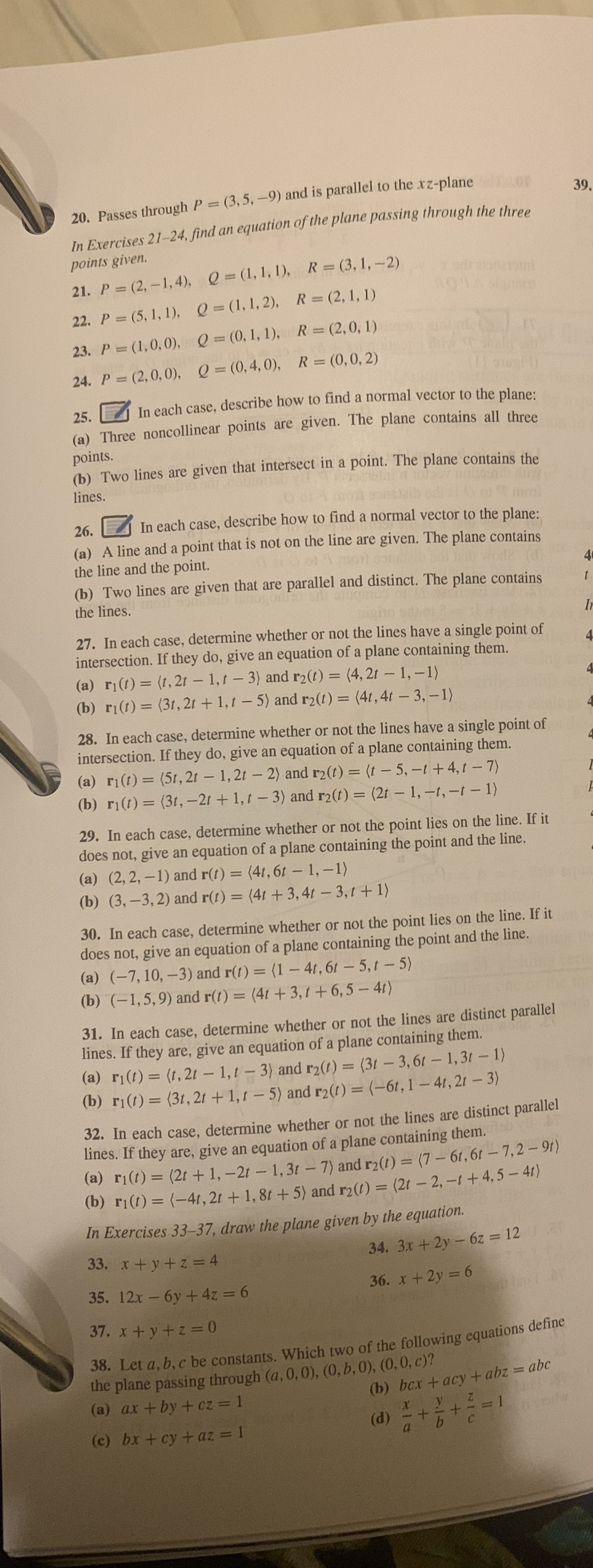
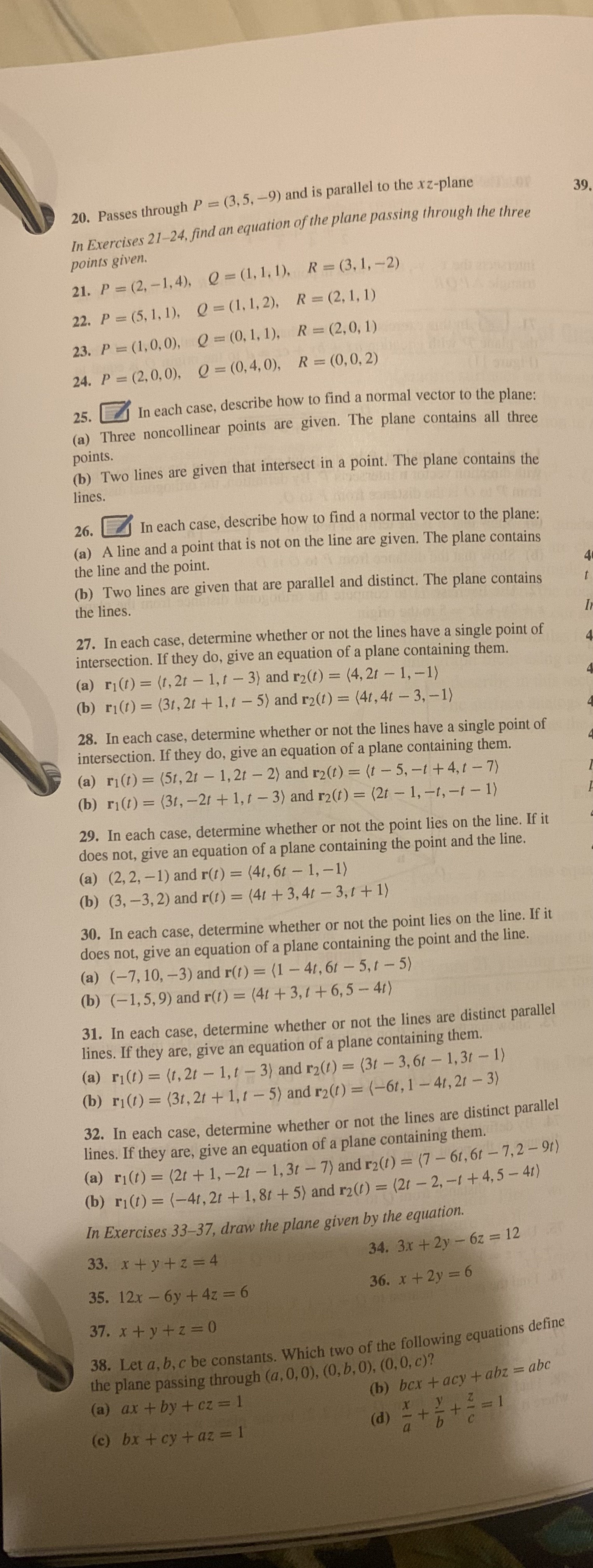
20. Passes through P = (3,5, -9) and is parallel to the xz-plane 39 In Exercises 21-24, find an equation of the plane passing through the three points given. 21. P = (2, -1,4), Q = (1, 1, 1), R= (3, 1, -2) 22. P = (5, 1, 1), Q = (1, 1, 2), R = (2, 1, 1) 23. P = (1,0,0), Q = (0, 1, 1), R = (2,0, 1) 24. P = (2, 0, 0), Q = (0,4, 0), R = (0, 0, 2) 25. In each case, describe how to find a normal vector to the plane: (a) Three noncollinear points are given. The plane contains all three points. (b) Two lines are given that intersect in a point. The plane contains the lines. 26. In each case, describe how to find a normal vector to the plane: (a) A line and a point that is not on the line are given. The plane contains the line and the point. (b) Two lines are given that are parallel and distinct. The plane contains the lines. 27. In each case, determine whether or not the lines have a single point of intersection. If they do, give an equation of a plane containing them. (a) ri(t) = (t, 2t - 1, t - 3) and r2(t) = (4, 2t - 1, -1) (b) ri(t) = (3t, 2t + 1, t - 5) and r2(t) = (4t, 4t - 3, -1) 28. In each case, determine whether or not the lines have a single point of intersection. If they do, give an equation of a plane containing them. (a) ri(t) = (5t, 2t - 1, 2t - 2) and r2(t) = (t - 5, -t + 4, t - 7) (b) ri(t) = (3t, -21 + 1, t - 3) and r2(t) = (2t - 1, -t, -t - 1) 29. In each case, determine whether or not the point lies on the line. If it does not, give an equation of a plane containing the point and the line. (a) (2, 2, -1) and r(t) = (4t, 6t - 1, -1) (b) (3, -3, 2) and r(t) = (41 + 3, 41 - 3, 1 + 1) 30. In each case, determine whether or not the point lies on the line. If it does not, give an equation of a plane containing the point and the line. (a) (-7, 10, -3) and r(t) = (1 - 4t, 61 - 5, t -5) (b) (-1,5, 9) and r(t) = (41 + 3, 1 + 6, 5- 41) 31. In each case, determine whether or not the lines are distinct parallel lines. If they are, give an equation of a plane containing them. (a) ri(t) = (t, 2t - 1, t - 3) and r2(t) = (3t - 3, 61 - 1, 3t - 1) (b) ri(t) = (3t, 2t + 1, 1 - 5) and r2(t) = (-6t, 1 - 41, 21 - 3) 32. In each case, determine whether or not the lines are distinct parallel lines. If they are, give an equation of a plane containing them. (a) ri(t) = (2t + 1, -2t - 1, 3t - 7) and r2(t) = (7 - 6t, 6t - 7, 2-91) (b) ri(t) = (-41, 2t + 1, 81 + 5) and r2(1) = (2t - 2, -1 + 4, 5-41) In Exercises 33-37, draw the plane given by the equation. 33. xty+z=4 34. 3x + 2y - 6z = 12 35. 12x - 6y + 4z = 6 36. x + 2y =6 37. x+y +z=0 38. Let a, b, c be constants. Which two of the following equations define the plane passing through (a, 0, 0), (0, b, 0), (0, 0, c)? (b) bex + acy + abz = abc (a) ax + by + cz=1 (d) ~ +2+ 1 2 =1 (c) bx + cy + az = 1 C
Step by Step Solution
There are 3 Steps involved in it

Get step-by-step solutions from verified subject matter experts
 Study Help