


Question: (20 points) Triangle Airlines serves the route between New York and Bermuda with a single- flight-daily 120-seat aircraft. The one-way fare for discount ticket is

(20 points) Triangle Airlines serves the route(20 points) Triangle Airlines serves the route

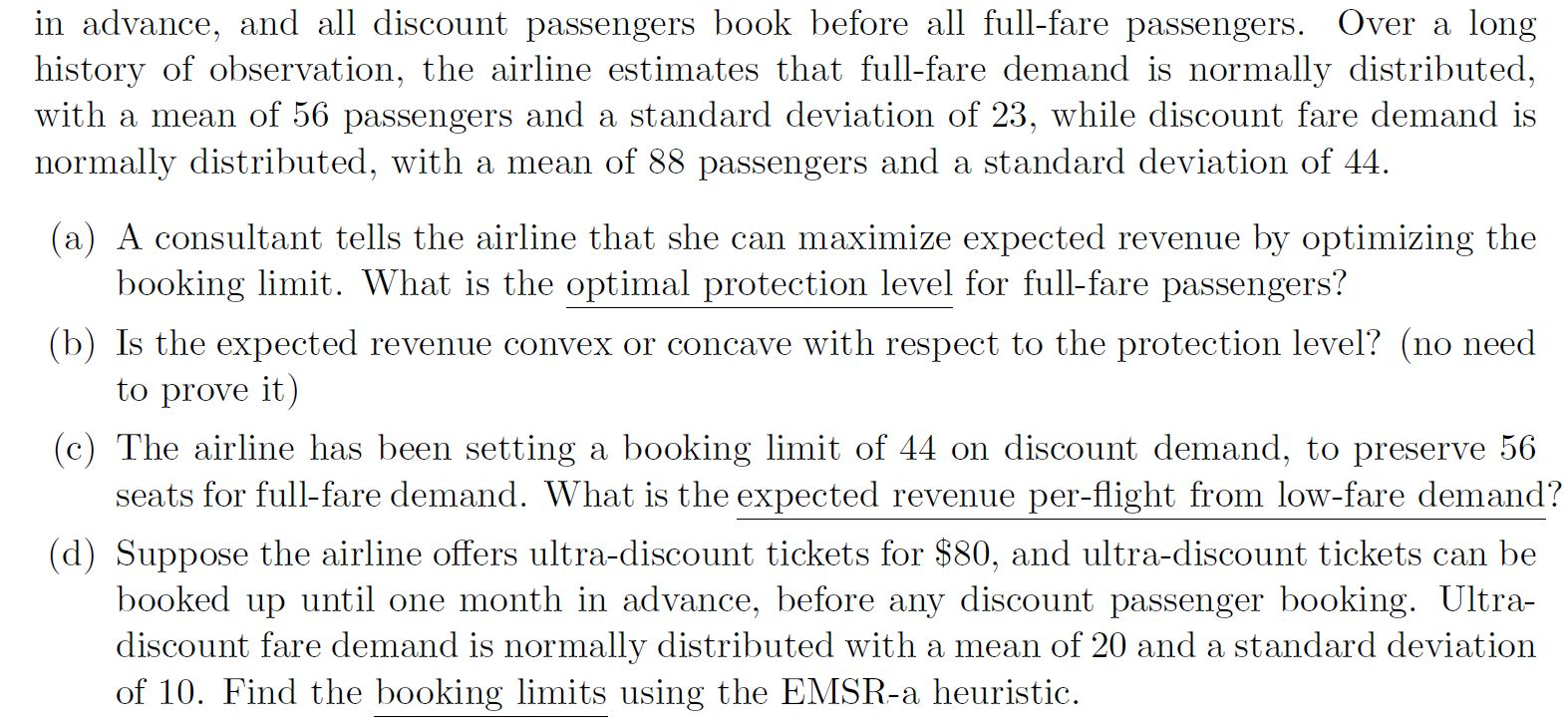
(20 points) Triangle Airlines serves the route between New York and Bermuda with a single- flight-daily 120-seat aircraft. The one-way fare for discount ticket is $100, and the one- way fare for full-fare tickets is $150. Discount tickets can be booked up until one week in advance, and all discount passengers book before all full-fare passengers. Over a long history of observation, the airline estimates that full-fare demand is normally distributed, with a mean of 56 passengers and a standard deviation of 23, while discount fare demand is normally distributed, with a mean of 88 passengers and a standard deviation of 44. (a) A consultant tells the airline that she can maximize expected revenue by optimizing the booking limit. What is the optimal protection level for full-fare passengers? (b) Is the expected revenue convex or concave with respect to the protection level? (no need to prove it) (c) The airline has been setting a booking limit of 44 on discount demand, to preserve 56 seats for full-fare demand. What is the expected revenue per-flight from low-fare demand? (d) Suppose the airline offers ultra-discount tickets for $80, and ultra-discount tickets can be booked up until one month in advance, before any discount passenger booking. Ultra- discount fare demand is normally distributed with a mean of 20 and a standard deviation of 10. Find the booking limits using the EMSR-a heuristic. (20 points) Triangle Airlines serves the route between New York and Bermuda with a single- flight-daily 120-seat aircraft. The one-way fare for discount ticket is $100, and the one- way fare for full-fare tickets is $150. Discount tickets can be booked up until one week in advance, and all discount passengers book before all full-fare passengers. Over a long history of observation, the airline estimates that full-fare demand is normally distributed, with a mean of 56 passengers and a standard deviation of 23, while discount fare demand is normally distributed, with a mean of 88 passengers and a standard deviation of 44. (a) A consultant tells the airline that she can maximize expected revenue by optimizing the booking limit. What is the optimal protection level for full-fare passengers? (b) Is the expected revenue convex or concave with respect to the protection level? (no need to prove it) (c) The airline has been setting a booking limit of 44 on discount demand, to preserve 56 seats for full-fare demand. What is the expected revenue per-flight from low-fare demand? (d) Suppose the airline offers ultra-discount tickets for $80, and ultra-discount tickets can be booked up until one month in advance, before any discount passenger booking. Ultra- discount fare demand is normally distributed with a mean of 20 and a standard deviation of 10. Find the booking limits using the EMSR-a heuristic

Step by Step Solution

There are 3 Steps involved in it

1 Expert Approved Answer
Step: 1 Unlock blur-text-image

Question Has Been Solved by an Expert!

Get step-by-step solutions from verified subject matter experts

Step: 2 Unlock
Step: 3 Unlock

Students Have Also Explored These Related General Management Questions!