







Question: 20. Unlike Smalltalk and most other languages that support object-oriented programming, a C++ class can also be stand-alone, without a(n) A. superclass B. subclass C.
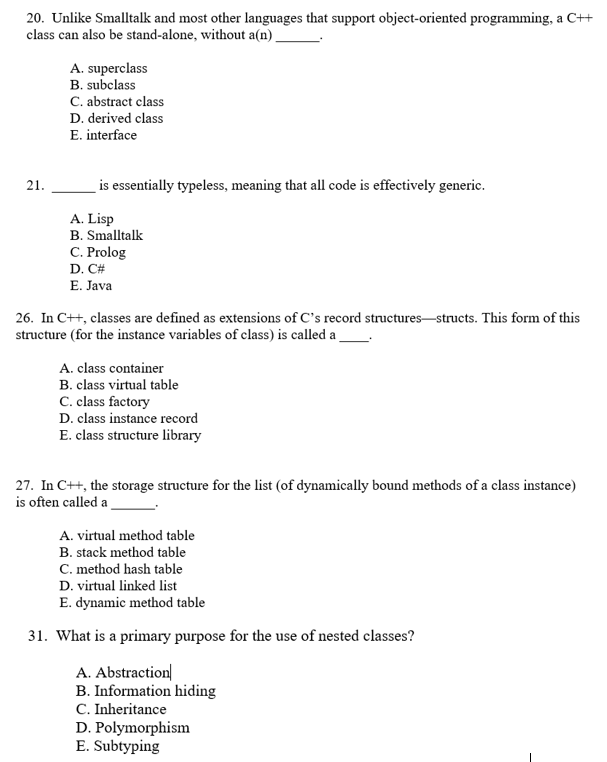
20. Unlike Smalltalk and most other languages that support object-oriented programming, a C++ class can also be stand-alone, without a(n) A. superclass B. subclass C. abstract class D. derived class E. interface 21 is essentially typeless, meaning that all code is effectively generic A. Lisp B. Smalltalk C. Prolog D. C# E. Java 26. In C+, classes are defined as extensions of C's record structures-structs. This form of this structure (for the instance variables of class) is called a A. class container B. class virtual table C. class factory D. class instance record E. class structure library 27. In C++, the storage structure for the list (of dynamically bound methods of a class instance) is often called a A. virtual method table B. stack method table C. method hash table D. virtual linked list E. dynamic method table 31. What is a primary purpose for the use of nested classes? A. Abstraction B. Information hiding C. Inheritance D. Polymorphism E. Subtyping
Step by Step Solution
There are 3 Steps involved in it

Get step-by-step solutions from verified subject matter experts
 Study Help