







Question: Answer needs to be written in c++ !!! Again, the answer needs to be in c++. I will rate and everything if it is correct
Answer needs to be written in c++ !!!
Again, the answer needs to be in c++.
I will rate and everything if it is correct and in c++
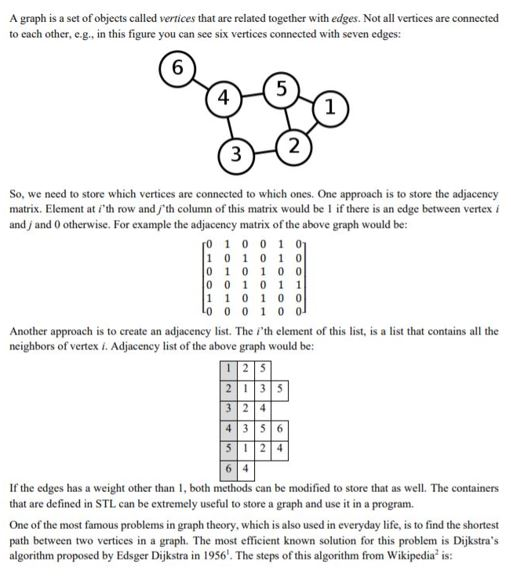
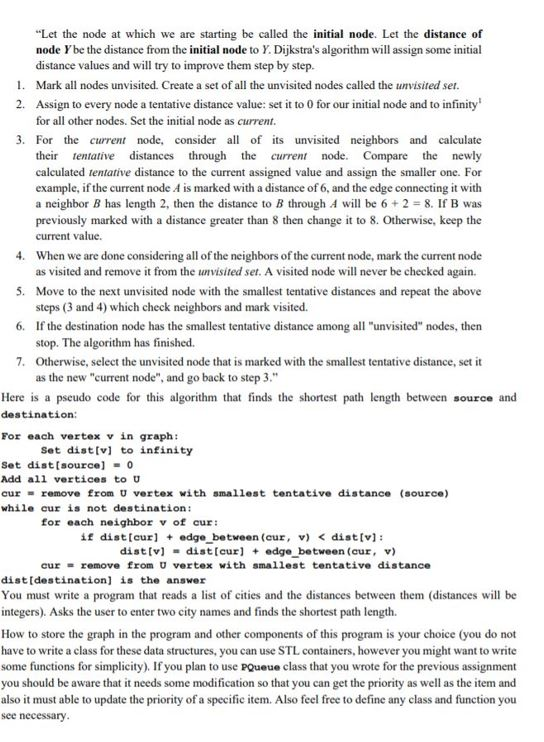
A graph is a set of objects called vertices that are related together with edges. Not all vertices are connected to each other, e.g., in this figure you can see six vertices connected with seven edges: 6 4 1 2 So, we need to store which vertices are connected to which ones. One approach is to store the adjacency matrix. Element at i'th row and jth column of this matrix would be 1 if there is an edge between vertex i and j and 0 otherwise. For example the adjacency matrix of the above graph would be: 0 0 1 01 1 Another approach is to create an adjacency list. The ith element of this list, is a list that contains all the neighbors of vertex i. Adjacency list of the above graph would be 2 13 5 4 3 5 6 If the edges has a weight other than 1, both methods can be modified to store that as well. The containers that are defined in STL can be extremely useful to store a graph and use it in a program. One of the most famous problems in graph theory, which is also used in everyday life, is to find the shortest path between two vertices in a graph. The most efficient known solution for this problem is Dijkstra's algorithm proposed by Edsger Dijkstra in 1956. The steps of this algorithm from Wikipedia is A graph is a set of objects called vertices that are related together with edges. Not all vertices are connected to each other, e.g., in this figure you can see six vertices connected with seven edges: 6 4 1 2 So, we need to store which vertices are connected to which ones. One approach is to store the adjacency matrix. Element at i'th row and jth column of this matrix would be 1 if there is an edge between vertex i and j and 0 otherwise. For example the adjacency matrix of the above graph would be: 0 0 1 01 1 Another approach is to create an adjacency list. The ith element of this list, is a list that contains all the neighbors of vertex i. Adjacency list of the above graph would be 2 13 5 4 3 5 6 If the edges has a weight other than 1, both methods can be modified to store that as well. The containers that are defined in STL can be extremely useful to store a graph and use it in a program. One of the most famous problems in graph theory, which is also used in everyday life, is to find the shortest path between two vertices in a graph. The most efficient known solution for this problem is Dijkstra's algorithm proposed by Edsger Dijkstra in 1956. The steps of this algorithm from Wikipedia is
Step by Step Solution
There are 3 Steps involved in it

Get step-by-step solutions from verified subject matter experts
 Study Help