Question: 20-2 UNIT 7: INDUCTIVE AND DEDUCTIVE REASONING Hand In Assignment Learning Objective: I can determine if a given argument is valid, and justify the reasoning.
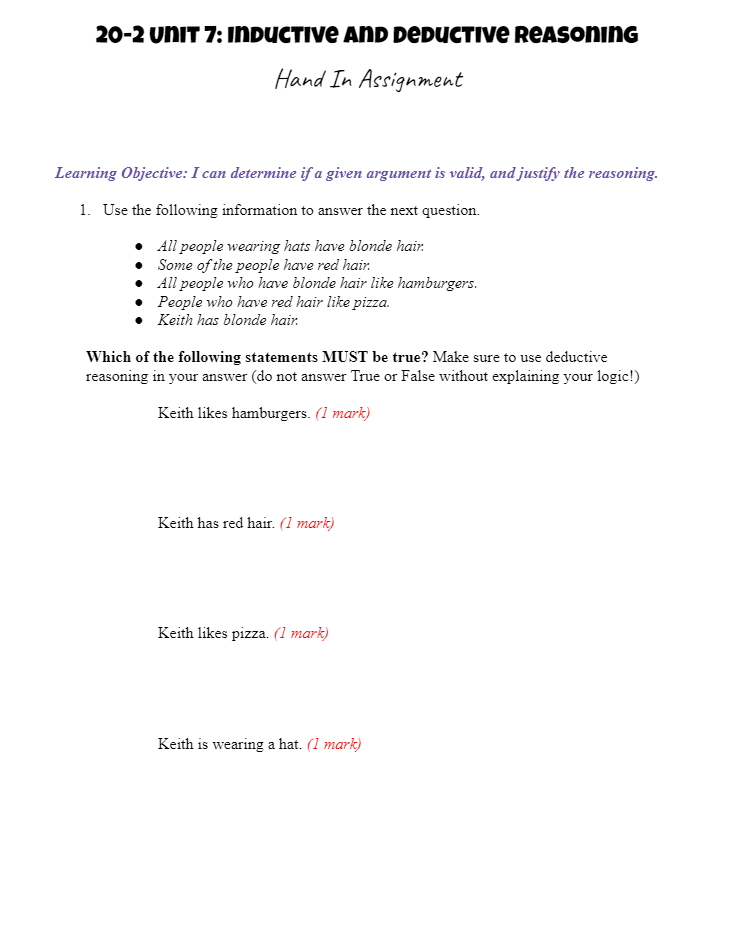
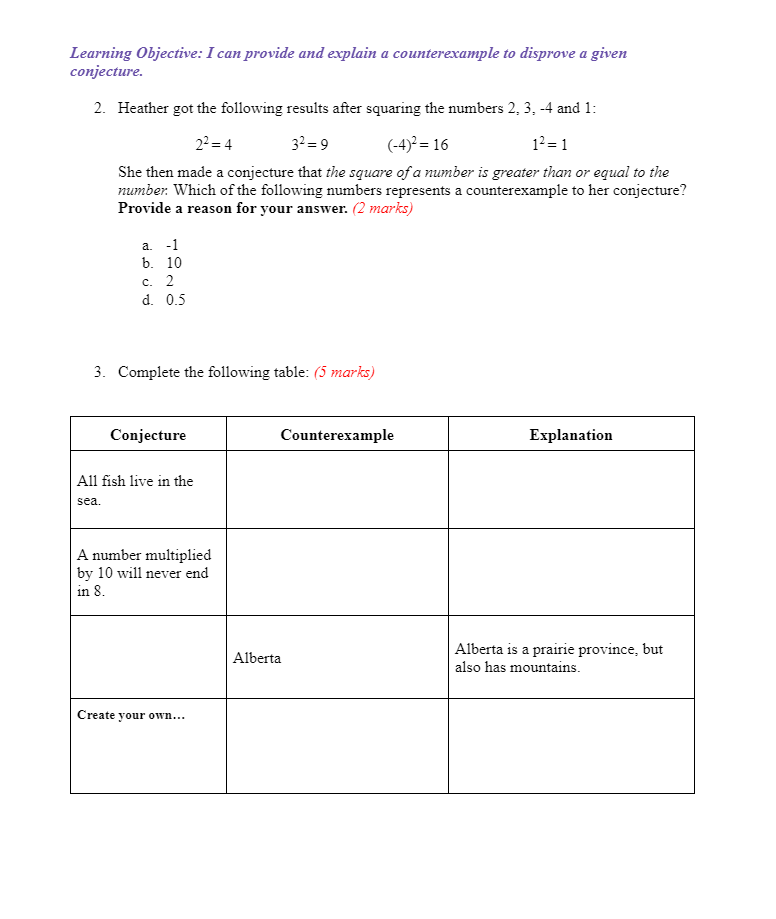
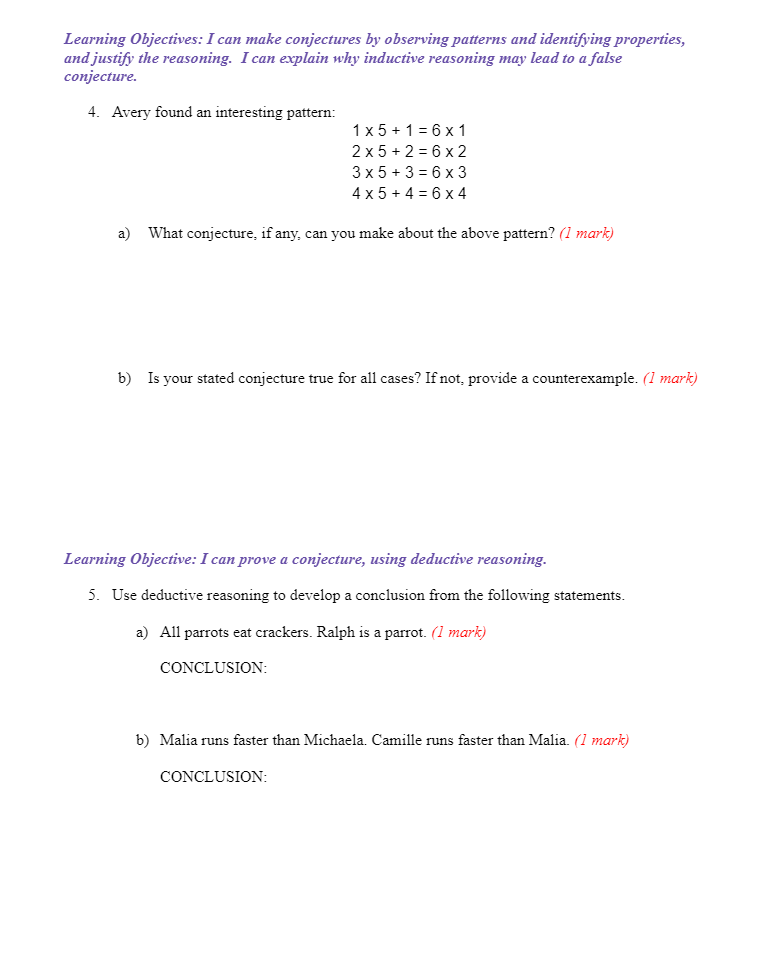
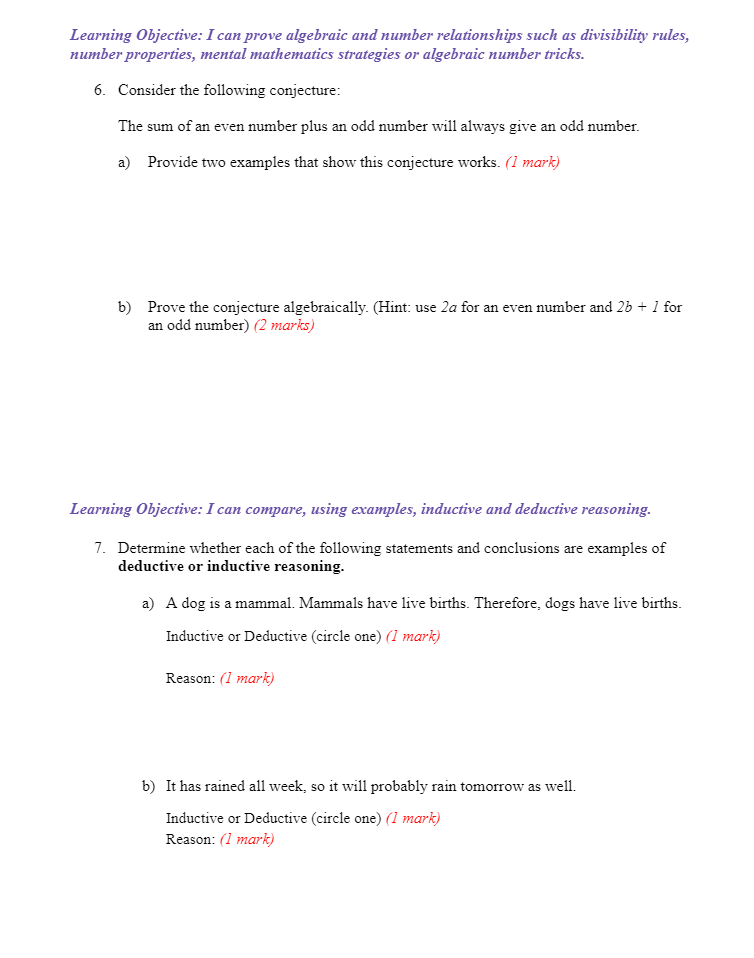
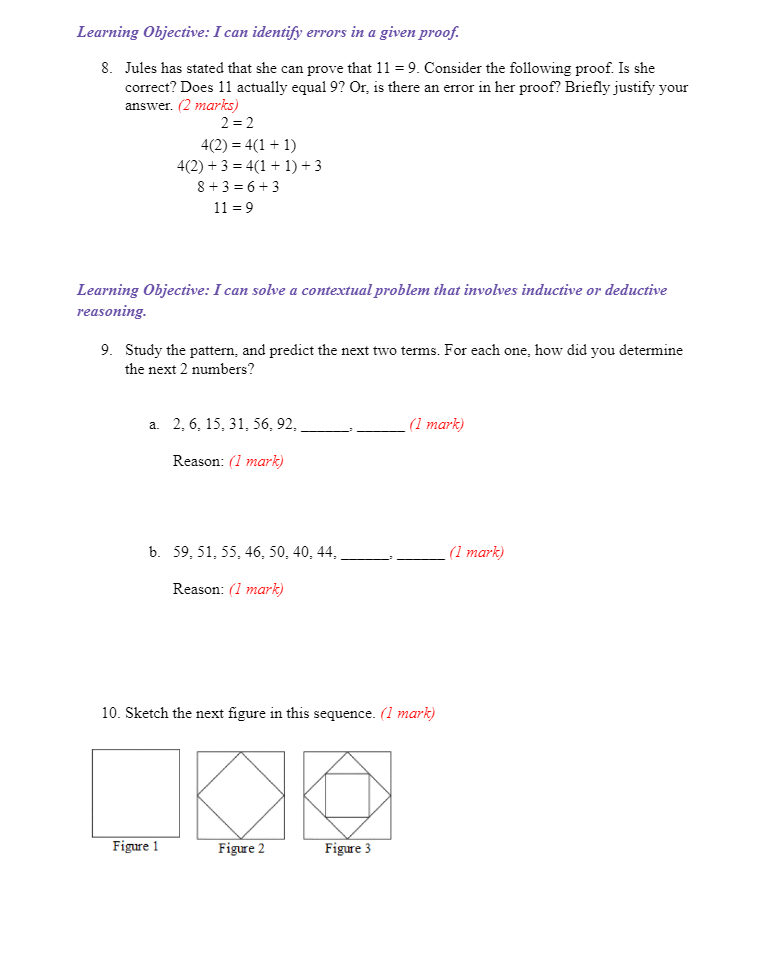
20-2 UNIT 7: INDUCTIVE AND DEDUCTIVE REASONING Hand In Assignment Learning Objective: I can determine if a given argument is valid, and justify the reasoning. 1. Use the following information to answer the next question. All people wearing hats have blonde hair. Some of the people have red hair. . . . . All people who have blonde hair like hamburgers. People who have red hair like pizza. Keith has blonde hair. Which of the following statements MUST be true? Make sure to use deductive reasoning in your answer (do not answer True or False without explaining your logic!) Keith likes hamburgers. (1 mark) Keith has red hair. (1 mark) Keith likes pizza. (1 mark) Keith is wearing a hat. (1 mark)Learning Objective: I can provide and explain a counterexample to disprove a given conjecture. 2. Heather got the following results after squaring the numbers 2, 3, -4 and 1: 22 = 4 32 =9 (-4)2 =16 12 = 1 She then made a conjecture that the square of a number is greater than or equal to the number. Which of the following numbers represents a counterexample to her conjecture? Provide a reason for your answer. (2 marks) -1 b. 10 c. 2 d. 0.5 3. Complete the following table: (5 marks) Conjecture Counterexample Explanation All fish live in the sea. A number multiplied by 10 will never end in 8. Alberta Alberta is a prairie province, but also has mountains. Create your own...Learning Objectives: I can make conjectures by observing patterns and identifying properties, and justify the reasoning. I can explain why inductive reasoning may lead to a false conjecture. 4. Avery found an interesting pattern: 1 x5 + 1 =6 x1 2 x5 + 2 =6 x2 3 x5+ 3 =6 x3 4 x5 + 4 =6 x4 a) What conjecture, if any, can you make about the above pattern? (1 mark) b) Is your stated conjecture true for all cases? If not, provide a counterexample. (1 mark) Learning Objective: I can prove a conjecture, using deductive reasoning. 5. Use deductive reasoning to develop a conclusion from the following statements. a) All parrots eat crackers. Ralph is a parrot. (1 mark) CONCLUSION: b) Malia runs faster than Michaela. Camille runs faster than Malia. (1 mark) CONCLUSION:Learning Objective: I can prove algebraic and number relationships such as divisibility rules, number properties, mental mathematics strategies or algebraic number tricks. 6. Consider the following conjecture: The sum of an even number plus an odd number will always give an odd number. a) Provide two examples that show this conjecture works. (1 mark) b) Prove the conjecture algebraically. (Hint: use 2a for an even number and 2b + ] for an odd number) (2 marks) Learning Objective: I can compare, using examples, inductive and deductive reasoning. 7. Determine whether each of the following statements and conclusions are examples of deductive or inductive reasoning. a) A dog is a mammal. Mammals have live births. Therefore, dogs have live births. Inductive or Deductive (circle one) (1 mark) Reason: (1 mark) b) It has rained all week, so it will probably rain tomorrow as well. Inductive or Deductive (circle one) (1 mark) Reason: (1 mark)Learning Objective: I can identify errors in a given proof. 8. Jules has stated that she can prove that 11 = 9. Consider the following proof. Is she correct? Does 11 actually equal 9? Or, is there an error in her proof? Briefly justify your answer. (2 marks) 2=2 4(2) = 4(1 + 1) 4(2) + 3 =4(1 + 1)+ 3 8+3=6+3 11 = 9 Learning Objective: I can solve a contextual problem that involves inductive or deductive reasoning. 9. Study the pattern, and predict the next two terms. For each one, how did you determine the next 2 numbers? a. 2, 6, 15, 31, 56. 92. (1 mark) Reason: (1 mark) b. 59, 51, 55, 46, 50, 40, 44. (1 mark) Reason: (1 mark) 10. Sketch the next figure in this sequence. (1 mark) Figure 1 Figure 2 Figure 3
Step by Step Solution
There are 3 Steps involved in it
1 Expert Approved Answer
Step: 1 Unlock
Question Has Been Solved by an Expert!
Get step-by-step solutions from verified subject matter experts
Step: 2 Unlock
Step: 3 Unlock
Students Have Also Explored These Related Mathematics Questions!









 Study Help