







Question: 2.1 Sampling Methodology: Briefly discuss the sampling methodology that you would use for the proposed study by answering the following questions: 2.1.1 Identify the target
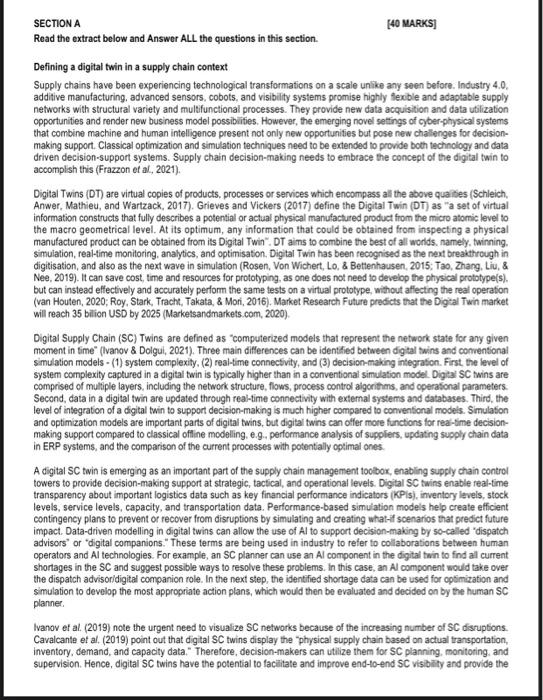
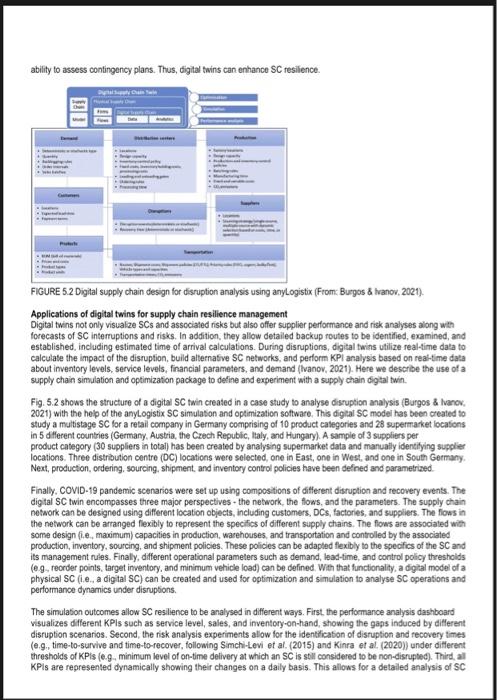
SECTION A [40 MARKS] Read the extract below and Answer ALL the questions in this section. Defining a digital twin in a supply chain context Supply chains have been experiencing technological transformations on a scale unlike any seen before. Industry 4.0 . additive manufacturing, advanced sensors, cobots, and visibility systems promise highly flexible and adaptable supply networks with structural variety and multifunctional processes. They provide new data acquisition and data utilization opportunities and render new business model possibuities. However, the emerging novel settings of cyber-physical systems that combine machine and human intelligence present not only new opportunities but pose new challenges for decisionmaking support. Classical optimization and simulation techniques need to be extended to provide both technology and data driven decision-support systems. Supply chain decision-making needs to embrace the concept of the digital twin to accomplish this (Frazzon of al, 2021). Digital Twins (DT) are virtual copies of products, processes or services which encompass all the above quaifes (Schleich, Anwer, Mathieu, and Wartzack, 2017). Grieves and Vickers (2017) define the Digital Twin (DT) as "a set of virtual information constructs that fully describes a potential or actual physical manufactured product from the micro atomic level to the macro geometrical level. At its optimum, any information that could be obtained from inspecting a physical manufactured product can be obtained from its Digital Twin. DT aims to combine the best of all worlds. namely. twinning. simulation, real-time monitoring, analytics, and optimisation. Digital Twin has been rectgnised as the next breakthrough in digitisation, and also as the next wave in simulation (Rosen, Von Wichert, Lo, \& Bettenhausen, 2015; Tao, Zhang, Liu, \& Nee, 2019). It can save cost, time and resources for prototyping, as one does not need to develop the physical prototype(s). but can instead effectively and accurately perform the same tests on a virtual prototype, without aflecting the real operation (van Houten, 2020; Roy, Stark, Tracht, Takata, \& Mori, 2016). Market Research Future predicts that the Digtal Twin market will reach 35 bilion USD by 2025 (Marketsandmarkets com, 2020). Digital Supply Chain (SC) Twins are defined as "computerized models that represent the network state for any given moment in time" (Ivanov & Dolgui, 2021). Three main differences can be identified between digital twins and comentional simulation models - (1) system complexity, (2) real-time connectivity, and (3) decision-making integration. First. the level of system complexity captured in a digital twin is typically higher than in a conventional simulation model. Digital SC wins afe comprised of multiple layers, including the network structure, flows, process control aligorithms, and operatonal parameters. Second, data in a digital twin are updated through real-time connectivity with external systems and databases. Third, the level of integration of a digital twin to support decision-making is much higher compared to conventional models. Simulaton and optimization models are important parts of digital twins, but digital twins can offer more functions for real-time decisionmaking support compared to classical offline modelling, e.9. performance analysis of supplers, updating supply chain data in ERP systems, and the comparison of the current processes with potentially optimal ones. A digital SC twin is emerging as an important part of the supply chain management toobox, enabling supply chain control towers to provide decision-making support at strategic, tactical, and operational levels. Digital SC twins enable real-time transparency about important logistics data such as key financial performance indicators (KP/s), inventory levels, stock levels, service levels, capacity, and transportation data. Performance-based simulation models help create efficient contingency plans to prevent or recover from disruptions by simulating and creating what-if scenarios that predict future impact. Data-driven modelling in digital twins can allow the use of Al to support decision-making by so-called "dispatch advisors' or "digital companions." These terms are being used in industry to refer to collaborations between human operators and Al technologies. For example, an SC planner can use an Al component in the digital twin to find al current shortages in the SC and suggest possible ways to resolve these problems. In this case, an Al component would take over the dispatch advisoridigital companion role. In the next step, the identified shortage data can be used for cptimization and simulation to develop the most appropriate action plans, which would then be evaluated and decided on by the human SC planner. Ivanov ef al. (2019) note the urgent need to visualize SC networks because of the increasing number of SC disruptions. Cavalcante et al. (2019) point out that digital SC twins display the "physical supply chain based on actual transportation, inventory, demand, and capacity data." Therefore, decision-makers can utilize thern for SC planning, monitoring. and supervision. Hence, digital SC twins have the potential to facilitate and improve end-to-end SC visibility and provide the ability to assess contingency plans. Thus, digital twins can enhance SC resilience. FIGURE 5.2. Digital supply chain design for disruption analysis using anyLogistix (From: Burgos 8 hanov, 2021). Applications of digital twins for supply chain resilience management Digital twins not only visualize SCs and associated risks but also offer supplier performance and risk analyses along with forecasts of SC interruptions and risks. In addition, they allow detailed backup routes to be identified, examined, and established, including estimated time of arrival calculations. During disruptions, digital twins utilize real-time da'a to calculate the impact of the disruption, build alternative SC networks, and perform KPI analysis based on real-ime data about inventory levels, service levels, financial parameters, and demand (ivanov, 2021). Here we describe the use of a supply chain simulation and optimization package to define and experiment with a supply chain cigtal twin. Fig. 5.2 shows the structure of a digital SC twin created in a case study to analyse disruption analysis (Burgos 8 lvanov, 2021) with the help of the anyLogistix SC simulation and optimization software. This digital SC model has been created to study a multistage SC for a retail company in Germany comprising of 10 product calegories and 28 supermaket locasions in 5 dillerent countries (Germany, Austria, the Crech Republic, ltaly, and Hungary). A sample of 3 suppliers per product category (30 suppliers in totai) has been created by analysing supermarket data and manually identifying suppler locations. Three distribution centre (DC) locations were selected, one in East, one in West, and one in South Germany. Next, production, ordering, sourcing, shipment. and inventory control policies have been defned and parametriaed. Finally, COVID-19 pandemic scenarios were set up using compositions of different distuption and recovery events. The digital SC twin encompasses three major perspectives - the network, the flows, and the parameters. The supply chain network can be designed using different location objects, including customers, DCs, factories, and suppliers. The fows in the network can be arranged fexibly to represent the specifics of different supply chains. The flows are associated with some design (i.e., maximum) capacities in production, warehouses, and transportation and controled by the associated production, inventory, sourcing, and shipment policies. These policies can be adapted flexibly to the specifics of the SC and its management rules. Finaly, different operational parameters such as demand, lead-time, and control policy threshelds (e.g, reorder points, target inwentory, and minimum vehicle load) can be defined. With that functionality, a digital model of a physical SC (i.e., a digital SC) can be created and used for optimization and simulation to analyse SC operations and pertormance dynamics under disnupsions. The simulation outcomes allow SC resilience to be analysed in different ways. First. the performance analysis dashboard visualizes different KPls such as service level, sales, and inventory-on-hand, showing the gaps induced by different disruption scenarios. Second, the risk analysis experiments allow for the identlicabon of disruption and recovery times (e.g., time-to-survive and time-to-recover, following Simch-Levi et at. (2015) and Kinra et al. (2020)) under different threshoids of KPis (e.9. minimum level of on-time delivery at which an SC is still considered to be non-disrupted). Third, all KPis are represented dynamically showing their changes on a daily basis. This allows for a detailed analysis of SC dynamics under disruptions at a high level of granularity. Source: Zhang, G., MacCarthy, B.L., and Ivanov, D. (2022). Chapter 5 - the cloud, platforms, and digital twins-Enablers of the digital supply chain, in: B.L. MacCarthy, D. Ivanov (Eds.), The Digital Supply Chain, Elsevier, pp. 86-87, http://dx.doi.org/ 10.1016/B978-0-323-91614-1.00005-8/ Required: Even though the concept of digital twin (DT) was introduced over a decade ago, as an innovative all-encompassing tool, with perceived benefits including real-time monitoring, simulation, optimisation, and accurate forecasting, the theoretical framework and practical implementations of digital twin are yet to fully achieve this vision at scale. You are a business researcher with a keen interest in the transformative effects of digital technologies on the nature of business interactions and commercial transactions, and consequently on markets, businesses, and supply chain operations across the continent of Africa. You are proposing a quantitative study with the following: The proposed title of the study: An investigation into the impact of the implementation of a digital supply chain twin on the financial performance of JSElisted companies The research questions of the proposed study are as follows: Does the implementation of a digital supply chain twin engender a continuous improvement ethos among JSE-listed companies? Is there a significant difference in financial performance before, during and after the implementation of a digital supply chain twin by JSE-listed companies? How can the effect of a digital supply chain twin on financial performance be leveraged by JSE-listed companies
Step by Step Solution
There are 3 Steps involved in it

Get step-by-step solutions from verified subject matter experts
 Study Help