



Question: (2)(10 pts) NAT traversal is a difficult problem to overcome in many P2P applications. Some NATs assign ports in a predicable way by just incrementing
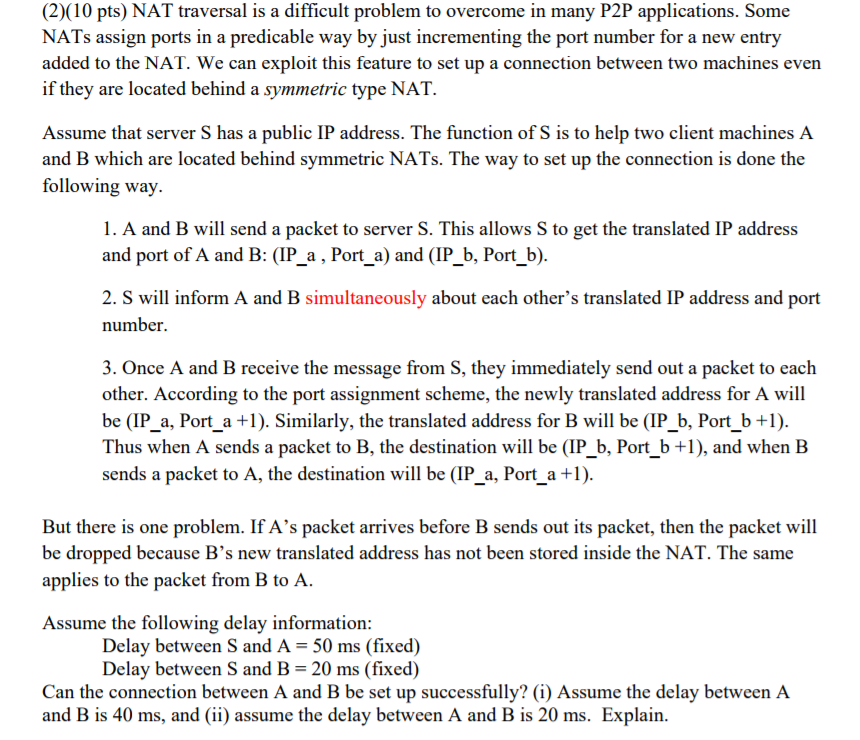
(2)(10 pts) NAT traversal is a difficult problem to overcome in many P2P applications. Some NATs assign ports in a predicable way by just incrementing the port number for a new entry added to the NAT. We can exploit this feature to set up a connection between two machines even if they are located behind a symmetric type NAT. Assume that server S has a public IP address. The function of S is to help two client machines A and B which are located behind symmetric NATs. The way to set up the connection is done the following way. 1. A and B will send a packet to server S. This allows S to get the translated IP address and port of A and B: (IP_a, Port_a) and (IP_b, Port b) 2. S will inform A and B simultaneously about cach other's tanslated IP adressand pot number. UT 3. Once A and B receive the message from S, they immediately send out a packet to each other. According to the port assignment scheme, the newly translated address for A will be (IP_a, Port a +1). Similarly, the translated address for B will be (IP_b, Port_b +1) Thus when A sends a packet to B, the destination will be (IP b, Port_b+1), and when B sends a packet to A, the destination will be (IP_a, Port a +1) But there is one problem. If A's packet arrives before B sends out its packet, then the packet will be dropped because B's new translated address has not been stored inside the NAT. The same applies to the packet from B to A. Assume the following delay information: Delay between S and A -50 ms (fixed) Delay between S and B 20 ms (fixed) Can the connection between A and B be set up successfully? (i) Assume the delay between A and B is 40 ms, and (ii) assume the delay between A and B is 20 ms. Explain
Step by Step Solution
There are 3 Steps involved in it

Get step-by-step solutions from verified subject matter experts