



Question: 2.11. The simultaneous-move game (below) is played twice, with the outcome of the first stage observed before the second stage be- gins. There is no
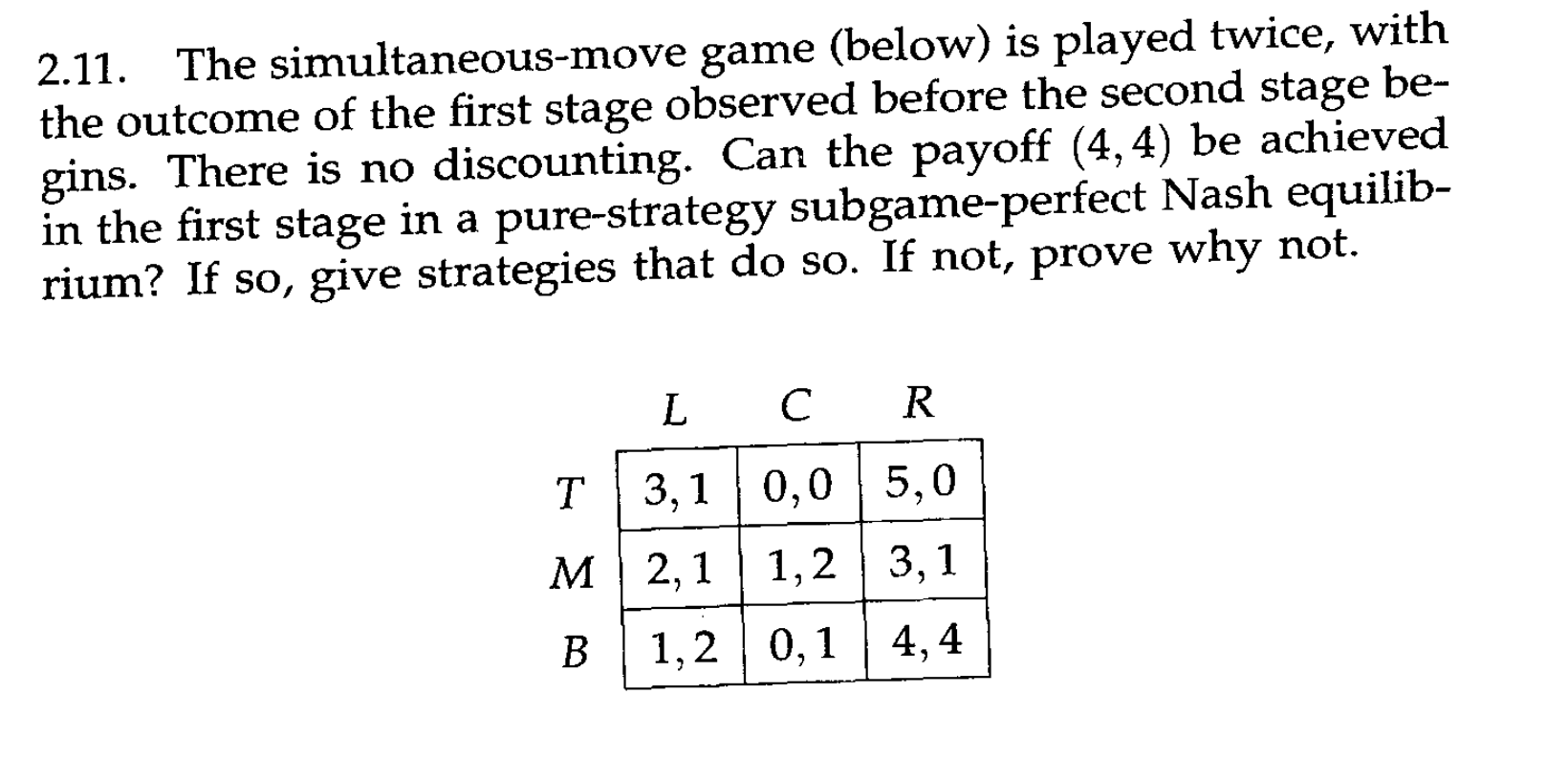
2.11. The simultaneous-move game (below) is played twice, with the outcome of the first stage observed before the second stage be- gins. There is no discounting. Can the payoff (4, 4) be achieved in the first stage in a pure-strategy subgame-perfect Nash equilib rium? If so, give strategies that do so. If not, prove why not. L C R T 3, 1 0, 0 5,0 M 2, 1 1,2 3, 1 B 1, 2 0, 1 4, 4
Step by Step Solution
There are 3 Steps involved in it
1 Expert Approved Answer
Step: 1 Unlock

Question Has Been Solved by an Expert!
Get step-by-step solutions from verified subject matter experts
Step: 2 Unlock
Step: 3 Unlock