







Question: Problem 5 (15 points). The simultaneous move game below is played twice, with the outcome of the first stage observed before the second stage
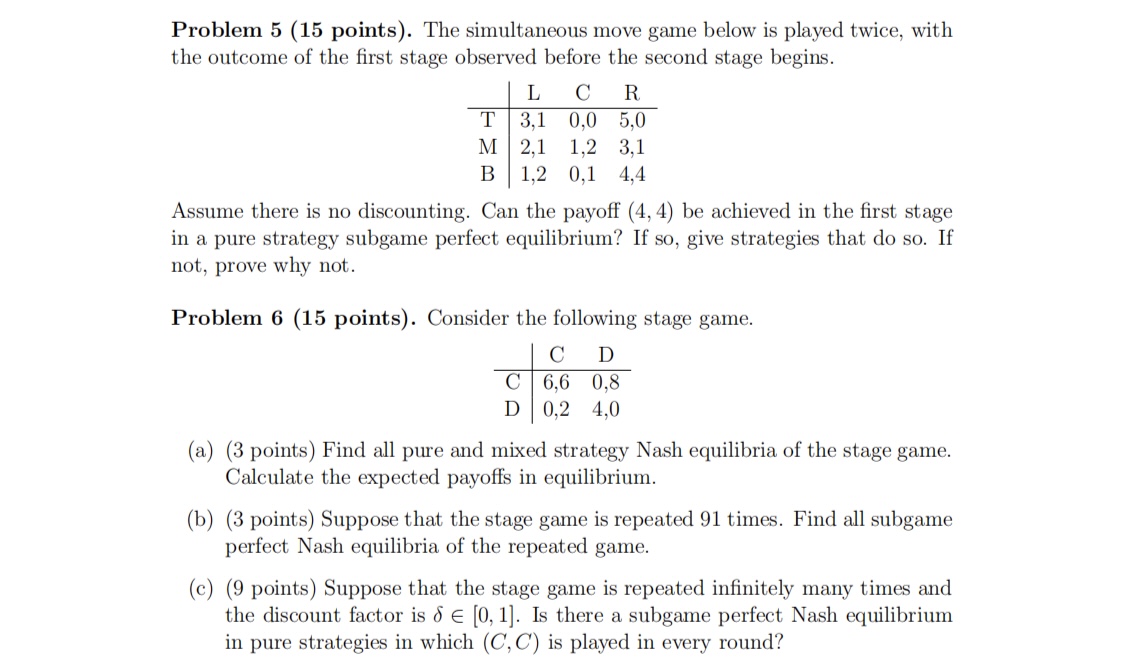
Problem 5 (15 points). The simultaneous move game below is played twice, with the outcome of the first stage observed before the second stage begins. L C R T 3,1 0,0 5,0 M 2,1 1,2 3,1 B 1,2 0,1 4,4 Assume there is no discounting. Can the payoff (4, 4) be achieved in the first stage in a pure strategy subgame perfect equilibrium? If so, give strategies that do so. If not, prove why not. Problem 6 (15 points). Consider the following stage game. C D C 6,6 0,8 D 0,2 4,0 (a) (3 points) Find all pure and mixed strategy Nash equilibria of the stage game. Calculate the expected payoffs in equilibrium. (b) (3 points) Suppose that the stage game is repeated 91 times. Find all subgame perfect Nash equilibria of the repeated game. (c) (9 points) Suppose that the stage game is repeated infinitely many times and the discount factor is 8 [0,1]. Is there a subgame perfect Nash equilibrium in pure strategies in which (C,C) is played in every round?
Step by Step Solution
There are 3 Steps involved in it
To solve these problems well analyze them step by step Problem 5 Can the payoff 44 be achieved in the first stage in a pure strategy subgame perfect e... View full answer

Get step-by-step solutions from verified subject matter experts
 Study Help