







Question: 2.2 points) Consider Named Entity Recognition and Classification (NERC) for entity types person (PER), location (LOC) and quantities of money (MON). a) Write generic NERC
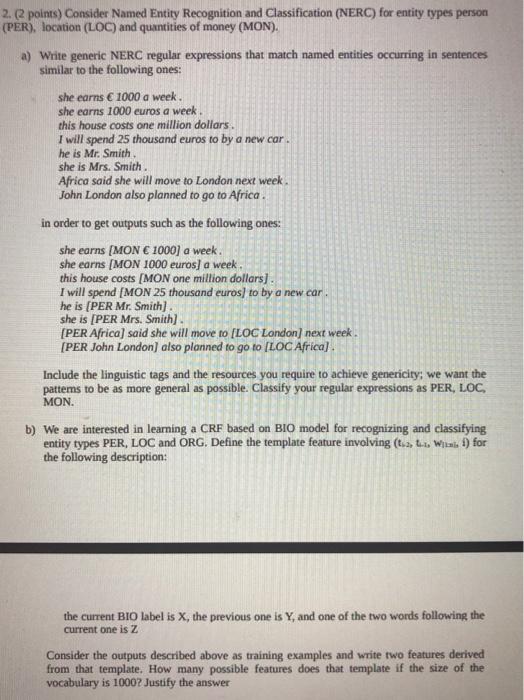
2.2 points) Consider Named Entity Recognition and Classification (NERC) for entity types person (PER), location (LOC) and quantities of money (MON). a) Write generic NERC regular expressions that match named entities occurring in sentences similar to the following ones: she earns 1000 a week. she earns 1000 euros a week. this house costs one million dollars. I will spend 25 thousand euros to by a new car. he is Mr. Smith she is Mrs. Smith Africa said she will move to London next week. John London also planned to go to Africa. in order to get outputs such as the following ones: she earns (MON 1000] a week. she earns [MON 1000 euros) a week. this house costs [MON one million dollars]. I will spend [MON 25 thousand euros) to by a new car. he is (PER Mr. Smith) she is [PER Mrs. Smith). [PER Africa) said she will move to [LOC London) next week. [PER John London) also planned to go to [LOC Africa] Include the linguistic tags and the resources you require to achieve genericity: we want the pattems to be as more general as possible. Classify your regular expressions as PER, LOC, MON. b) We are interested in learning a CRF based on BIO model for recognizing and classifying entity types PER, LOC and ORG. Define the template feature involving (t., Li, Wat: 1) for the following description: the current BIO label is X, the previous one is Y, and one of the two words following the current one is z Consider the outputs described above as training examples and write two features derived from that template. How many possible features does that template if the size of the vocabulary is 1000? Justify the answer 2.2 points) Consider Named Entity Recognition and Classification (NERC) for entity types person (PER), location (LOC) and quantities of money (MON). a) Write generic NERC regular expressions that match named entities occurring in sentences similar to the following ones: she earns 1000 a week. she earns 1000 euros a week. this house costs one million dollars. I will spend 25 thousand euros to by a new car. he is Mr. Smith she is Mrs. Smith Africa said she will move to London next week. John London also planned to go to Africa. in order to get outputs such as the following ones: she earns (MON 1000] a week. she earns [MON 1000 euros) a week. this house costs [MON one million dollars]. I will spend [MON 25 thousand euros) to by a new car. he is (PER Mr. Smith) she is [PER Mrs. Smith). [PER Africa) said she will move to [LOC London) next week. [PER John London) also planned to go to [LOC Africa] Include the linguistic tags and the resources you require to achieve genericity: we want the pattems to be as more general as possible. Classify your regular expressions as PER, LOC, MON. b) We are interested in learning a CRF based on BIO model for recognizing and classifying entity types PER, LOC and ORG. Define the template feature involving (t., Li, Wat: 1) for the following description: the current BIO label is X, the previous one is Y, and one of the two words following the current one is z Consider the outputs described above as training examples and write two features derived from that template. How many possible features does that template if the size of the vocabulary is 1000? Justify the
Step by Step Solution
There are 3 Steps involved in it

Get step-by-step solutions from verified subject matter experts
 Study Help