





Question: 2.3 DualArrayDeques Recall that a DualArrayDeque implements the List interface using two ArrayStacks public class DualArrayDeque extends AbstractList front; ArrayStack back; 1. If the elements
 2.3 DualArrayDeques Recall that a DualArrayDeque implements the List interface using

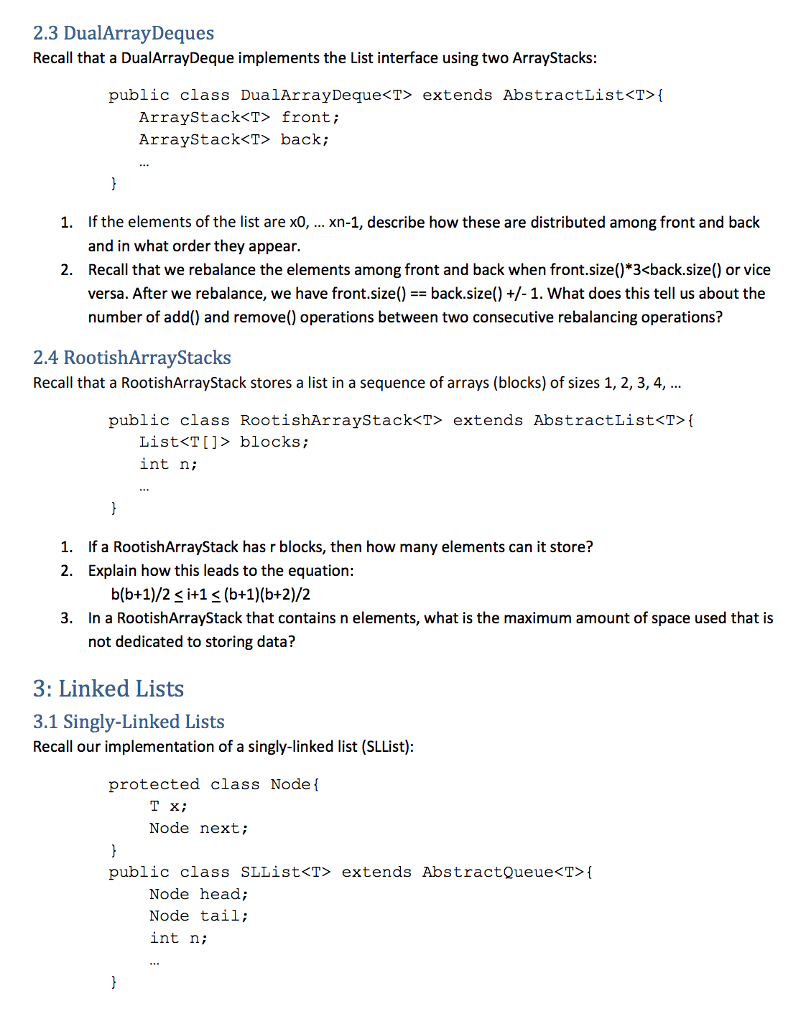
2.3 DualArrayDeques Recall that a DualArrayDeque implements the List interface using two ArrayStacks public class DualArrayDeque extends AbstractList front; ArrayStack back; 1. If the elements of the list are x0,. Xn-1, describe how these are distributed among front and back and in what order they appear 2. Recall that we rebalance the elements among front and back when front.size()*3 extends AbstractList List blocks; int n; 1. 2. If a RootishArrayStack has r blocks, then how many elements can it store? Explain how this leads to the equation: b(b+1)/2 si 1 (b+1)(b+2)/2 In a RootishArrayStack that contains n elements, what is the maximum amount of space used that is not dedicated to storing data? 3. 3: Linked Lists 3.1 Singly-Linked Lists Recall our implementation of a singly-linked list (SLList) protected class Nodef Node next; public class SLList extends AbstractQueue extends AbstractList front; ArrayStack back; 1. If the elements of the list are x0,. Xn-1, describe how these are distributed among front and back and in what order they appear 2. Recall that we rebalance the elements among front and back when front.size()*3 extends AbstractList List blocks; int n; 1. 2. If a RootishArrayStack has r blocks, then how many elements can it store? Explain how this leads to the equation: b(b+1)/2 si 1 (b+1)(b+2)/2 In a RootishArrayStack that contains n elements, what is the maximum amount of space used that is not dedicated to storing data? 3. 3: Linked Lists 3.1 Singly-Linked Lists Recall our implementation of a singly-linked list (SLList) protected class Nodef Node next; public class SLList extends AbstractQueue

Step by Step Solution

There are 3 Steps involved in it

1 Expert Approved Answer
Step: 1 Unlock blur-text-image
Question Has Been Solved by an Expert!

Get step-by-step solutions from verified subject matter experts

Step: 2 Unlock
Step: 3 Unlock

Students Have Also Explored These Related Databases Questions!