







Question: 2.36 [5] Write the RISC-V assembly code that creates the 64-bit constant 0x11223344556677881w and stores that value to register x10. 2.39 Assume for a given
![2.36 [5] Write the RISC-V assembly code that creates the 64-bit](https://s3.amazonaws.com/si.experts.images/answers/2024/08/66bb4da791869_14366bb4da730274.jpg)
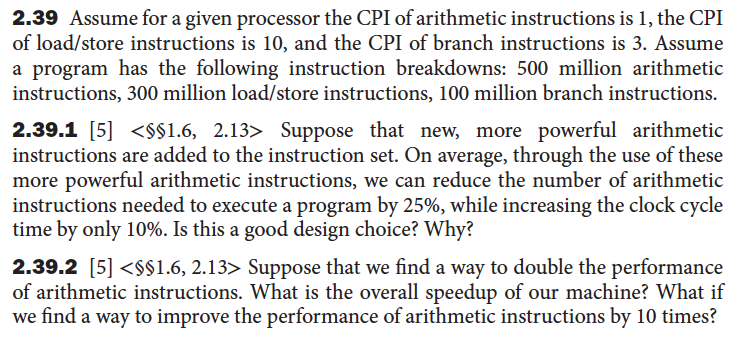
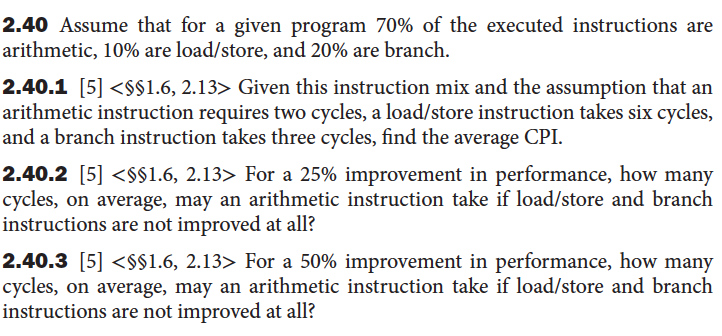
2.36 [5] Write the RISC-V assembly code that creates the 64-bit constant 0x11223344556677881w and stores that value to register x10. 2.39 Assume for a given processor the CPI of arithmetic instructions is 1, the CPI of load/store instructions is 10, and the CPI of branch instructions is 3. Assume a program has the following instruction breakdowns: 500 million arithmetic instructions, 300 million load/store instructions, 100 million branch instructions. 2.39.1 [5] Suppose that new, more powerful arithmetic instructions are added to the instruction set. On average, through the use of these more powerful arithmetic instructions, we can reduce the number of arithmetic instructions needed to execute a program by 25%, while increasing the clock cycle time by only 10%. Is this a good design choice? Why? 2.39.2 [5] Suppose that we find a way to double the performance of arithmetic instructions. What is the overall speedup of our machine? What if we find a way to improve the performance of arithmetic instructions by 10 times? 2.40 Assume that for a given program 70% of the executed instructions are arithmetic, 10% are load/store, and 20% are branch. 2.40.1 [5] Given this instruction mix and the assumption that an arithmetic instruction requires two cycles, a load/store instruction takes six cycles, and a branch instruction takes three cycles, find the average CPI. 2.40.2 [5] For a 25% improvement in performance, how many cycles, on average, may an arithmetic instruction take if load/store and branch instructions are not improved at all? 2.40.3 [5] For a 50% improvement in performance, how many cycles, on average, may an arithmetic instruction take if load/store and branch instructions are not improved at all? 2.36 [5] Write the RISC-V assembly code that creates the 64-bit constant 0x11223344556677881w and stores that value to register x10. 2.39 Assume for a given processor the CPI of arithmetic instructions is 1, the CPI of load/store instructions is 10, and the CPI of branch instructions is 3. Assume a program has the following instruction breakdowns: 500 million arithmetic instructions, 300 million load/store instructions, 100 million branch instructions. 2.39.1 [5] Suppose that new, more powerful arithmetic instructions are added to the instruction set. On average, through the use of these more powerful arithmetic instructions, we can reduce the number of arithmetic instructions needed to execute a program by 25%, while increasing the clock cycle time by only 10%. Is this a good design choice? Why? 2.39.2 [5] Suppose that we find a way to double the performance of arithmetic instructions. What is the overall speedup of our machine? What if we find a way to improve the performance of arithmetic instructions by 10 times? 2.40 Assume that for a given program 70% of the executed instructions are arithmetic, 10% are load/store, and 20% are branch. 2.40.1 [5] Given this instruction mix and the assumption that an arithmetic instruction requires two cycles, a load/store instruction takes six cycles, and a branch instruction takes three cycles, find the average CPI. 2.40.2 [5] For a 25% improvement in performance, how many cycles, on average, may an arithmetic instruction take if load/store and branch instructions are not improved at all? 2.40.3 [5] For a 50% improvement in performance, how many cycles, on average, may an arithmetic instruction take if load/store and branch instructions are not improved at all
Step by Step Solution
There are 3 Steps involved in it

Get step-by-step solutions from verified subject matter experts
 Study Help