





Question: 24. If quick response allows multiple orders in the season, a. profits decrease and the overstock quantity decreases. b. profits decrease and the overstock quantity
24. If quick response allows multiple orders in

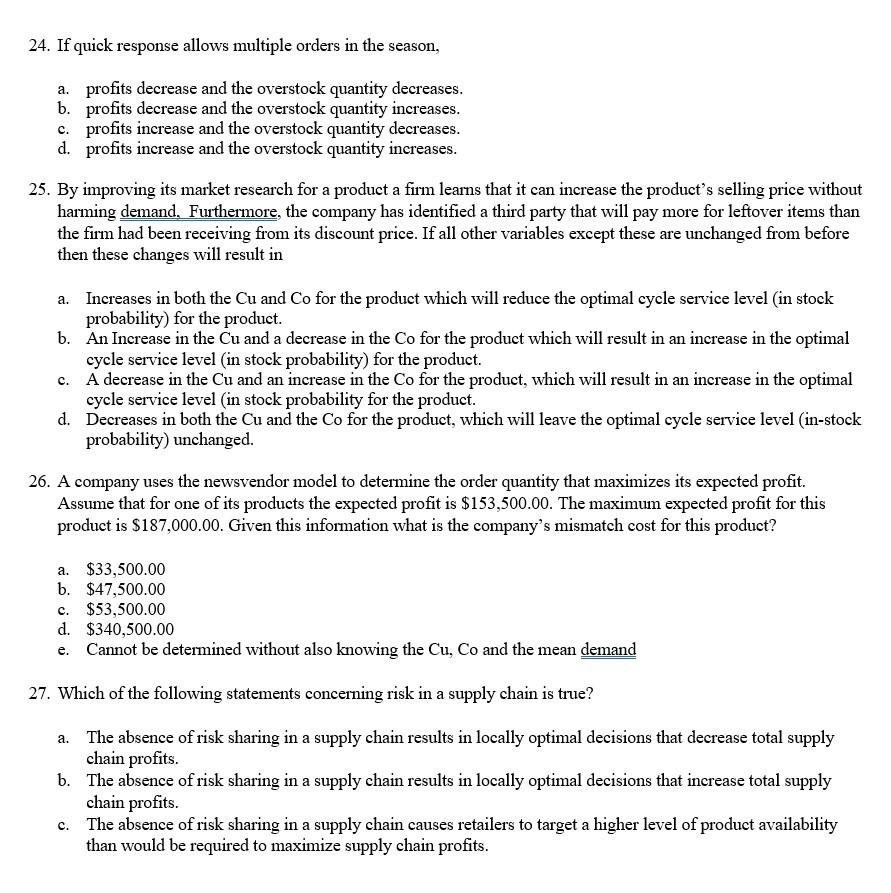
24. If quick response allows multiple orders in the season, a. profits decrease and the overstock quantity decreases. b. profits decrease and the overstock quantity increases. c. profits increase and the overstock quantity decreases. d. profits increase and the overstock quantity increases. 25. By improving its market research for a product a firm learns that it can increase the product's selling price without harming demand. Furthermore, the company has identified a third party that will pay more for leftover items than the firm had been receiving from its discount price. If all other variables except these are unchanged from before then these changes will result in a. Increases in both the Cu and Co for the product which will reduce the optimal cycle service level (in stock probability) for the product. b. An Increase in the Cu and a decrease in the Co for the product which will result in an increase in the optimal cycle service level (in stock probability) for the product. c. A decrease in the Cu and an increase in the Co for the product, which will result in an increase in the optimal cycle service level (in stock probability for the product. d. Decreases in both the Cu and the Co for the product, which will leave the optimal cycle service level (in-stock probability) unchanged. 26. A company uses the newsvendor model to determine the order quantity that maximizes its expected profit. Assume that for one of its products the expected profit is $153,500.00. The maximum expected profit for this product is $187,000.00. Given this information what is the company's mismatch cost for this product? a. $33,500.00 b. $47,500.00 c. $53,500.00 d. $340,500.00 e. Cannot be determined without also knowing the Cu, Co and the mean demand 27. Which of the following statements concerning risk in a supply chain is true? a. The absence of risk sharing in a supply chain results in locally optimal decisions that decrease total supply chain profits. b. The absence of risk sharing in a supply chain results in locally optimal decisions that increase total supply chain profits. c. The absence of risk sharing in a supply chain causes retailers to target a higher level of product availability than would be required to maximize supply chain profits

Step by Step Solution

There are 3 Steps involved in it

1 Expert Approved Answer
Step: 1 Unlock blur-text-image

Question Has Been Solved by an Expert!

Get step-by-step solutions from verified subject matter experts

Step: 2 Unlock
Step: 3 Unlock

Students Have Also Explored These Related General Management Questions!