







Question: 24.4.2 Let T1 be... programming language R BUFFON'S NEEDLE AND CROSS 545 24.4 Buffon's needle and cross The following question was first considered by George
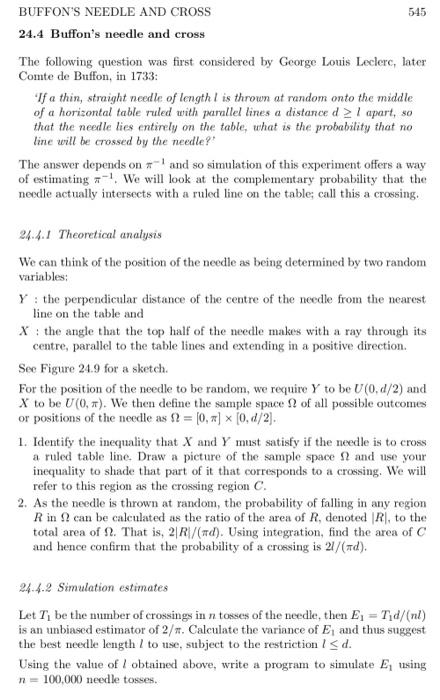
BUFFON'S NEEDLE AND CROSS 545 24.4 Buffon's needle and cross The following question was first considered by George Louis Leclerc, later Comte de Buffon, in 1733: If a thin, straight needle of length l is thrown at random onto the middle of a horizontal table ruled with parullel lines a distance dl apart, so that the needle lies entirely on the table, what is the probability that no line will be crossed by the needle?" The answer depends on 1 and so simulation of this experiment offers a way of estimating 1. We will look at the complementary probability that the needle actually intersects with a ruled line on the table; call this a crossing. 24.4.1 Theoretical analysis We can think of the position of the needle as being determined by two random variables: Y : the perpendicular distance of the centre of the needle from the nearest line on the table and X : the angle that the top half of the needle makes with a ray through its centre, parallel to the table lines and extending in a positive direction. See Figure 24.9 for a sketch. For the position of the needle to be random, we require Y to be U(0,d/2) and X to be U(0,). We then define the sample space of all possible outcomes or positions of the needle as =[0,][0,d/2]. 1. Identify the inequality that X and Y must satisfy if the needle is to cross a ruled table line. Draw a picture of the sample space and use your inequality to shade that part of it that corresponds to a crossing. We will refer to this region as the crossing region C. 2. As the needle is thrown at random, the probability of falling in any region R in can be calculated as the ratio of the area of R, denoted R, to the total area of . That is, 2R/(d). Using integration, find the area of C and hence confirm that the probability of a crossing is 2l/(d). 24.4.2 Simulation estimates Let T1 be the number of crossings in n tosses of the needle, then E1=T1d/(nl) is an umbiased estimator of 2/. Calculate the variance of E1 and thus suggest the best needle length l to use, subject to the restriction ld. Using the value of l obtained above, write a program to simulate E1 using n=100,000 needle tosses
Step by Step Solution
There are 3 Steps involved in it

Get step-by-step solutions from verified subject matter experts
 Study Help