







Question: 26. Men: ? - ? - ? per?, this means that ? per? cases of CVD among men can be attributed to MS; : Women:

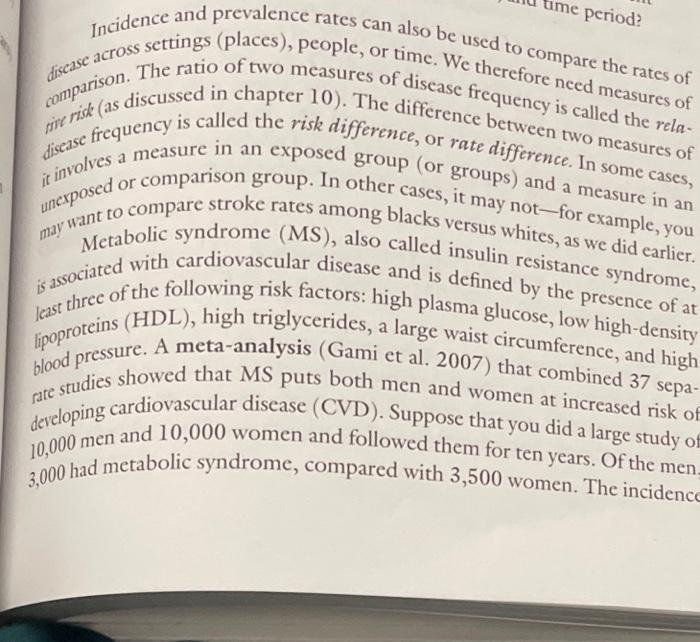
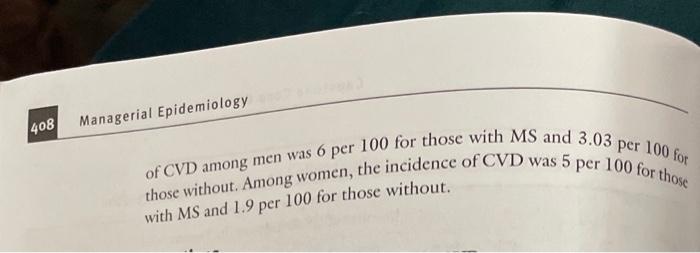
26. Men: ? - ? - ? per?, this means that ? per? cases of CVD among men can be attributed to MS; : Women: ? - ? ? ?er?, this means that? per ? cases of CVD among women can be attributed to MS. Incidence and prevalence rates can also be used to compare the rates of disese across settings (places), people, or time. We therefore need measures of comp pirison. discussed in chapter 10). The differene frequency is called the rela. iil tish frequency is called the risk difference, or retween two measures of is involves a measure in an exposed group (or groups) and a measure in an, unexposed or comparison group. In other cases, it may not-for example, you [13y want to compare stroke rates among blacks versus whites, as we did earlier. is associated the following risk factors: least threc of the following triglycerides, aigh plasma glucose, low high-density lipoproteins (HDe. A meta-analysis (Gami large waist circumference, and high blood pressure. A meta-analysis (Gami et al. 2007) that combined 37 sepapate studies showed that MS puts both men and women at increased risk of developing cardiovascular disease (CVD). Suppose that you did a large study o 10,000 men and 10,000 women and followed them for ten years. Of the men 3,000 had metabolic syndrome, compared with 3,500 women. The incidence of CVD among men was 6 per 100 for those with MS and 3.03 per 100 for those without. Among women, the incidence of CVD was 5 per 100 for those with MS and 1.9 per 100 for those without
Step by Step Solution
There are 3 Steps involved in it

Get step-by-step solutions from verified subject matter experts
 Study Help