







Question: Case Study for it. NA0367 Qadri-Group: Sustaining Beyond the First 100 Years Muhammad Shakeel Sadiq Jajja, Lahore University of Management Sciences Syed Zaboor Hassan, Lahore
Case Study for it. 
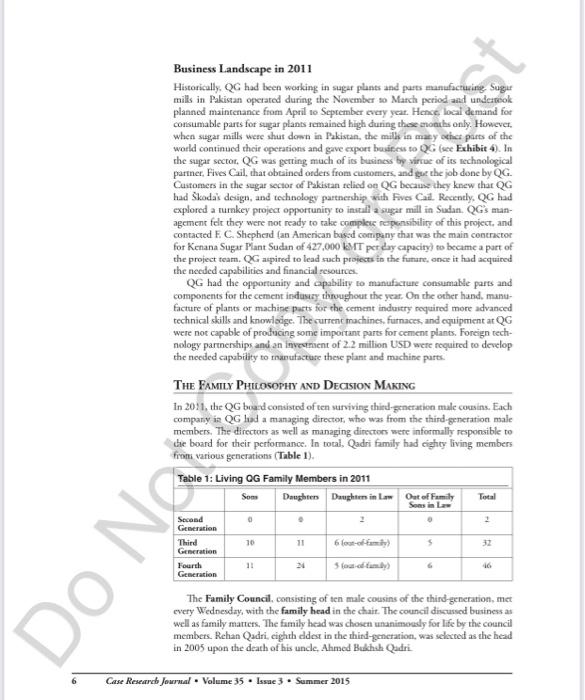
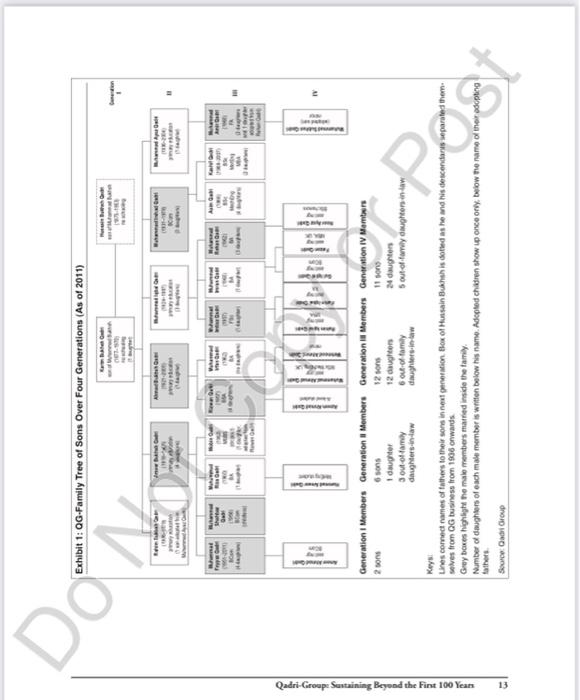
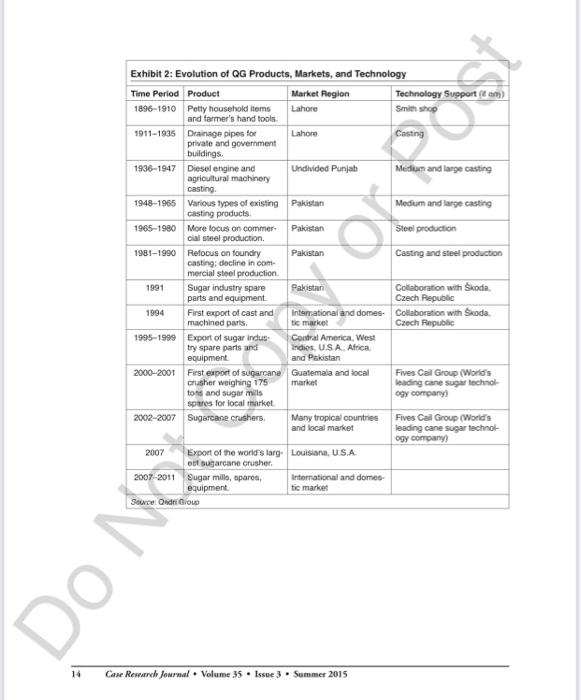
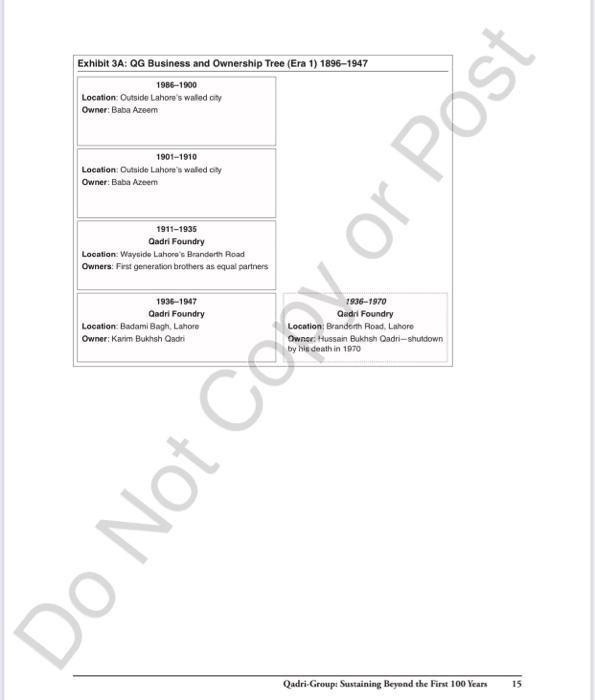
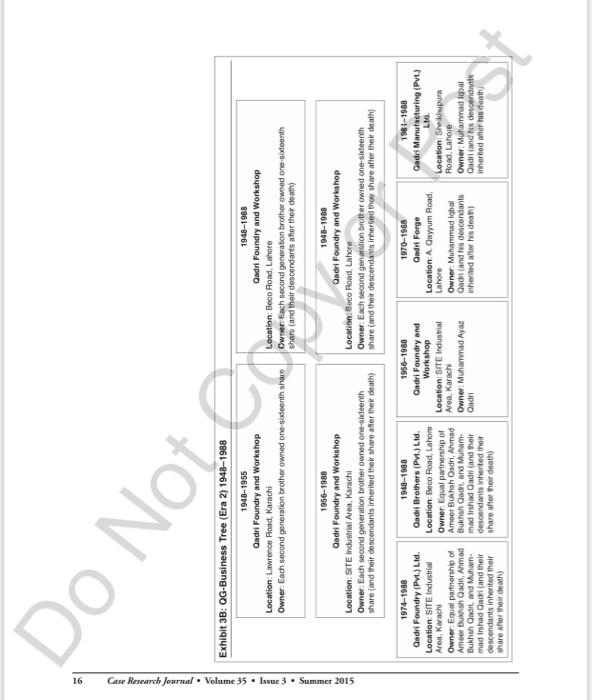
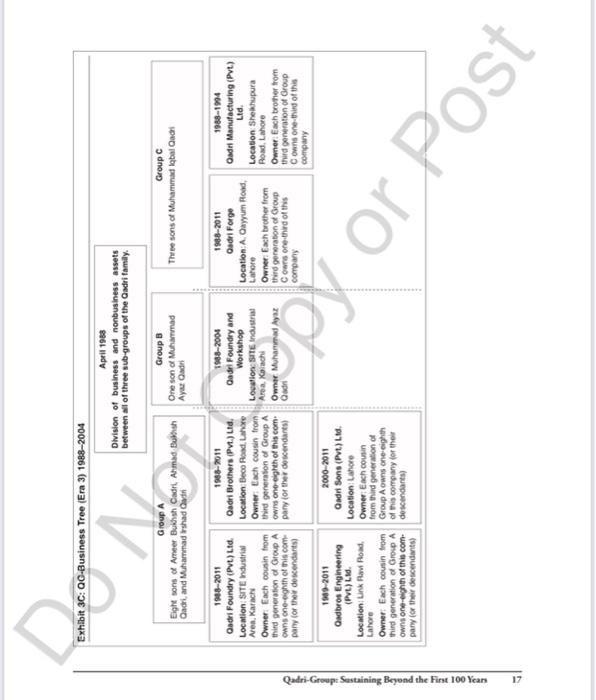
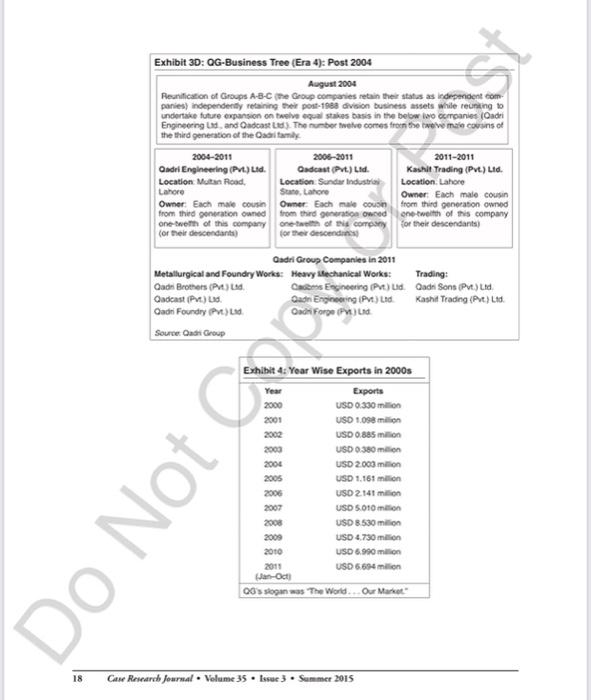

NA0367 Qadri-Group: Sustaining Beyond the First 100 Years Muhammad Shakeel Sadiq Jajja, Lahore University of Management Sciences Syed Zaboor Hassan, Lahore University of Management Sciences 1 o November 2011. Rixwan Qadri, marketing director and a chuird generation family member of the Qadri-Group (QG) board of directors was preparing his suggestions regarding the Family Constitution for the coming veekly meeting of the Group's Family Council. Riwan had initiated and advocated the idea of develop ing a Family Constitution since the family was facing a number of complex matters that required prompt attention and decisions Rizwan's grandfather, Karim Bukhsh Qadri, and greas-unde Husain Bukhsh Qadri started the business as a small foundry more than 100 years ago in Lahore, Pakistan. As the QG leadership passed through three generations (se Exhibit 1. the family evolved some shared values, policies and governance structure. A number of develop ments in the family during recent years had resulted in several new challenges to keep the family and business together in the years to come. Firstly, the Group's decision of not allowing female members of the family to participate in business matters had created many complications. Progeny of Asini Qudrs, a cousin of the third-generation who only had daughters, would not have any participation in the Group business matters after his demise. The policy of not permitting the family women to partici pate in the family business governance kepe a well-educated and aspiring daughter of Rizwan Qadri from employment in the Group's companies. The wife of deceased Kashif Qadri , a cousin fron the thind-generation was also not permitted to take part in the Group's business governance though she and her two daughters had inherited a share in the business after the death of Kashif Qadri. Despite discouragement from a majority of male family members, educated daughters and daughter-in-law from the third and fourth-generations showed keen interest to work in QG companies Secondly, cousin manages, which kept the family close-knit and retained the share of female family members, cven after marriage, had come to a halt. It was anticipated that following the Islamic Sharia, daughters of the fourth-generation would inherit almost half of the QG's assets. Five male cousins of the fourth generation had already married outside of the family. These marriages had brought social diversity in the QG Copyright 2015 by the Germaand by Muhammad Shake Sadiqlis and Syed Zaho Husan. The author want to expensione gratitude the Qadri Faily for fredy sharing their family and business detail. Also, the authors are thankful to Phone Robert Bundesandanum for their valuable comments and seations cartiet is of his case. This case is intended o wie du diction the these efecte effective pent of family and huis Qadri Groups Sustaining Beyond the First 100 Years family, Some of these daughter-in-law alo aspined to work in the Group companies and develop their professional carecs. Hence, the Group needed to create a mecha- nism to deal with anticipated involvement of our of-family in-laws in the busines Thirdly, as of 2011, all male members from the fourth generation were hired at the same salaries and designations regardless of their educational and professional qualifications. For example, salaries and designations of Muhammed Ahmad Qadri and Faizan Qadri, both of whom had postgraduate qualifications in engineering and business administration from the UK respectively, were no different from other male cousins of the fourth-generation with only basic college education Issues such as employment of daughters and daughters in low in the business, compensation for family members , competitive and merit-based career planning were increasingly being raised by the family members In 2011. QGewned cight companies and was operating in local and international sugar plant manufacturing markets. On the business side, QG's sugar plant manufae turing business faced new challenges and opportunities nationally and globally. In the national market, very few new sugar plants were being set up in Pakistan. The Group was considering the option to venture into manufacture of equipment for Pakistan's cement sector. This option would require new technology acquisition and sizcable initial investment. In the international market opportunities for export of sugar man- ufacturing equipment to some African countries had also emerged. Rizwan Qadri was confident that QG collectively had most of the needed resources and capabilities but still had to acquire new sechnology to benefit from the emerging opportunities. Rizwan strongly felt than in order to address the business-related challenges and opportunities effectively was important to address the issues of family. He also felt that a formal Family Constitution needed to be laid down and that policies and mech- anisms were required for this purpose. He had discussed this matter on many occasions with his cousins earlier and found them receptive to the idea. Hence he had taken it upon himself to drive the initiative to formulate the Family Constitution He was cager to present gestions to the Family Council on how these chal- lenges could be addressed in the Family Constination. Alw, he realized that process of development of a murually agreed Family Constitution would take time. Hence he wanted to formulate and submit his suggestions to the family at the earlies--in the next Family Council meeting EARLY EVOLUTION OF QG: PERIOD 1896-1947 QGs beginnings could be traced back to 1896, when two brothers, Hussain Bukhsh and Karim Bukhh, worked as apprentices at a tiny ctucible-melting shop for house hold items wwwned by Baba Aneem (see Exhibit 2). Babu Azeem was their teacher and mentor, er stand in Pakistani was. When the land passed away he left the business to the two apprentices as equal partners free Exhibit 3A). It was at this time that, as desired by their spiritual leades, the two brothers named the business Qadri Foundry First Separation of QG Business The twilight years of the British Rule in India were tough times for small businesses like Qadri Foundry, as new projects stopped. The brothers parted ways to set up their separate businesses in 1936, but chose to live together and keep the family connected through cross marriages DO NO Case Research Journal Volume 35 Isse 3. Summer 2015 Post Cousin marriages were common in Pakistani culture for many reasons. They were considered a pragmatic means of tying the families together. It was considered that even with a very serious dispute, the marriage bond would keep them together. Cousin marriages kept ownership of the family assets within the family. Similarly, in family businesses, cousin marriages would trim the involvement of the cut-of-family-in-laws of daughters in the ownership and business matters. Three of Karim Bukhsh Qadri sons married Hussain Buchsh Qadri's daughters. With the exception of Karim Bukhsh Qadri's oldest son, who died without an offspring, the remaining five sons shared the ownership and management of the Qadri Foundry business as illustrated in Exhibit ! on the Qadri family tree. EARLY EXPANSION AND DEMISE OF THREE SECOND-GENERATION BROTHERS: PERIOD 1947-1987 Early Business Expansion After the creation of Pakistan in 1947, the family business expanded and setup new metallurgical foundries in the industrial areas of Lahore and Karachi (located nearly 1.200 km from Lahore). In 1956, a new foundry facility under the name of Qadri Brothers Foundry was established in the Sindh Industrial and Trading Estate, Paki- stan's first organized industrial estate in Karachi (ne Exhibit 3B Diversification and Commercial Steel Production By the mid-1960s QG had gained the capability of calling both steel and cast-iron and had diversified their business. A steel rolling plant named Qadri Brothers Ltd. located at the Badami Bagh Industrial Area in Lahore was established in 1965. The opening of Qadri Manufacturing Corporation (Pvt.) Ltd. in 1981 was another milestone in the Groups life as the Group entered commercial steel production, Death of Three Second-Generation Brothers and Signs of Mistrust Ameer Bukhsh Qadri and Muhammad Irshad Qadri died in 1966 and 1978. teipec tively. Although the ownership of the assets of both the brothers transferred to their descendants, their brother. Ahmad Bukhsh Qadri, cook charge of managing their busi- ness matters. In 1979. Rahim Bukhsh Qadri died childless and his share of assets were divided among his five brothers. One-fifth of Rahim's share were given to his adopted son, Muhammad Ayaz Qadri , who was also his younger brother. The remaining four- Gifths of his share wis equally divided among his five brothers or their descendants. By this time, many among the third-generation male members had started playing an active role in the management of the family business but with varying degrees of effectiveness. According to a third generation family member: The business style of a few male family members from the second and third-generation, from Karachi, wa whimsical and financially non-transparent. A male family member from the third-generation, who was accused of being involved in drugs lost millions of Rupees. In 1987. just before his death, Muhammad Iqbal Qadiri, the most enterpris- ing male member of the second-generation who was managing the Group's business in Lahore, demanded separation of his business assets from the Group, Ahmad Bakhsh Qadri, who was the oldest at that time was soft and lacked the vigor needed to resolve Qadri-Group, Sustaining Beyond the First 100 Years 3 the family's issues and we temained unable to settle our differences and that led to a split in the family business OS SECOND SEPARATION OF QG BUSINESS: YEAR 1988 In April 1988, when the last remaining two male members of the second-generation were still in good health, the Qadri-Family agreed to division of its business and non-business assets. The cousins owned five companies Qadri Foundry Ltd. Qadri Brothers Led.. Qadri Foundry and Workshop, Qadri Forge, and Qadri Manufacturing Concern Lid. Three different family groups emerged in the division process: Group A, consisting of the families of Muhammad Irshad Qadri, Ameer Bakhsh Qadri, and Ahmed Bakhsh Qadri: Group B, consisting of the family of Muhammad Ayaz Qadri: and Group C. consisting of the family of Muhammad Iqbul Qadri. The members in these family groups shared ownership and governance of the five companies within the groups. Group A, owning Qadri Foundry Ltd. and Qadri Brothers Ltd., Group B, owning Qadri Foundry and Workshop, and Group C, owning Qadri Forge and Qadri Manufacturing Concern Led, as illustrated in Exhibit 3C. As per Islamic sharia, the share of the female members of the third-generation of Group A was determined in terms of the weight of gold based on the April 1988 valu- ation of the family's business and non-business assets. One-eighth of the total assets of the deceased male were given to his widow. The remainder (seven-cighths of the total assets) was distributed among children in such a way that each daughter got half of cach son's share. The highest share determined among all third-generation female cousins of Group A was approximately worth 18 kg of gold in 1988. After a consensus among the Group A family members, this was set as the standard. All third-generation female members of Group A, including those who otherwise would have gained a smaller share accord- ing to Islamic shari, became entitled to 18 kg of gold each (approximately worth 0.25 million USD in 1988). After agreeing to pay the shares of their sisters in terms of the weight of gold in the following years, the third-generation men of Group A became equal shareholders of the collective business and non-business assets of their fathers. This 18 kg sharc, in terms of gold, of cach third-generation Group A female member was being paid to them in yearly installments in terms of weight of gold. Every fol- lowing year after 1988, Group A gave a certain amount of gold to cach female cousin and deducted the same from her 18 kg gold entitlement Completion of payoff was expected by the year 2015. Third-generation males of Group B and Group C followed a similar methodology for the third-generation women in their respective groups Although businesses were separated the Qadri families of all the three groups con- tinued to live together in one big house in Lahore. Common food was cooked by elder female family members in big cauldrons in the single kitchen for the family members of all the cousins. Do Norte TRANSITIONS: PERIOD 1989-2003 The year 1989 witnessed the birth of Qadbros Engineering (Pvt.) Ltd., a new com- pany owned by Group A of QG. In 1991. "Technology Partnership Agreement was signed between Qadbros and koda and the family-business began to extend overseas, Case Research Journal Volume 35 Issue 3 Summer 2015 . Post In 1997, Fletcher Smith UK a leader in cane sugar technology, teamed up with Qad- bros and QBL to setup a sugar mill in Ghana (see Exhibit 2). REUNIFICATION AND DEMISE OF Two THIRD-GENERATION COUSINS: PERIOD 2004-2011 Reunification and Expansion After the death of Muhammad Ayaz Qadri, Ahmed Bakhsh Qadri (of second-gener ation) called a meeting of twelve third-generation cousins in August 2004 to reanite them to pursue new business opportunities. All twelve male members were asked to join hands in setting up Qadri Engineering Ltd. (QEL) to tap the rising market demand in the local market and anticipated opportunities in the international market. All third-generation cousins were asked to announce the amount of funds they could afford to invest in the family business. After everyone, except one, had announced the maximum amount of money he could invest, the smallest amount was selected as the standard unit. The twelfth brother did not have any money to invest in the busi- ness. Ahmed Balchsh Qadri invested the standard unit amount on behalf of the twelfth brother, giving the twelfth brother equal share in the new venture. Hence all third- generation cousins had cqual share one-twelfth) in the new company. However, even after combining the investmens, the collected amount was 0.65 million USD and the amount required for setting QEL was 2.2 million USD. The remaining money was borrowed from Qadheas as an interest free loan to be paid at some time in the future. Qadcast (Pvt.) Ltd. was established in 2006 on the basis of equal partnership among the twelve male cousins of the third-generation to share the casting load of QG with Qadri Brothers Ltd. Additional investment was taken from Qadbros as an inter- est free loan. According to Rizwan Qadri: We increased our apabilities daring the parmeship with Skoda) period. In March 2007 the company exported the world's largest Qadri-Design sugar cane crusher weighing over 350 tonto Louisiana U.S.A. This extraordinary feat was the outcome of a joint effort by all QG companies Death of Two Third-Generation Cousins In January 2007, Kusinif Qadin, the youngest among the twelve sons, and away at the age of thirty-eight, lowing behind his widow and two very young daughters. Asim Qadri, brother of Kashif Qadri, took over responsibilities as a guardian of Kathis family. In 2011, Muliammad Fayyaz Qadri, the oldest among the twelve cousins of the third generation, also passed away leaving behind his widow, one son, and four daughters. Rixwan Qadri described the ownership status of assets of the deceased as Though we consider the descendants of our deceased brothers as were the share certificates have not been legally transferred to them. We are working towards pas ing a resolution that the descendants of the deceased own their share in the various group companies as determined from their inheritance. Their shares will be determined according to Islamic sharia. Meanwhile, every month a monthly dividend is given to the wives of the deceased cousins Qadri Group: Sustaining Beyond the First 100 Years Business Landscape in 2011 Historically. QG had been working in sugar plants and parts manufacturing Suger mills in Pakistan operated during the November to March period and undertook planned maintenance from April to September every year. Hence, local demand for consumable parts for sugar plants remained high during this manus only. However, when sugar mills were shut down in Pakistan, the mills in many other parts of the world continued their operations and gave export business to QG (see Exhibit 4). In the sugar sector. QG was getting much of its business by virtue of its technological partner, Fives Cail that obtained ordets from customers and gur the job done by QG. Customers in the sugar sector of Pakistan relied on QG because they knew thar QG had kodas design, and technology partnership with Fives Cai. Recently. QG had explored a turnkey project opportunity to install a sugar mill in Sudan. QG's man- agement felt they were not ready to take complete responsibility of this project, and contacted E C. Shepherd (an American based company that was the main contractor for Kenana Sugar Plant Sudan of 427,000 MT per day capacity to became a part of the project team. QG aspired to lead such projects in the future, once it had acquired the needed capabilities and financial resources QG had the opportunity and capability to manufacture consumable parts and components for the cement industry throughout the year. On the other hand, manu- facture of plants or machine parts for the cement industry required more advanced technical skills and knowlodge. The current machines, furnaces, and cquipment at QG were not capable of producing some important parts for cement plants. Foreign tech- nology partnerships and an investment of 2.2 million USD were required to develop the needed capability to rnanufacture these plant and machine parts. THE FAMILY PHILOSOPHY AND DECISION MAKING In 2011, the QG board consisted of ten surviving third generation male cousins. Each company in QGlad a managing director, who was from the third-generation male members. The directors as well as managing directors were informally responsible to the board for their performance. In total, Qadri family had eighty living members from various generations (Table 1). Table 1: Living OG Family Members in 2011 Som Daughter Daughtenin low Out of Family Total Soms in Second Generation Third 6 low-of any) 5 Generation Fourth 3 feed Generation . 2 : 1 10 11 Do No 11 24 16 The Family Council. consisting of ten male cousins of the third-generation, met every Wednesday, with the family head in the chait. The council discussed business as well as family matters. The family head was chosen unanimously for life by the council members. Rehan Qadri, eighth ddest in the third-generation, was selected as the head in 2005 upon the death of his uncle, Ahmed Bucha Qadri Case Research Journal. Volume 35 Issue 3. Summer 2015 Post The meeting started with the recitation of a few wenses from the Holy Quran During the first half of the meeting which was named as the junior board meet ing-fourth-generation working male members were permitted to sit with the Family Council to raise and discuss family and business matters. After the fourth-generation members left the gathering, The Family Council proceeded with discussion on the family's common matters, followed by one on the group's business affairs. All major decisions, including those regarding inter company matters, new investment ideas, and anything that could significantly impact any particular company, were made in the Family Council meeting Imran Qadri, a member of the Family Council, described the composition and dynamics of the Family Council as There at eight members in our Family Council who regularly attend weekly meetings and actively participate in the decisive voting process on all business and common family related matters. Two members are very active, peritive and argumentative and bring new ideas and proposal. They fight to seek support of others for their poporiah Four are open-to-be-convinced and Rehan Qadri, the family head, one of them These open to be convinced memben debate with the ones who bring ew ideals and keenly assess their suggestions. The remaining two are agre-ro-be-convinced. They are generally passive and follow the majority trends. Hence, practically speaking to get a proposal through the first two have to sell their proposal to the open to be convinced The Family Council had given financial autonomy to all of the family houscholds. Third-generation male members were allowed to cxercise free will is spending their salatied income and share of carnings from the group's busines. However , the family members were obliged not to pursue their own private businesses or develop their out of-family-business income sources. Each family member, if employed in the Group business, drew a salary for running his houshold. The family head chaired all Family Council meetings, where he tried to achieve consensus. In the frequent event of consentus not being achieved, the family head made the final call. Since the Family Council's inception, the family head's decision had never been challenged. According to Rehan Qadri (family head): We don't punue an activity onless we achieve at least 85 percentagement among the Family Council members. If we don't reach consensus in the Family Council in a meeting we let the conflict pacify for a period varying from 1-5 days to six months to a year, unless it is target It was agreed in the Family Council in 2011 that a Family Constitution was needed. According to Ruwan Qudri. We have to develop a system, the Family Comunication, which can provide a basis to sustait growth of our family business for another hundred yan. group of four DEVELOPMENTS IN THE FAMILY AND THE FAMILY PHILOSOPHY Separation of Houses. The Qadri family had lived together in an ancestral house located next to Qadbros at Badami Bagh, Lahore for over a hundred years. As the family expanded and requirements of Qadbros for more land increased, the cousim vacated the house to give more land for expansion to Qadbros in 2006. According to Noor Ayaz Qadri, a fourth generation Qadri: Qadri-Groups Sustaining Beyond the First 100 Years On leaving the common house everyone of us preferred to live at Izmir Town, 2 micide class residential area, even when many of us could financially afford to live in cite residential colonies of the city. We sacrificed out penonal peckerence for the fimily tunity. We are not only fair to the family, we are fair to the country too. Noncofa foreign nationality and we believe in strong connection with our land. We have also allocated a piece of land for family graveyard in Izmir Town According to Faizan Qadri from the fourth-generation: All men of the fourth-generation have gone to the same scrol. Similarly, our family's women have gone to the same school. Since now we are living a parehouses here and out interaction with each other has shrunk, I feat the level of trust and warmth of relationships among us may go down in future may disagree on things on which we agree today No Do Qadri Women's Role in Business In 2011, QGs business ownership was under the male cousins from third-generation for their descendants in case of their death). The Qadri women had no role in the family busines's administration. However, women from the third- and fourth-generations were allowed to seek modern educa- tion and work outside the Group. Fuz exampl. a daughter of Rizwan Qadri who had graduated in economics from a leading university of Pakistan was working outside the Group. Similarly, one female cousin from the third-generation was independently running a not-for-profit forty bed welfare hospital . Rirwan Qadri expressed his views on the role of women in business Although our family's wochen at very well educated, they are not the business-doing type. Our family women do not bother to take time out from their activities like shop ping and lacing clodies. On top of it, when they get married, they are busy with kids and managing the houschold as well. I have experimented with involving them in the business. I engaged wives (who are from outside the family) of two third-generation cousins to assist me in business, but their arinade was as if they were doing me a favour whenever they pared even an hour for the work. Also, they wondered why they had to manage their household as well as spend energy in business while the other females were managing households only. On the other hand, I also understand women have more patience and perseverance to take up challenges, but these qualities will not show up in our case our family's women are not under any financial burden Quoting the advice of Syed Wajid Ali Shah who was a leading figure from a highly respected business family of Lahore a childhood fellow of the second-generation Qadri brothers, and a mentor of the family, Rizwan Qadri stated: Never involve women in business matters. Shahbaz Qadri, from the third-generation, expressed his views as follows: Though our daughters are well educated, they ought to go to their husbands' home and live there. If they want to get a job they can go anywhere outside the Group com panics... But ace 1 a childless this is thet my matter. In case thelt father wants them to work in the Group companies, I shall keep my mouth shut. However. Faizan Qadri, a fourth-generation family member, had a different opin- ion on this topic: Case Rearch Journal . Volume 35 Issue 3. Summer 2015 Post While I agree that daughters should not be permitted to work in the family business, daughter-in-law should be welcome to work. For example, if my bhabhi wishes to participate in the family business, the family system should not stop her. I shall think Similarly for my wife too. I understand the nature of our business is tough but they can perhaps work in HR and marketing Asim Qadri, who had daughters only and looked after the family of the deceaser Kashif Qadri as well, had carlier axpressed his take on the involvement of fourch generation daughters in the business I want to inherit ownership as well as be able to transfer my management role in QG business to my daughters. If my daughters do not receive boch roles in the family bus ness, what are they left with to do in the family after my death! I think similarly for the daughters of Kashif Qadri. Furthermore, what if a daughter from the fourth generation chooses nor to marry? My point is that males and females should be provided quia opportunities to seek cmployment in the Group companies. If we really space the right to own and the right to manage this concern will be automatically resolved In recent family meetings four daughter-in-law from the third-generation had shown their eagernes to work in the family business, but complained of a lack of sup. port from the Group companies. They too considered their commitments at home as an obstacle to their full-time employment with the Group. According to the widow of Kashif Qadri: I was involved in the design and construction of our head otice building I did not find it very intereiting--there was no learning and professional growth. I appreciate that I did not understand the technical work without bon given an opportunity to kam. I could learn. I lost my motivation and reverted back to my small boutique busines. I am doing that boutique business from home and bence I can monitor my young daughters when I am working Now I might not want to come back to the fum ily business Asim Qadri's wife, a third generation daughter-in-law, described her perspective Aftet my marriage. I worked with a bank fit cight year in the area of international trade which is exactly what is doing right now. Then I had to leave that job because I could not manager at the birth of my first daughter. Now I can perhaps think of joining QG in the same ata but not for the next two to three years as my youngest daughter is only one year old Est the thing is our group does not pay salaries to the family women for the work that we do for the group for comple, adatghter from the fourth-generation where ed action was relevant to group's requirements.chose to work outside thu goup at half the salary of what a similarly educated male could get within the group. She did to become her father told her that she would not be given any salary if she worked for the group Mubin Qadris wife, a third-generation daughter-in-law added: I to spend two hours a day in office to look after administration matters of the QG head office burt am not paid anything for this service except a mobile phone and lovely office. A third-generation daughter-in-law expressed her views Bado not have to prove their abilities to get employment in the group. Where would the motivation to work here come from for the family women chent this not dis- crimination? Perhaps our views are different because we have daughters only. Those with son(s) may take it differently Qadri-Group Sustaining Beyond the First 100 Years Another daughter-in-law contributed to the discussion, while others modded affirmatively If some incompetent boys of the fourth-generation with dubious educational degrees can join the group companies and might become competent after a lot of crining over time then what is wrong with giving training and opportunities to the aspiring and educated female family member? Similarly, what is wrong with women asking for flex- able work-hours if some boys go to their offices at 11 a... or 12 noon. notting and come back at 4p..! One more daughter-in-law pinched in the discussion and received nods from the fellow daughter-in-law: If it goes unchanged, what is the support program for theme with daughters only: The wife of Muhammad Irfan Qadri and a third-generation daughter-in-law, stated: We are short of boys. We have more daugines chansons. So I think we should give a chance to our daughten. Also, we should be allowed to work with flexible hours so that when our husband come back at home in the evening they find everything in the house in order Involvement of in-laws The trend of family marriages had reduced significantly in Pakistani society in recent years. Contrary to the pat educational and personality compatibility of the pair was gaining more importance in matrape decisions, thereby reducing the probability of finding a decent match within the family. Moreover, since medical research argued that cousin marriages were leading to physically impaired children, this too contributed to the decrease of such union The four-generation was getting married outside of Qadri family. As a result. involvement of out of the family in-laws, especially from the daughters' side, in the ownership, and potentially in governance of the business, was anticipated. It was con sidered an inportant concern as a few cousins of third-generation only had daughters. According to Noor Ayaz Qadri of the fourth-generations I don't want to talk business with my brother-in-law. He brat a position of respect and regard to me and I fear that the relationship may not remain comfortable if he stars parcipating in the family's businea governance where diagreements are common Rizwan Qadri of the third-generation also articulated his views We anticipate outside family members from in-laws of fourth-generation or relatives from the broader family might be interested in joining the QG business as sharcholders as well as employees. We must have a criterion for including them, if we have to include them. Similarly there should be an exit strategy if anyone wishes to take out their share in the business and/or set up a competing business Faizan Qadri of the fourth-generation added another dimension to the debate If for any reason such as in case of God forbid. death of a third generation male mem bet, fourth generation females with their free wil or by compulsion from their in-laws choose to take out their home from QG QG will be left with great financial challenges given that we have a commitment to take loan from banks Do Norte 10 Case Research Journal Volume 35 Issue 3 Summer 2015 Post Recruitment and Compensation of the Family Members at QG The Qadri family cousins from the fourth-generation, working at various positions in the Group companies were salaried employees of the companies Every employed family member from the fourth-generation started his career at the assistant manager (AM) level with a monthly salary of PKR 25,000 and a company car. In 2011. employed family members at the AM level had working experiences ranging from none to four years. However, their educational qualifications were quite divene. For example, one had started working after obtaining a master's degree in mechanical engi neering from Imperial College London; another had not continued education beyond twelfth grade. So far the Qadri men were not permitted to pursue their professional cafeer outside the Group companies According to Muhammad Ahmad Qadri from the fourth generation: Some people want to be diftentiated from the rest in the group. One person avec our generation is not thed with this system of everyone getting the ume designa tion, salary, and rewards on joining the family business as an employee. If he team unatisfied consely I fear he may go for a solo flight. He was to rughe capa bilities outside the family business. According to Rizwan Qadri: Since the fourth generation has divne academic and beines zumca profiles, uphold ng merit, qualification, and performance based swand system, and discouragement of Tree rider tendency will be a serious challenge sea. We want to clearly separate the Right to Own and the Right to Manage Rizwan Qadri's daughter, a fourth-generation family member who is working as a human-resource professional outside the Group. cxpressed her opinion on recruitment of gevenance and ownership se to separate meets then one gets evaluated for employment on merit and this might open up werk opportunities for family women. People might disagree with me on that but I think there should not be an equal dias sion of the pie and one must be rewarded based on one's competency and performance On the contrary, Fairan Qadri, a fourth generation male, had expressed his stand- point on measuring competency and performance in a different way Performance of a family member employee and that of non-family member employee cannot be compared. A family member can serve G on mo fronts, family and bani ne. For example, Irfan Qadri spend time in managing the household needs of his well as the linuse of Rirwan Qadri, who spends most of his time at work and in trand- ting as the group's director tracketing We cannot say cither of them is performing lan Avim Qadri, a third generation male. cipressed his far: Compensating all founh-generation male members equally will not work in the long run. Even if the fourth-generation males will accepe this parity, their families might noc For example. Ium afraid that the wives, who are coming from different families and varie systems of highly educated fourth generatie males will instigate their husbands * why they are getting salaries equal to the lowest educated cousin in the group Even if their wives swallow this family ideology of qual salaries, their kids might noc Dame Qadri-Group Sustaining Beyond the First 100 Years 11 CONCLUSION In 2011. QG was facing challenges on multiple family and ownership fronts: the family had already expanded to a size of cighty members (forty were from the fourth-generation) making the achievement of consensus on various issues more and more difficult differences in the individual education levels in the fourth-generation was testing the limits of existing policies of hiring, promotion and compensation of family members outside the family marriages were bringing more ideological diver- sity into the family's value system and posing potential challenges to the existing family philosophy, contrary to the male dominant philosophy of keeping the family women from governance of business, educated daughters and daughters in law of the fourth- generation wanted to participate in the family business , and it was not clear as to if and how the right to participate in business governance will cransfer to the fourth-generation daughters or their in-laws, particularly in case of the third generation cousins who had daughters only In the meanwhile, QG business faced new growth opportunities and challenges. In order to benefit from these business opportunities, the family-rated challenges had to be addressed quickly. QG meded to develop a more comprehensive and last- ing mechanism for managing family and ownership matters so as to concentrate the groups etforts towards growing the business. As Rizwan Qadri was preparing for the forthcoming meeting of the Family Coun- cil, he recalled a discussion during a previous meeting where Imran Qadri had said: Our fourth generation in very different from the third generation. Like everywhere in the society, the tendency to orice and play fair is teducing. We need to have clear guidelines to cholites that may emerge in future so that our future generation can stay other Rizwan Qadri lud alded to the discusion: Manage are not going to be a bond between us and next generation anymore. It is money which is going to keep us togethet. Hence it is best that we focus on bringing prosperity to the businesses to keep us united. A Family Constitution will be an enable to resolve family conflicts as we move forward. Rirwan Qadri wondered what specific recommendations he should make to the Family Council to resolve these issues through a formulation of a Family Constitution He alio pondered about the process that should be followed to arrive at this constitu tion. He had stated in the last meeting Complexity in the family and business is increasing As a result, things on which we can agree today, we might not agree on them tomorrow. We need to formalise the Family Contitution now No Do 12 Case Research Journal . Volume 35. Issue 3. Summer 2015 DO Exhibit 1: QG-Family Tree of Sons Over Four Generations (As of 2011) what 7. Wha Ama ka w - | : Qadri-Groupe Sustaining Beyond the First 100 Years Generation Members Generation Members Generation till Members Generation IV Members 2 sons sons 11 son 1 daughter 12 daug daughter 3 out of famay ou of family Soutelowy dwughtonina daughter-in-law daughters.it Keys Livescored names of others to their son innost generation Box of Hussain Bois dotted as he and his descendanis separated them selves from OG business from 1906 onwards Grey boxes highlight the male members married inside the family Number of daughters of each malu member is written below his name. Adopted children show up once ony, below the name of their adoption fathers Source: Cadi Group 13 Post Or Exhibit 2: Evolution of QG Products, Markets, and Technology Time Period Product Market Region Technology Support (8) 1896-1910 Potty household items Lahore Smithshop and farmer's hand tools. 1911-1936 Drainage pipes for Lahore Casting private and government buildings 1936-1947 Diesel engine and Undivided Punjab Medium and large casting agricultural machinery casting 1948-1965 Various types of existing Pakistan Medium and large casting casting products 1965-1980 More focus on commer Pakistan Stoel production cial steel production 1981-1990 Refocus on foundry Pakistan Casting and steel production casting; decline in com mercial steel production 1991 Sugar industry spare Pakistan Collaboration with Skoda parts and equipment Czech Republic 1994 First export of cast and International and domes Collaboration with Skoda, machined parts tic market Czech Republic 1995-1999 Export of sugar indus Cantral America, West try spare parts and Indios, USA Africa equipment and Pakistan 2000-2001 First export of sugarcane Guatemala and iocal Fives Cal Group (World's wisher weighing 175 market Loading cane sugar technol to and sugar mis ogy company) Spares for local market 2002-2007 Sugarcane crushers. Many tropical countries Fives Cal Group (World's and local market leading cane sugar technol ogy company) 2007 Export of the world's larg. Louisiana, U.S.A o sugarcane crusher 2007-2011 Sugar millo, apares, International and domes equipment tic market Do Case Reward Journal. Volume 35. Issue 3. Summer 2015 Exhibit 3A: QG Business and Ownership Tree (Era 1) 18961947 1986-1900 Location: Outside Lahore's waled city Owner: Baba Azoom 1901-1910 Location: Outside Lahore's walled only Owner: Baba Azeem 1911-1935 Oadri Foundry Location: Waysido Lahore's Branderth Road Owners: Fest generation brothers as equal partners Qadri Foundry 1936-1947 Qadri Foundry Location: Badami Bagh, Lahore Owner: Karim Bukhsh Qadin Owner Hussain Bukhsh Qadr-shutdown Do Not Coom or Post Qadri Groupe Sustaining Beyond the First 100 Years 15 16 Case Research Journal . Volume 35 - Issue 3 Summer 2015 Do Not Exhibit 3B: QG-Business Tree (Era 2) 1948-1988 1948-1955 Qadri Foundry and Workshop Location: Lawrence Road, Karachi Owner: Each second generation brother owned one-sideenth share C 1948-1988 Qadrl Foundry and Workshop Location: Bleco Road, Lahore Owner Each second generation brother owned one-sadeenth share and their descendants after the death) 1956-1988 Qadri Foundry and Workshop Location: SITE Industrial Area, Karachi Owner. Each second generation brother owned one-steenth share and their descendants inherited their share after their death) 1948-1988 Qadri Foundry and Workshop Location Beco Road, Lahore Owner: Each second generation brother owned one-steenth share and their descendants inherited to share after their death 1974-1988 Qadri Foundry (Pvt.) Lid. Location: SITE Industrial Area, Karachi Owner: Equal partnership of Ameer Bunin Qadri, Ahmad Bukhsh art and Muham. mad Irshad Qadri (and their descendants inherited their share after their douth) 1940-1988 Qadri Brothers (Pvt.) Ltd. Location: Beco Road, Lahore Owner Equal partnership of Ameer Bukhsh Ondri, Ahmad Bukhan Qadri, and Munam mad Irshad Qadri and their descendants inherited their share after their death) 1956-1980 Qadri Foundry and Workshop Location: SITE Industrial Area, Karachi Owner: Muhamad Ayaz Qadri 1970-1988 Qadri Forge Location: A. Qayyum Road, Lahore Owner: Muhammad Iqbal Qadin (and is descendants inherited after his deat) 1981-1988 Qadri Manutacturing (Pvt) Ltd. Location: Sheikhupurn Road, Lahore Owner: Muhammad igal Qadri (and Ns descendente inherited after his death Exhibit 3C: QG-Business Tree (Era 3) 19882004 April 1988 Division of business and nonbusiness assets between all of three sub-groups of the Qadri family. Group A Eighe son of Ameer Bukhah Cadri Ahmad Bubbish Qadri and Muhammad Irshad Group B One son of Muhammad Ayaz Ondri Group Three sons of Muhammad labeledi 1988-2004 Qadri Foundry and 1998-2011 1988-2011 Ondri Foundry (Pvt) Ltd. Qadri Brothers (Pvt.) Lid. Location: SITE Industrial Location: Beco Road, Lahore Nea. Karach Owner Each cousin from OwnerEach cousin from third generation of Group A third generation of Group Aow one eighth of this com owns one of this com pany for the descendants) pany for the descendants) 1988-2011 Qadri Forge Location: A. Oayyum Road, Lahore Owner Each brother from third generation of Group Cows one-third of this Area Karachi 1988-1994 Ondel Manufacturing (PVL) Ltd. Location: Shehupura Road, Lahore Owner: Each brother from third generation of Group Cowns one-third of this company Qadri Qadri-GroupSestal Sustaining Beyond the First 100 Years 1989-2011 2000-2011 Ondbros Engineering Qadri Sons (Pvt) Lid (PVL) Lid LocationLahore Location:unk Rai Road Owner: Each cousin Lahore from third generation of Owner: Each cousin from Group A owns one-eighth third generation of Group A of this company for their owns one-eighth of this com descendants) pany for their descendants) 17 sp or Post Exhibit 3D: QG-Business Tree (Era 4): Post 2004 August 2004 Reunification of Groups A-B-C the Group companies retain the status as independent com panies) independently retaining their post-1988 division business assets while reuniting to undertake future expansion on twelve equal tas basis in the below to companies (Ondri Engineering Lid and Odcast Ltd). The number twelve comes fronte twee ma cousins of the third generation of the family 2004-2011 2011-2011 Qadri Engineering (Pvt.) Lid. Qadcast Pvt.) Lid. Kahit Trading (Pvt) Lid. Location Multan Road, Location Sundar Industrial Location. Lahore Lahore State, Lahore Owner: Ench male cousin Owner Each male cousin Owner Each male cousin from third generation owned from the oneration owned from third generation owned ontwerth of this company one-beth of this company netwee of company for their descendants for their descendants for the descend Qadri Group Companies in 2011 Metallurgical and Foundry Works: Heavy Mechanical Works: Trading: Qadr Brothers (Pvt) Ltd Cams Engineering (P) Lid Qadr Sons Pvt.) Ltd Qadcast (Pvt) Lid. Qadin Engineering (P) Ltd Kashit Trading (Pt) Ltd Gadni Foundry) Led Source: Ont Group Do Not Exhibit 4: Year Wise Exports in 2000 Exports USD 0.330 milion USO L OSS milion USD 0.885 million 20 USD 0.380 million 2008 USD 2.000 milion USD 1.161 million USD 2.141 million 2007 USD 5.010 min 2008 USD 8530 milion 2009 USD & Tigo mons 2010 USD 6.990 million 2011 USD 6,404 miten Jan-Oct 20's sopan was the World. Our Market Case Research Journal . Volume 35 Issue 3 Summer 2015 NOTES 1. "Family Constitution--the family's policies and guiding vision and values that regulate members relationship with the business. This written document can be short or long detailed or simple, but every family in business benefits from this kind of statement." Sownr: Davis, John. The Three Components of Family Governance." Harvard Business School Working Knowledge, 2001. 2. Qadri is the name of a line of Sufi ints in the South Asia region. 3. Babhi means brother's wife. 4. In 2011 an approximately average USD to PKR conversion rate was 1 USD 86 PKR Do Not Copy on Post Qadri-Groupe Sustaining Beyond the First 100 Years 19 NA0367 Qadri-Group: Sustaining Beyond the First 100 Years Muhammad Shakeel Sadiq Jajja, Lahore University of Management Sciences Syed Zaboor Hassan, Lahore University of Management Sciences 1 o November 2011. Rixwan Qadri, marketing director and a chuird generation family member of the Qadri-Group (QG) board of directors was preparing his suggestions regarding the Family Constitution for the coming veekly meeting of the Group's Family Council. Riwan had initiated and advocated the idea of develop ing a Family Constitution since the family was facing a number of complex matters that required prompt attention and decisions Rizwan's grandfather, Karim Bukhsh Qadri, and greas-unde Husain Bukhsh Qadri started the business as a small foundry more than 100 years ago in Lahore, Pakistan. As the QG leadership passed through three generations (se Exhibit 1. the family evolved some shared values, policies and governance structure. A number of develop ments in the family during recent years had resulted in several new challenges to keep the family and business together in the years to come. Firstly, the Group's decision of not allowing female members of the family to participate in business matters had created many complications. Progeny of Asini Qudrs, a cousin of the third-generation who only had daughters, would not have any participation in the Group business matters after his demise. The policy of not permitting the family women to partici pate in the family business governance kepe a well-educated and aspiring daughter of Rizwan Qadri from employment in the Group's companies. The wife of deceased Kashif Qadri , a cousin fron the thind-generation was also not permitted to take part in the Group's business governance though she and her two daughters had inherited a share in the business after the death of Kashif Qadri. Despite discouragement from a majority of male family members, educated daughters and daughter-in-law from the third and fourth-generations showed keen interest to work in QG companies Secondly, cousin manages, which kept the family close-knit and retained the share of female family members, cven after marriage, had come to a halt. It was anticipated that following the Islamic Sharia, daughters of the fourth-generation would inherit almost half of the QG's assets. Five male cousins of the fourth generation had already married outside of the family. These marriages had brought social diversity in the QG Copyright 2015 by the Germaand by Muhammad Shake Sadiqlis and Syed Zaho Husan. The author want to expensione gratitude the Qadri Faily for fredy sharing their family and business detail. Also, the authors are thankful to Phone Robert Bundesandanum for their valuable comments and seations cartiet is of his case. This case is intended o wie du diction the these efecte effective pent of family and huis Qadri Groups Sustaining Beyond the First 100 Years family, Some of these daughter-in-law alo aspined to work in the Group companies and develop their professional carecs. Hence, the Group needed to create a mecha- nism to deal with anticipated involvement of our of-family in-laws in the busines Thirdly, as of 2011, all male members from the fourth generation were hired at the same salaries and designations regardless of their educational and professional qualifications. For example, salaries and designations of Muhammed Ahmad Qadri and Faizan Qadri, both of whom had postgraduate qualifications in engineering and business administration from the UK respectively, were no different from other male cousins of the fourth-generation with only basic college education Issues such as employment of daughters and daughters in low in the business, compensation for family members , competitive and merit-based career planning were increasingly being raised by the family members In 2011. QGewned cight companies and was operating in local and international sugar plant manufacturing markets. On the business side, QG's sugar plant manufae turing business faced new challenges and opportunities nationally and globally. In the national market, very few new sugar plants were being set up in Pakistan. The Group was considering the option to venture into manufacture of equipment for Pakistan's cement sector. This option would require new technology acquisition and sizcable initial investment. In the international market opportunities for export of sugar man- ufacturing equipment to some African countries had also emerged. Rizwan Qadri was confident that QG collectively had most of the needed resources and capabilities but still had to acquire new sechnology to benefit from the emerging opportunities. Rizwan strongly felt than in order to address the business-related challenges and opportunities effectively was important to address the issues of family. He also felt that a formal Family Constitution needed to be laid down and that policies and mech- anisms were required for this purpose. He had discussed this matter on many occasions with his cousins earlier and found them receptive to the idea. Hence he had taken it upon himself to drive the initiative to formulate the Family Constitution He was cager to present gestions to the Family Council on how these chal- lenges could be addressed in the Family Constination. Alw, he realized that process of development of a murually agreed Family Constitution would take time. Hence he wanted to formulate and submit his suggestions to the family at the earlies--in the next Family Council meeting EARLY EVOLUTION OF QG: PERIOD 1896-1947 QGs beginnings could be traced back to 1896, when two brothers, Hussain Bukhsh and Karim Bukhh, worked as apprentices at a tiny ctucible-melting shop for house hold items wwwned by Baba Aneem (see Exhibit 2). Babu Azeem was their teacher and mentor, er stand in Pakistani was. When the land passed away he left the business to the two apprentices as equal partners free Exhibit 3A). It was at this time that, as desired by their spiritual leades, the two brothers named the business Qadri Foundry First Separation of QG Business The twilight years of the British Rule in India were tough times for small businesses like Qadri Foundry, as new projects stopped. The brothers parted ways to set up their separate businesses in 1936, but chose to live together and keep the family connected through cross marriages DO NO Case Research Journal Volume 35 Isse 3. Summer 2015 Post Cousin marriages were common in Pakistani culture for many reasons. They were considered a pragmatic means of tying the families together. It was considered that even with a very serious dispute, the marriage bond would keep them together. Cousin marriages kept ownership of the family assets within the family. Similarly, in family businesses, cousin marriages would trim the involvement of the cut-of-family-in-laws of daughters in the ownership and business matters. Three of Karim Bukhsh Qadri sons married Hussain Buchsh Qadri's daughters. With the exception of Karim Bukhsh Qadri's oldest son, who died without an offspring, the remaining five sons shared the ownership and management of the Qadri Foundry business as illustrated in Exhibit ! on the Qadri family tree. EARLY EXPANSION AND DEMISE OF THREE SECOND-GENERATION BROTHERS: PERIOD 1947-1987 Early Business Expansion After the creation of Pakistan in 1947, the family business expanded and setup new metallurgical foundries in the industrial areas of Lahore and Karachi (located nearly 1.200 km from Lahore). In 1956, a new foundry facility under the name of Qadri Brothers Foundry was established in the Sindh Industrial and Trading Estate, Paki- stan's first organized industrial estate in Karachi (ne Exhibit 3B Diversification and Commercial Steel Production By the mid-1960s QG had gained the capability of calling both steel and cast-iron and had diversified their business. A steel rolling plant named Qadri Brothers Ltd. located at the Badami Bagh Industrial Area in Lahore was established in 1965. The opening of Qadri Manufacturing Corporation (Pvt.) Ltd. in 1981 was another milestone in the Groups life as the Group entered commercial steel production, Death of Three Second-Generation Brothers and Signs of Mistrust Ameer Bukhsh Qadri and Muhammad Irshad Qadri died in 1966 and 1978. teipec tively. Although the ownership of the assets of both the brothers transferred to their descendants, their brother. Ahmad Bukhsh Qadri, cook charge of managing their busi- ness matters. In 1979. Rahim Bukhsh Qadri died childless and his share of assets were divided among his five brothers. One-fifth of Rahim's share were given to his adopted son, Muhammad Ayaz Qadri , who was also his younger brother. The remaining four- Gifths of his share wis equally divided among his five brothers or their descendants. By this time, many among the third-generation male members had started playing an active role in the management of the family business but with varying degrees of effectiveness. According to a third generation family member: The business style of a few male family members from the second and third-generation, from Karachi, wa whimsical and financially non-transparent. A male family member from the third-generation, who was accused of being involved in drugs lost millions of Rupees. In 1987. just before his death, Muhammad Iqbal Qadiri, the most enterpris- ing male member of the second-generation who was managing the Group's business in Lahore, demanded separation of his business assets from the Group, Ahmad Bakhsh Qadri, who was the oldest at that time was soft and lacked the vigor needed to resolve Qadri-Group, Sustaining Beyond the First 100 Years 3 the family's issues and we temained unable to settle our differences and that led to a split in the family business OS SECOND SEPARATION OF QG BUSINESS: YEAR 1988 In April 1988, when the last remaining two male members of the second-generation were still in good health, the Qadri-Family agreed to division of its business and non-business assets. The cousins owned five companies Qadri Foundry Ltd. Qadri Brothers Led.. Qadri Foundry and Workshop, Qadri Forge, and Qadri Manufacturing Concern Lid. Three different family groups emerged in the division process: Group A, consisting of the families of Muhammad Irshad Qadri, Ameer Bakhsh Qadri, and Ahmed Bakhsh Qadri: Group B, consisting of the family of Muhammad Ayaz Qadri: and Group C. consisting of the family of Muhammad Iqbul Qadri. The members in these family groups shared ownership and governance of the five companies within the groups. Group A, owning Qadri Foundry Ltd. and Qadri Brothers Ltd., Group B, owning Qadri Foundry and Workshop, and Group C, owning Qadri Forge and Qadri Manufacturing Concern Led, as illustrated in Exhibit 3C. As per Islamic sharia, the share of the female members of the third-generation of Group A was determined in terms of the weight of gold based on the April 1988 valu- ation of the family's business and non-business assets. One-eighth of the total assets of the deceased male were given to his widow. The remainder (seven-cighths of the total assets) was distributed among children in such a way that each daughter got half of cach son's share. The highest share determined among all third-generation female cousins of Group A was approximately worth 18 kg of gold in 1988. After a consensus among the Group A family members, this was set as the standard. All third-generation female members of Group A, including those who otherwise would have gained a smaller share accord- ing to Islamic shari, became entitled to 18 kg of gold each (approximately worth 0.25 million USD in 1988). After agreeing to pay the shares of their sisters in terms of the weight of gold in the following years, the third-generation men of Group A became equal shareholders of the collective business and non-business assets of their fathers. This 18 kg sharc, in terms of gold, of cach third-generation Group A female member was being paid to them in yearly installments in terms of weight of gold. Every fol- lowing year after 1988, Group A gave a certain amount of gold to cach female cousin and deducted the same from her 18 kg gold entitlement Completion of payoff was expected by the year 2015. Third-generation males of Group B and Group C followed a similar methodology for the third-generation women in their respective groups Although businesses were separated the Qadri families of all the three groups con- tinued to live together in one big house in Lahore. Common food was cooked by elder female family members in big cauldrons in the single kitchen for the family members of all the cousins. Do Norte TRANSITIONS: PERIOD 1989-2003 The year 1989 witnessed the birth of Qadbros Engineering (Pvt.) Ltd., a new com- pany owned by Group A of QG. In 1991. "Technology Partnership Agreement was signed between Qadbros and koda and the family-business began to extend overseas, Case Research Journal Volume 35 Issue 3 Summer 2015 . Post In 1997, Fletcher Smith UK a leader in cane sugar technology, teamed up with Qad- bros and QBL to setup a sugar mill in Ghana (see Exhibit 2). REUNIFICATION AND DEMISE OF Two THIRD-GENERATION COUSINS: PERIOD 2004-2011 Reunification and Expansion After the death of Muhammad Ayaz Qadri, Ahmed Bakhsh Qadri (of second-gener ation) called a meeting of twelve third-generation cousins in August 2004 to reanite them to pursue new business opportunities. All twelve male members were asked to join hands in setting up Qadri Engineering Ltd. (QEL) to tap the rising market demand in the local market and anticipated opportunities in the international market. All third-generation cousins were asked to announce the amount of funds they could afford to invest in the family business. After everyone, except one, had announced the maximum amount of money he could invest, the smallest amount was selected as the standard unit. The twelfth brother did not have any money to invest in the busi- ness. Ahmed Balchsh Qadri invested the standard unit amount on behalf of the twelfth brother, giving the twelfth brother equal share in the new venture. Hence all third- generation cousins had cqual share one-twelfth) in the new company. However, even after combining the investmens, the collected amount was 0.65 million USD and the amount required for setting QEL was 2.2 million USD. The remaining money was borrowed from Qadheas as an interest free loan to be paid at some time in the future. Qadcast (Pvt.) Ltd. was established in 2006 on the basis of equal partnership among the twelve male cousins of the third-generation to share the casting load of QG with Qadri Brothers Ltd. Additional investment was taken from Qadbros as an inter- est free loan. According to Rizwan Qadri: We increased our apabilities daring the parmeship with Skoda) period. In March 2007 the company exported the world's largest Qadri-Design sugar cane crusher weighing over 350 tonto Louisiana U.S.A. This extraordinary feat was the outcome of a joint effort by all QG companies Death of Two Third-Generation Cousins In January 2007, Kusinif Qadin, the youngest among the twelve sons, and away at the age of thirty-eight, lowing behind his widow and two very young daughters. Asim Qadri, brother of Kashif Qadri, took over responsibilities as a guardian of Kathis family. In 2011, Muliammad Fayyaz Qadri, the oldest among the twelve cousins of the third generation, also passed away leaving behind his widow, one son, and four daughters. Rixwan Qadri described the ownership status of assets of the deceased as Though we consider the descendants of our deceased brothers as were the share certificates have not been legally transferred to them. We are working towards pas ing a resolution that the descendants of the deceased own their share in the various group companies as determined from their inheritance. Their shares will be determined according to Islamic sharia. Meanwhile, every month a monthly dividend is given to the wives of the deceased cousins Qadri Group: Sustaining Beyond the First 100 Years Busines
Step by Step Solution
There are 3 Steps involved in it
1 Expert Approved Answer
Step: 1 Unlock

Question Has Been Solved by an Expert!
Get step-by-step solutions from verified subject matter experts
Step: 2 Unlock
Step: 3 Unlock
 Study Help