







Question: 26 Part1 - CASE APPLICATION #2 Introduction Who Needs a Boss? Topic: Holacracy ( [ olacracy.M That's the word of the day at Zappos. the
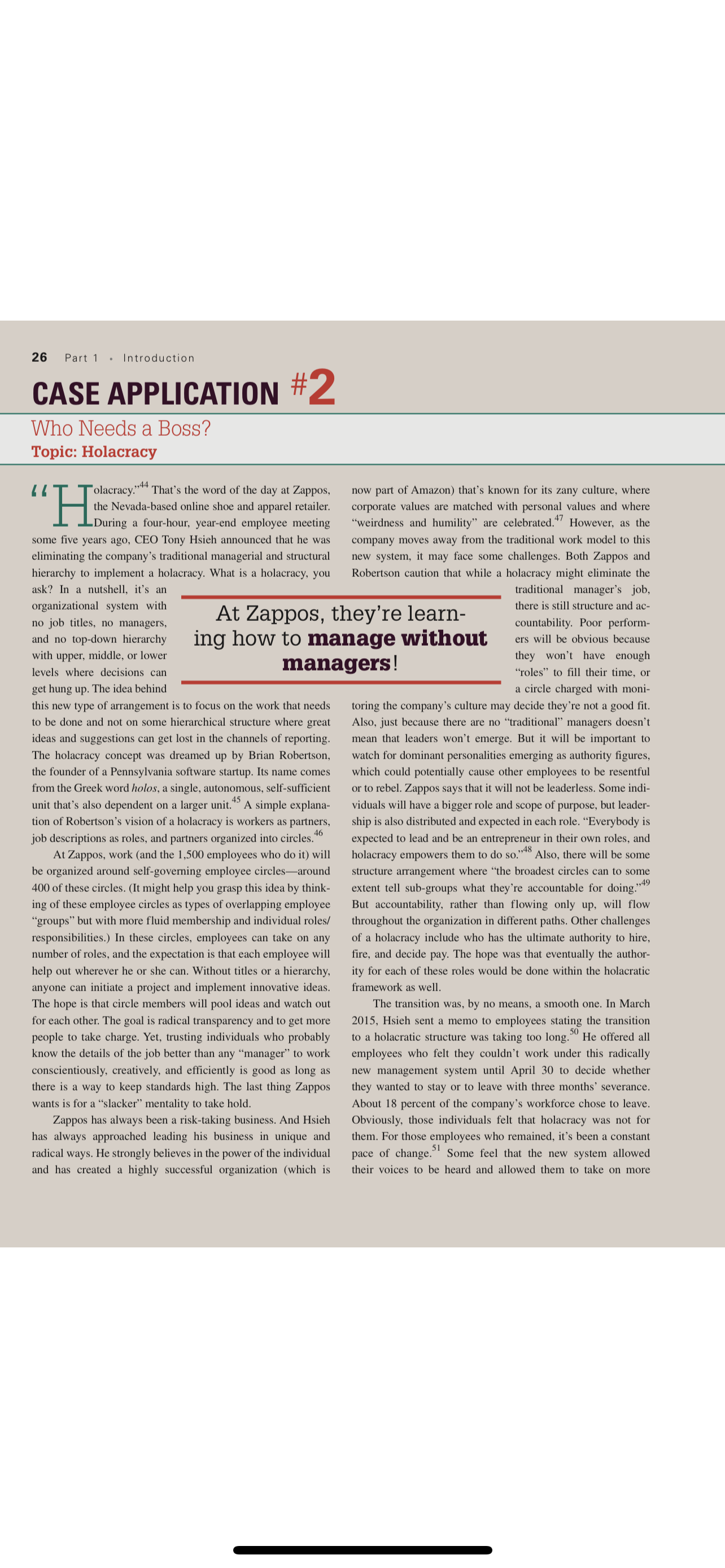
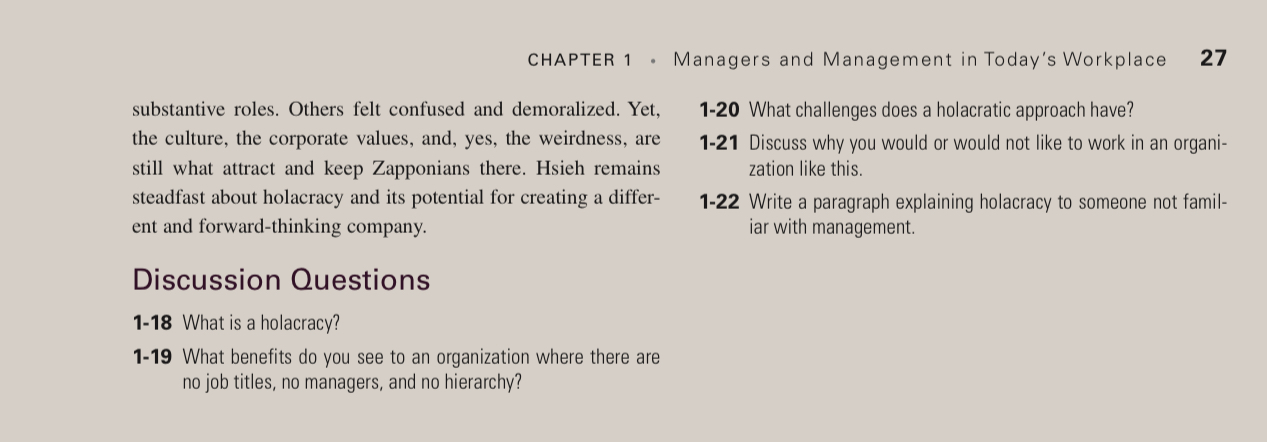
26 Part1 - CASE APPLICATION #2 Introduction Who Needs a Boss? Topic: Holacracy ( [ olacracy."M That's the word of the day at Zappos. the Nevada-based online shoe and apparel retailer. During a four-hour, year-end employee meeting some five years ago, CEO Tony Hsieh announced that he was eliminating the company's traditional managerial and structural hierarchy to implement a holacracy. What is a holacracy. you ask? In a nutshell, it's an organizational system with no job titles, no managers, and no top-down hierarchy with upper, middle, or lower levels where decisions can At Zappos, they're learn- ing how to manage without managers! now part of Amazon) that's known for its zany culture, where corporate values are matched with personal values and where \"weirdness and humility" are celebrated.47 However, as the company moves away from the traditional work model to this new system, it may face some challenges. Both Zappos and Robertson caution that while a holacracy might eliminate the traditional manager's job, there is still structure and ac- countability. Poor perform- ers will be obvious because they won't have enough \"roles" to fill their time, or get hung up. The idea behind this new type of arrangement is to focus on the work that needs to be done and not on some hierarchical structure where great ideas and suggestions can get lost in the channels of reporting The holacracy concept was dreamed up by Brian Robertson. the founder of a Pennsylvania software startupl Its name comes from the Greek word halos. a single. autonomous. self-sufficient unit that's also dependent on a larger unit.45 A simple explana- tion ofRobertson's vision of a holacracy is workers as partners. job descriptions as roles, and partners organized into circles.46 At Zappos. work (and the 1,500 employees who do it) will be organized around self-goveming employee circlesaround 400 of these circlesl (It might help you grasp this idea by think- ing of these employee circles as types of overlapping employee \"groups\" but with more fluid membership and individual roles/ responsibilities) In these circles, employees can take on any number of roles, and the expectation is that each employee will help out wherever he or she can. Without titles or a hierarchy. anyone can initiate a project and implement innovative ideas. The hope is that circle members will pool ideas and watch out for each other. The goal is radical transparency and to get more people to take charge. Yet, trusting individuals who probably know the details of the job better than any \"manager\" to work conscientiously, creatively, and efficiently is good as long as there is a way to keep standards high. The last thing Zappos wants is for a "slacker\" mentality to take hold. Zappos has always been a risk-taking business. And Hsieh has always approached leading his business in unique and radical ways. He strongly believes in the power of the individual and has created a highly successful organization (which is a circle charged with moni- toring the company's culture may decide they're not a good fit. Also. just because there are no \"traditional" managers doesn't mean that leaders won't emerge But it will be important to watch for dominant personalities emerging as authority gures, which could potentially cause other employees to be resentful or to rebel. Zappos says that it will not be leaderlessl Some indi- viduals will have a bigger role and scope of purpose, but leader- ship is also distributed and expected in each role. \"Everybody is expected to lead and be an entrepreneur in their own roles, and holacracy empowers them to do so?\" Also, there will be some structure arrangement where "the broadest circles can to some extent tell sub-groups what they're accountable for doing."49 But accountability, rather than flowing only up, will flow throughout the organization in different paths. Other challenges of a holacracy include who has the ultimate authority to hire, re, and decide pay. The hope was that eventually the author- ity for each of these roles would be done within the holacratic framework as well. The transition was, by no means, a smooth one. In March 2015. Hsieh sent a memo to employees stating the transition to a holacratic structure was taking too long.\" He offered all employees who felt they couldn't work under this radically new management system until April 30 to decide whether they wanted to stay or to leave with three months' severance. About 18 percent of the company's workforce chose to leave. Obviously, those individuals felt that holacracy was not for them. For those employees who remained, it's been a constant pace of change.\" Some feel that the new system allowed their voices to be heard and allowed them to take on more CHAPTER 1 . Managers and Management in Today's Workplace 27 substantive roles. Others felt confused and demoralized. Yet, 1-20 What challenges does a holacratic approach have? the culture, the corporate values, and, yes, the weirdness, are 1-21 Discuss why you would or would not like to work in an organi- still what attract and keep Zapponians there. Hsieh remains zation like this. steadfast about holacracy and its potential for creating a differ- 1-22 Write a paragraph explaining holacracy to someone not famil ent and forward-thinking company. iar with management. Discussion Questions 1-18 What is a holacracy? 1-19 What benefits do you see to an organization where there are no job titles, no managers, and no hierarchy
Step by Step Solution
There are 3 Steps involved in it

Get step-by-step solutions from verified subject matter experts
 Study Help