



Question: 26. The first step in the decision-making process of chapter 7, is to identify and define the problem. 27. Creativity is one of our greatest
26. The first step in the decision-making process of chapter 7, is to identify and define the problem.
27. Creativity is one of our greatest personal assets, even though it may not be recognized.
28. Step 3 of the decision-making process, making a decision, is the easiest of the four steps in this process.
29. The Mount Everest case in chapter 7, illustrates the do ethical reasoning for all of the steps of the decision-making process.
30. Self-confidence means you do not need others as team members to succeed at work.


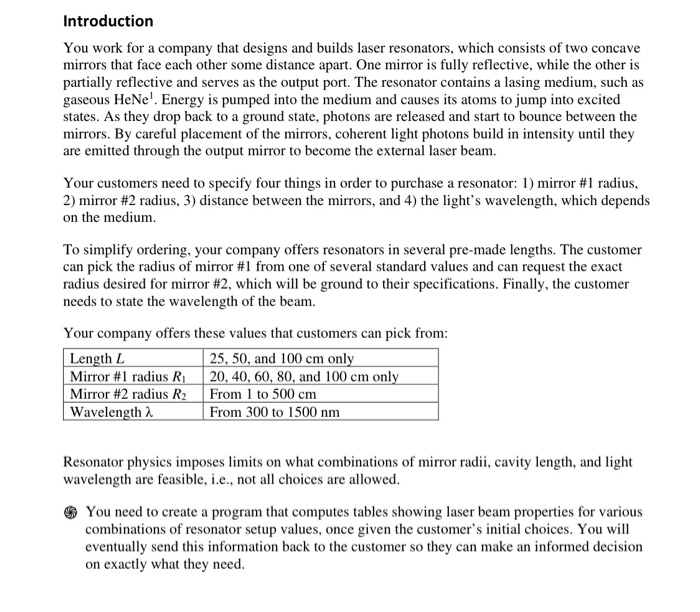
One proposed quality criterion for evaluating mixed methods findings and Interpretations (proposed by Teddlie and Tashakkori) combines notions of internal validity, statistical conclusion validity (quantitative criteria), and credibility (a qualitative criterion). What is this criterion called? A Inference transferability B. Interpretive rigor C. Inference quality OD. Meta-inference4.2.11 (Example 4.2.10 Continued) Let U, Vbe iid N(u, o?). Find the pdf of W = U + V by the convolution approach. Repeat the exercise for the random variable T = U - V.Introduction You work for a company that designs and builds laser resonators, which consists of two concave mirrors that face each other some distance apart. One mirror is fully reflective, while the other is partially reflective and serves as the output port. The resonator contains a lasing medium, such as gaseous HeNe . Energy is pumped into the medium and causes its atoms to jump into excited states. As they drop back to a ground state, photons are released and start to bounce between the mirrors. By careful placement of the mirrors, coherent light photons build in intensity until they are emitted through the output mirror to become the external laser beam. Your customers need to specify four things in order to purchase a resonator: 1) mirror #1 radius, 2) mirror #2 radius, 3) distance between the mirrors, and 4) the light's wavelength, which depends on the medium. To simplify ordering, your company offers resonators in several pre-made lengths. The customer can pick the radius of mirror #1 from one of several standard values and can request the exact radius desired for mirror #2, which will be ground to their specifications. Finally, the customer needs to state the wavelength of the beam. Your company offers these values that customers can pick from: Length L 25, 50, and 100 cm only Mirror #1 radius R 20, 40, 60, 80, and 100 cm only Mirror #2 radius R2 From 1 to 500 cm Wavelength 2 From 300 to 1500 nm Resonator physics imposes limits on what combinations of mirror radii, cavity length, and light wavelength are feasible, i.e., not all choices are allowed. You need to create a program that computes tables showing laser beam properties for various combinations of resonator setup values, once given the customer's initial choices. You will eventually send this information back to the customer so they can make an informed decision on exactly what they need
Step by Step Solution
There are 3 Steps involved in it

Get step-by-step solutions from verified subject matter experts