



Question: 28. Let ? {a,b), and let L be the language over ? exactly consisting of all strings that do not contain the substring aaa. Consider
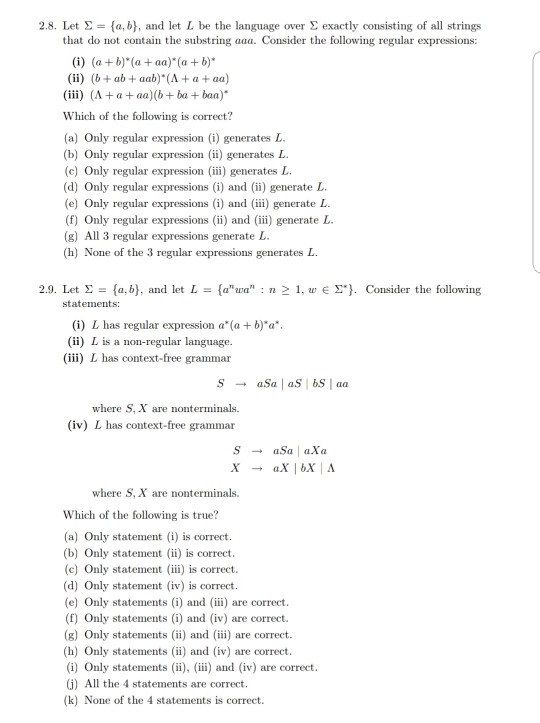
28. Let ? {a,b), and let L be the language over ? exactly consisting of all strings that do not contain the substring aaa. Consider the following regular expressions: (ii) (b + ab + aab)"(A + a + aa) (iii) (A + + aa)(b + ba-baa)" Which of the following is correct? (a) Only regular expression (i) generates L (b) Only regular expressionii generates L (c) Only regular expression (ii) generates L (d) Only regular expressions (i) and) generate L (e) Only regular expressions (i) andi) generate L (f) Only regular expressions (ii) and ) generate L (g) All 3 regular expressions generate L (h) None of the 3 regular expressions generates L 2.9. Let ?-{a,b), and let L-(antra": n > 1, w E ?*). Consider the following statements: (i) L has regular expression ?*(a + b)"a" (ii) L is a non-regular language. (ii) L has context-free grammar where S, X are non terminals (iv) L has context-free grammar where S,X are nonterminals. Which of the following is true? (a) Only statement (i) is correct. (b) Only statement (ii is correct (c) Only statement is correct (d) Only statement (iv) is correct. (e) Only statements (i) and iii are correct (f) Only statements (i) and (iv) are correct. (g) Only statementsi) and iii) are correct. (h) Only statements and (iv) are correct (i) Only statements (ii), and (iv) are correct (i) All the 4 statements are correct. (k) None of the 4 statements is correct
Step by Step Solution
There are 3 Steps involved in it

Get step-by-step solutions from verified subject matter experts