







Question: I need help with Picture 1 Chapter 2, problems 5, 7v. Chapter 2, problem 7i, use mathematical induction, Picture 2 and 3 Problems 2-7, 10,
I need help with
Picture 1 Chapter 2, problems 5, 7v. Chapter 2, problem 7i, use mathematical induction, Picture 2 and 3 Problems 2-7, 10, 11, 15, 18
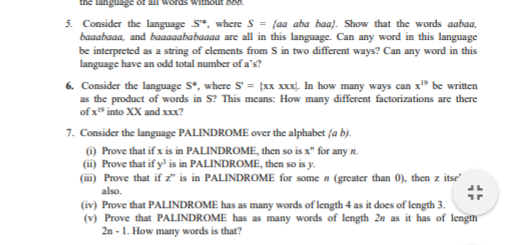
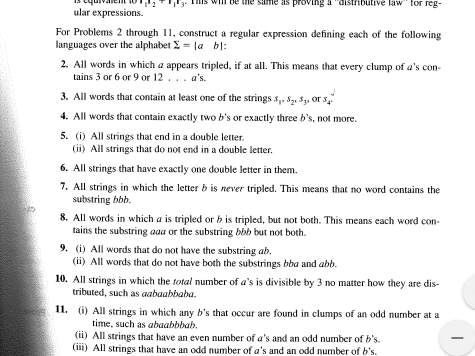
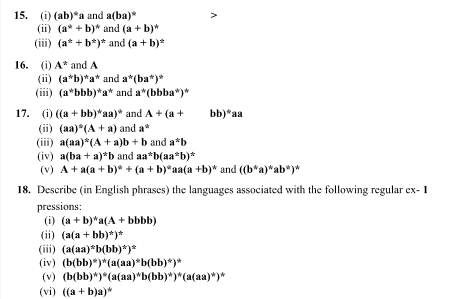
oces without DOD. 5. Consider the language S*, where S = {aa aba haa). Show that the words aahaa, baaahaaa, and haaaaahahaaaa are all in this language. Can any word in this language be interpreted as a string of clements from S in two different ways? Can any word in this language have an odd total number of a's? 6. Consider the language S*, where S = {xx xxx]. In how many ways can be written as the product of words in S? This means: How many different factorizations are there ofx" into XX and xxx? 7. Consider the language PALINDROME over the alphabet fa b). ) Prove that if x is in PALINDROME, then so is x" for any n. i) Prove that if y' is in PALINDROME,then so is y. (i) Prove that if 2" is in PALINDROME for some greater than 0), then z itse" (iv) Prove that PALINDROME has as many words of length 4 as it does of length 3. (v) Prove that PALINDROME has as many words of length 2n as it has of length 2n - 1. How many words is that? also Salme is proving a distributive law for reg- ular expressions For Problems 2 through 11, construct a regular expression defining each of the following languages over the alphabet S-lab: 2. All words in which a appears tripled, if at all. This means that every clump of a's con tains 3 or 6 or 9 or 12... a's. 3. All words that contain at least one of the strings 3., 878z, or 83 4. All words that contain exactly two b's or exactly three b's, not more. 5. (i) All strings that end in a double letter. (ii) All strings that do not end in a double letter. 6. All strings that have exactly one double letter in them. 7. All strings in which the letter b is never tripled. This means that no word contains the substring bbb. 8. All words in which a is tripled or b is tripled, but not both. This means each word con tains the substring ada or the substring bhd but not both. 9. (i) All words that do not have the substring ab. (ii) All words that do not have both the substrings bba and abb. 10. All strings in which the total number of a's is divisible by 3 no matter how they are dis- tributed, such as aabaabbaba. 11. (1) All strings in which any b's that occur are found in clumps of an odd number at a time, such as abaabbbah. (ii) All strings that have an even number of a's and an odd number of b's. (iii) All strings that have an odd number of a's and an odd number of bls. > 15. (i) (ab)*a and a(ba) (ii) (a + b) and (a + b) (iii) (a* + b*)* and (a + b) 16. (i) A* and A (ii) (a*b)*9* and a*(ba*)* (iii) (a*bbb)*a* and a"(bbba")* 17. (i) ((a+bb) Waa) and A + (a + bb) as (ii) (aa)*(A + a) and a* (iii) a(aa)"(A + a)b + b and a*b (iv) a(ba+a)*b and aa*b(aa*b)* (V) A+ a(a + b)* + (a + b)"aa(a+b)" and (ba)"ab) 18. Describe (in English phrases) the languages associated with the following regular ex-1 pressions: (i) (a + b)"a(A + bbbb) (ii) (a(a + bb)*)* (iii) (aaa)*b(bb)*)* (iv) (b(bb)*)*(aaa) b(bb)*)* (v) (b(bb)*)*(aaa)"b(bb)*)(aaa)*)* (vi) ((a+b)a) oces without DOD. 5. Consider the language S*, where S = {aa aba haa). Show that the words aahaa, baaahaaa, and haaaaahahaaaa are all in this language. Can any word in this language be interpreted as a string of clements from S in two different ways? Can any word in this language have an odd total number of a's? 6. Consider the language S*, where S = {xx xxx]. In how many ways can be written as the product of words in S? This means: How many different factorizations are there ofx" into XX and xxx? 7. Consider the language PALINDROME over the alphabet fa b). ) Prove that if x is in PALINDROME, then so is x" for any n. i) Prove that if y' is in PALINDROME,then so is y. (i) Prove that if 2" is in PALINDROME for some greater than 0), then z itse" (iv) Prove that PALINDROME has as many words of length 4 as it does of length 3. (v) Prove that PALINDROME has as many words of length 2n as it has of length 2n - 1. How many words is that? also Salme is proving a distributive law for reg- ular expressions For Problems 2 through 11, construct a regular expression defining each of the following languages over the alphabet S-lab: 2. All words in which a appears tripled, if at all. This means that every clump of a's con tains 3 or 6 or 9 or 12... a's. 3. All words that contain at least one of the strings 3., 878z, or 83 4. All words that contain exactly two b's or exactly three b's, not more. 5. (i) All strings that end in a double letter. (ii) All strings that do not end in a double letter. 6. All strings that have exactly one double letter in them. 7. All strings in which the letter b is never tripled. This means that no word contains the substring bbb. 8. All words in which a is tripled or b is tripled, but not both. This means each word con tains the substring ada or the substring bhd but not both. 9. (i) All words that do not have the substring ab. (ii) All words that do not have both the substrings bba and abb. 10. All strings in which the total number of a's is divisible by 3 no matter how they are dis- tributed, such as aabaabbaba. 11. (1) All strings in which any b's that occur are found in clumps of an odd number at a time, such as abaabbbah. (ii) All strings that have an even number of a's and an odd number of b's. (iii) All strings that have an odd number of a's and an odd number of bls. > 15. (i) (ab)*a and a(ba) (ii) (a + b) and (a + b) (iii) (a* + b*)* and (a + b) 16. (i) A* and A (ii) (a*b)*9* and a*(ba*)* (iii) (a*bbb)*a* and a"(bbba")* 17. (i) ((a+bb) Waa) and A + (a + bb) as (ii) (aa)*(A + a) and a* (iii) a(aa)"(A + a)b + b and a*b (iv) a(ba+a)*b and aa*b(aa*b)* (V) A+ a(a + b)* + (a + b)"aa(a+b)" and (ba)"ab) 18. Describe (in English phrases) the languages associated with the following regular ex-1 pressions: (i) (a + b)"a(A + bbbb) (ii) (a(a + bb)*)* (iii) (aaa)*b(bb)*)* (iv) (b(bb)*)*(aaa) b(bb)*)* (v) (b(bb)*)*(aaa)"b(bb)*)(aaa)*)* (vi) ((a+b)a)
Step by Step Solution
There are 3 Steps involved in it

Get step-by-step solutions from verified subject matter experts
 Study Help