







Question: 29. A is a 5 x 5 matrix with two eigenvalues. One eigenspace 36. With A and D as in Example 2, find an invertible
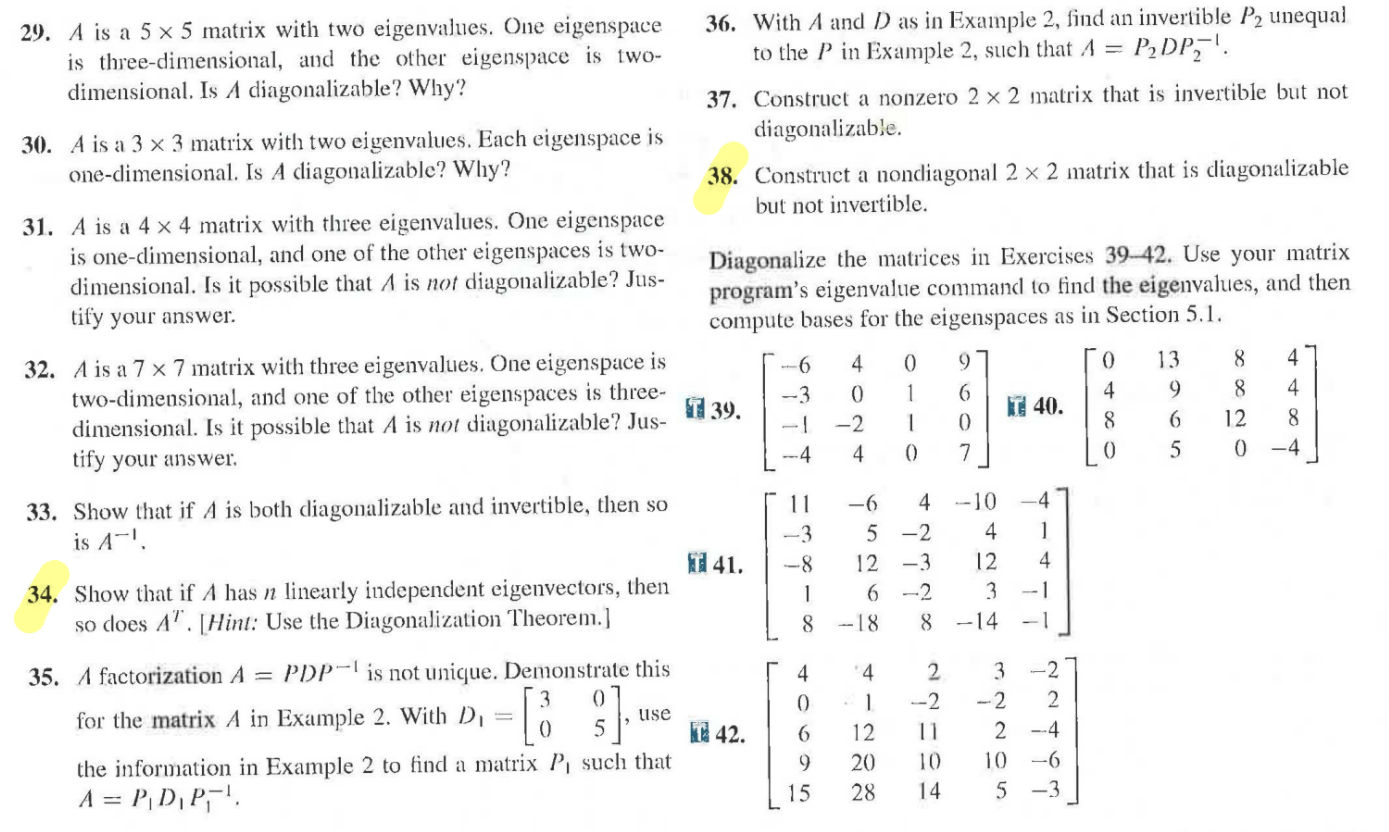
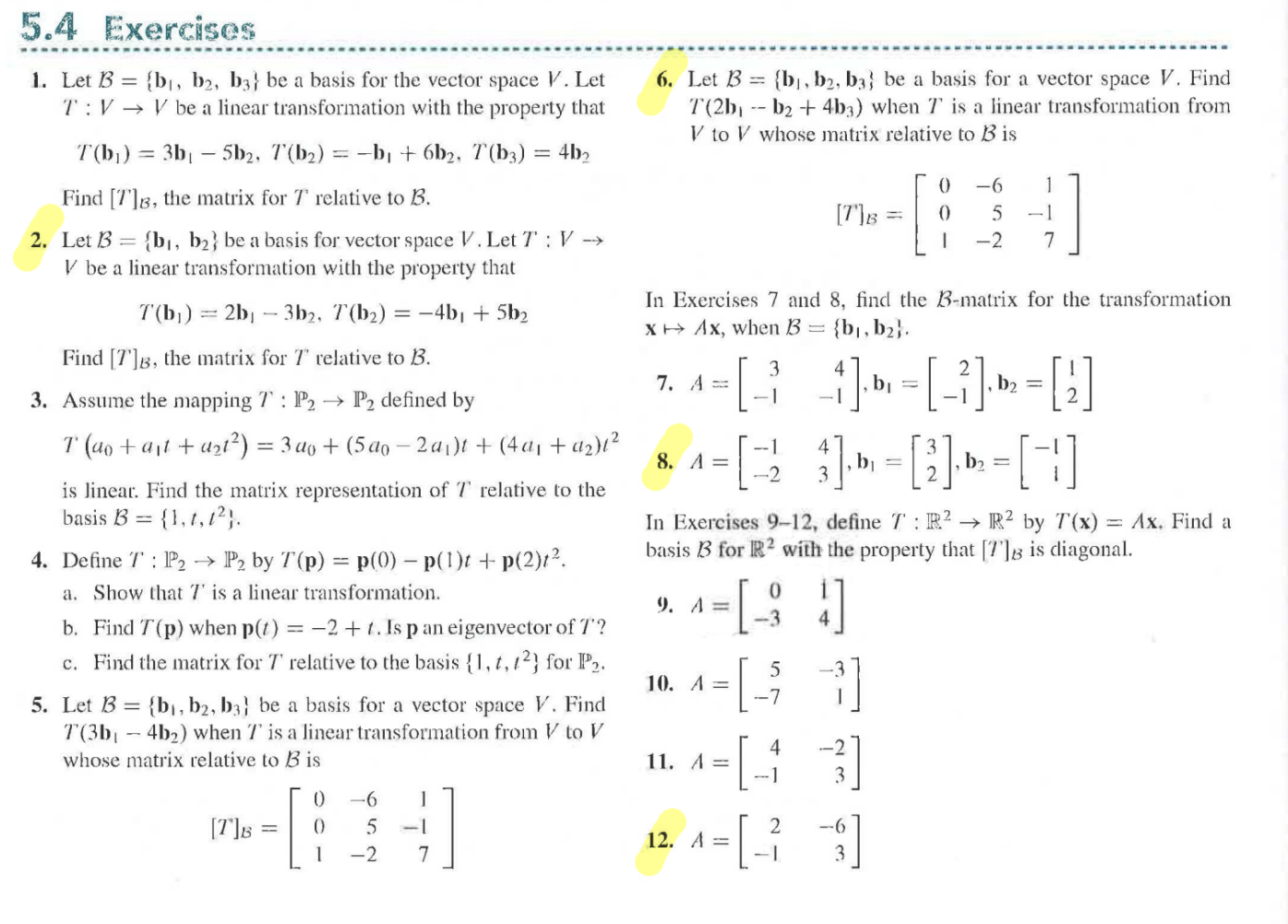
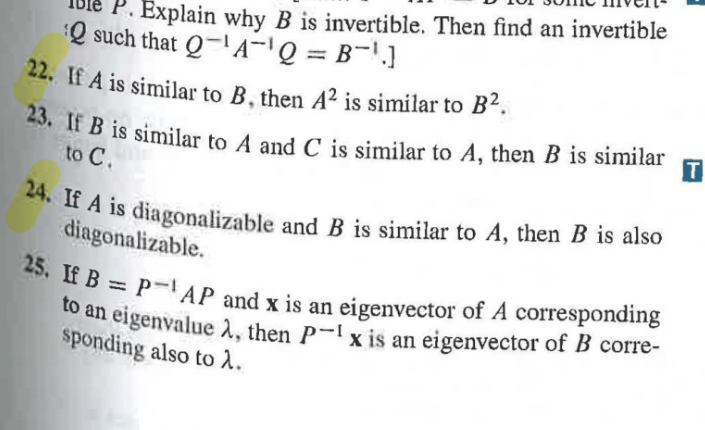
29. A is a 5 x 5 matrix with two eigenvalues. One eigenspace 36. With A and D as in Example 2, find an invertible P2 unequal is three-dimensional, and the other eigenspace is two- to the P in Example 2, such that A = P2 DP2. dimensional. Is A diagonalizable? Why? 37. Construct a nonzero 2 x 2 matrix that is invertible but not 30. A is a 3 x 3 matrix with two eigenvalues. Each eigenspace is diagonalizable. one-dimensional. Is A diagonalizable? Why? 38. Construct a nondiagonal 2 x 2 matrix that is diagonalizable 31. A is a 4 x 4 matrix with three eigenvalues. One eigenspace but not invertible. is one-dimensional, and one of the other eigenspaces is two- Diagonalize the matrices in Exercises 39-42. Use your matrix dimensional. Is it possible that A is not diagonalizable? Jus- program's eigenvalue command to find the eigenvalues, and then tify your answer. compute bases for the eigenspaces as in Section 5.1. 32. A is a 7 x 7 matrix with three eigenvalues. One eigenspace is O A 13 two-dimensional, and one of the other eigenspaces is three- dimensional. Is it possible that A is not diagonalizable? Jus- T 39. T 40. a tify your answer. -4 4 0 5 0 33. Show that if A is both diagonalizable and invertible, then so 11 is A-. -3 T 41. -8 34. Show that if A has n linearly independent eigenvectors, then so does A. [Hint: Use the Diagonalization Theorem. ] 8 WhAND LLA -A MONNW AWNAS 35. A factorization A = PDP is not unique. Demonstrate this - A for the matrix A in Example 2. With D, = 5 use THI 42. 6 12 the information in Example 2 to find a matrix P, such that 20 A = PDP-. 15 285.4 Exercises 1. Let B = {b1, b2, b3) be a basis for the vector space V. Let 6. Let B = (b1, b2, by; be a basis for a vector space V. Find T : V - V be a linear transformation with the property that 7(2b, -- b2 + 4b3) when 7 is a linear transformation from V to V whose matrix relative to 3 is T(b) = 3b, - 5b2, 7'(b2) = -b, + 6b2, (b3) = 402 Find [?'], the matrix for 7 relative to B. [716 = 2. Let B = (b1, b2; be a basis for vector space V. Let T' : V -> V be a linear transformation with the property that T(b,) = 2b, - 3b2, T(b2) = -4b, + 5b2 In Exercises 7 and 8, find the B-matrix for the transformation X +> Ax, when B = {b1, b2;. Find [?']s, the matrix for ?" relative to B. 3. Assume the mapping 7' : P2 - P2 defined by 7. A = 1 1 . D. - [ 7]. 12 = [2] T' ( do + alt + (212) = 3do + (500 - 201)t + (401 + (12)12 8. A= -2 37. =[3]. 12 =[-1] is linear. Find the matrix representation of 7 relative to the basis B = { 1, 1, 12 ). In Exercises 9-12, define 7 : 2 -> IR2 by T(x) = Ax. Find a 4. Define T : P2 -> P2 by T(p) = p(0) - p(1)t + p(2)12. basis B for 1R2 with the property that [?']g is diagonal. a. Show that T' is a linear transformation. 9. A= b. Find T(p) when p(t) = -2 + t. Is pan eigenvector of 7'? c. Find the matrix for T' relative to the basis { 1, t, 12) for P2. 10. A = 5. Let B = {b1, b2, by; be a basis for a vector space V. Find 7(3b1 - 4b2) when I is a linear transformation from V to V whose matrix relative to B is 11. A = 4 -1 -2 3 0 ina 12. A = -1IDie P. Explain why B is invertible. Then find an invertible Q such that QAQ = B-'. ] 22. If A is similar to B, then A2 is similar to B2. 23. If B is similar to A and C is similar to A, then B is similar T to C. 24. If A is diagonalizable and B is similar to A, then B is also diagonalizable. 25. If B = P-AP and x is an eigenvector of A corresponding to an eigenvalue 2. then P-'x is an eigenvector of B corre- sponding also to 1
Step by Step Solution
There are 3 Steps involved in it

Get step-by-step solutions from verified subject matter experts
 Study Help