







Question: 29 Based on their costs, technologies may be small ticket or big ticket. Each type affects healthcare costs, and: a. Aggregated, small ticket technologies have
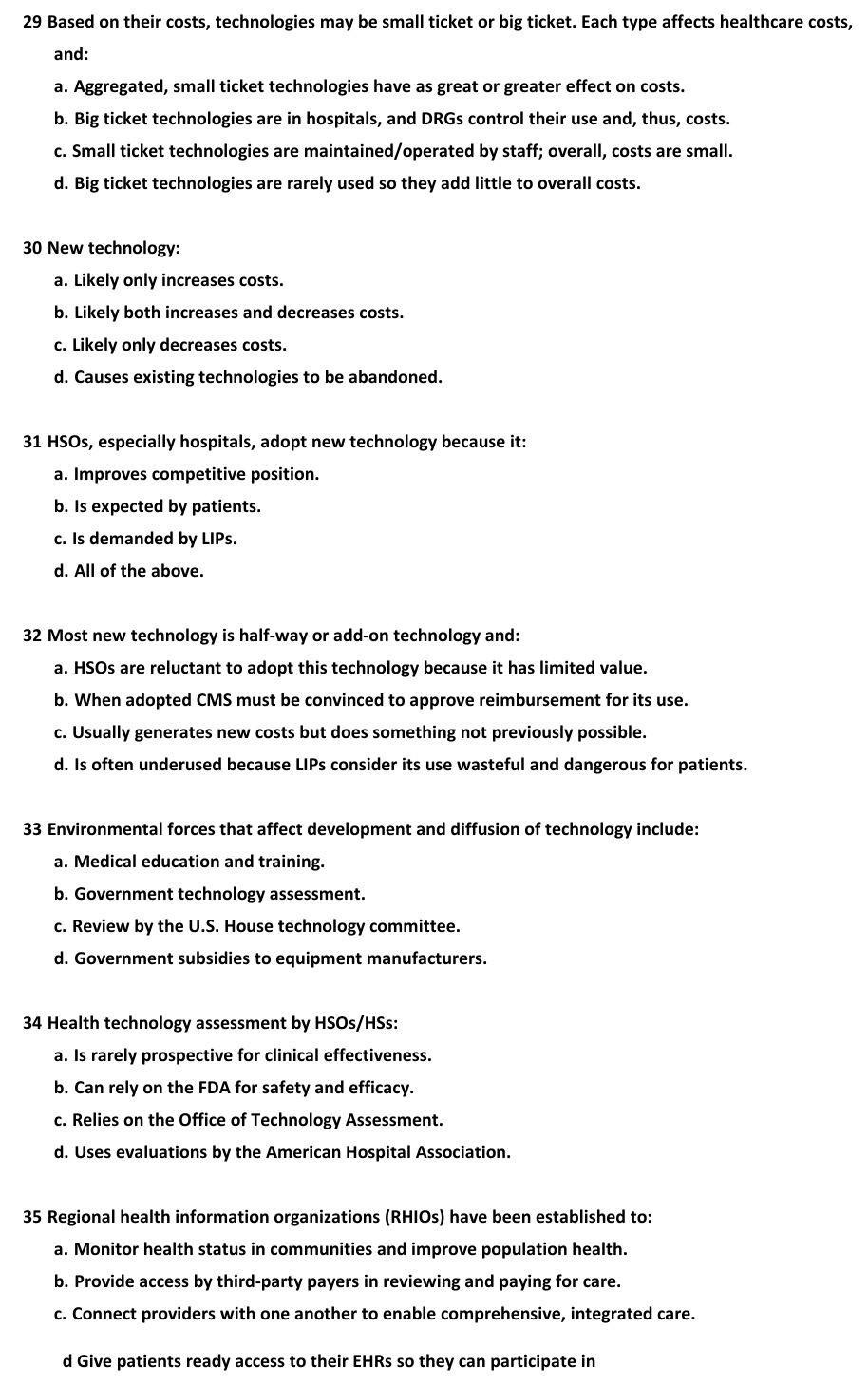
29 Based on their costs, technologies may be small ticket or big ticket. Each type affects healthcare costs, and: a. Aggregated, small ticket technologies have as great or greater effect on costs. b. Big ticket technologies are in hospitals, and DRGs control their use and, thus, costs. c. Small ticket technologies are maintained/operated by staff; overall, costs are small. d. Big ticket technologies are rarely used so they add little to overall costs. 30 New technology: a. Likely only increases costs. b. Likely both increases and decreases costs. c. Likely only decreases costs. d. Causes existing technologies to be abandoned. 31 HSOs, especially hospitals, adopt new technology because it: a. Improves competitive position. b. Is expected by patients. c. Is demanded by LIPs. d. All of the above. 32 Most new technology is half-way or add-on technology and: a. HSOs are reluctant to adopt this technology because it has limited value. b. When adopted CMS must be convinced to approve reimbursement for its use. c. Usually generates new costs but does something not previously possible. d. Is often underused because LIPs consider its use wasteful and dangerous for patients. 33 Environmental forces that affect development and diffusion of technology include: a. Medical education and training. b. Government technology assessment. c. Review by the U.S. House technology committee. d. Government subsidies to equipment manufacturers. 34 Health technology assessment by HSOs/HSS: a. Is rarely prospective for clinical effectiveness. b. Can rely on the FDA for safety and efficacy. c. Relies on the Office of Technology Assessment. d. Uses evaluations by the American Hospital Association. 35 Regional health information organizations (RHIOs) have been established to: a. Monitor health status in communities and improve population health. b. Provide access by third-party payers in reviewing and paying for care. c. Connect providers with one another to enable comprehensive, integrated care. d Give patients ready access to their EHRs so they can participate in
Step by Step Solution
There are 3 Steps involved in it
1 Expert Approved Answer
Step: 1 Unlock

Question Has Been Solved by an Expert!
Get step-by-step solutions from verified subject matter experts
Step: 2 Unlock
Step: 3 Unlock
 Study Help