Question: 29. In the case study The Project Manager/Customer Interface, which would not be a key skill required for an effective customer interface from the choices
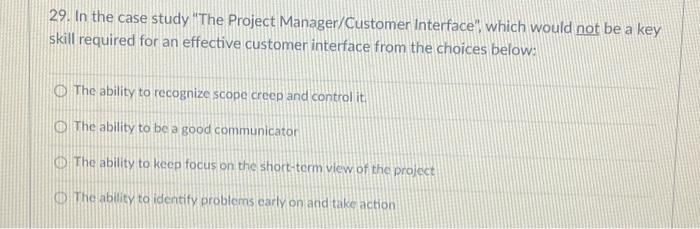
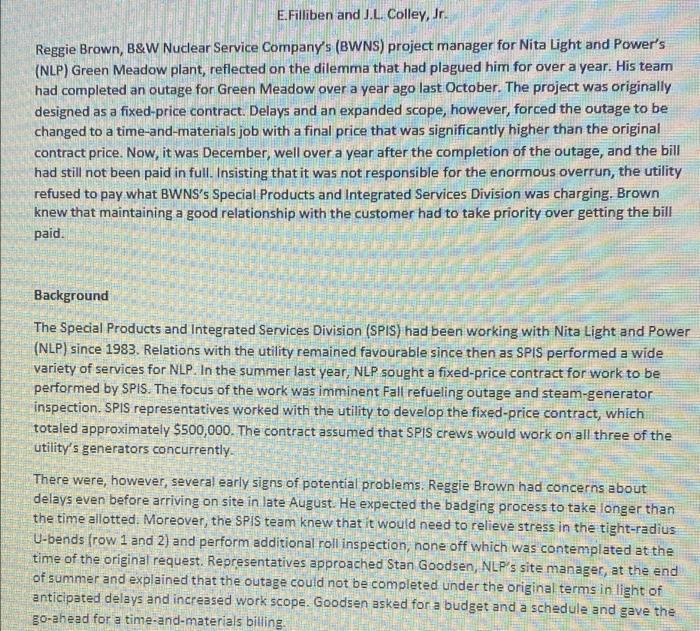
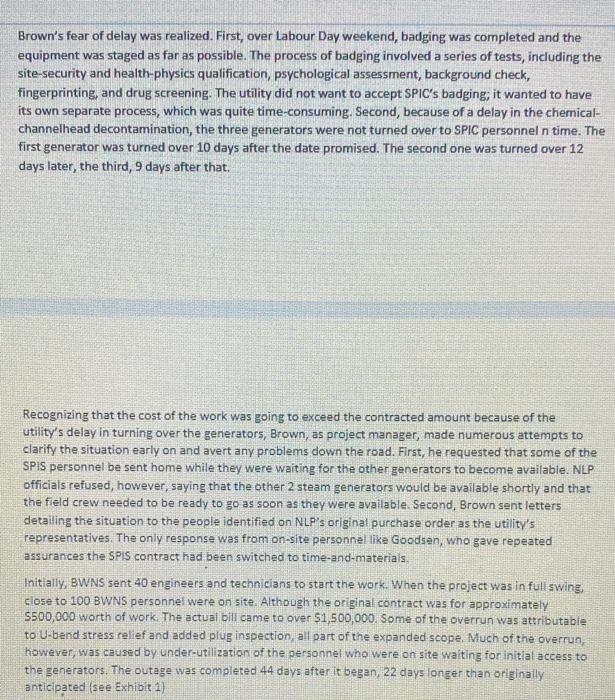
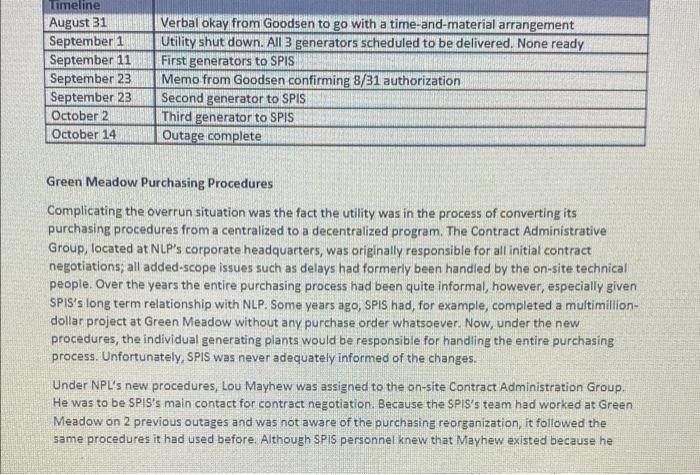
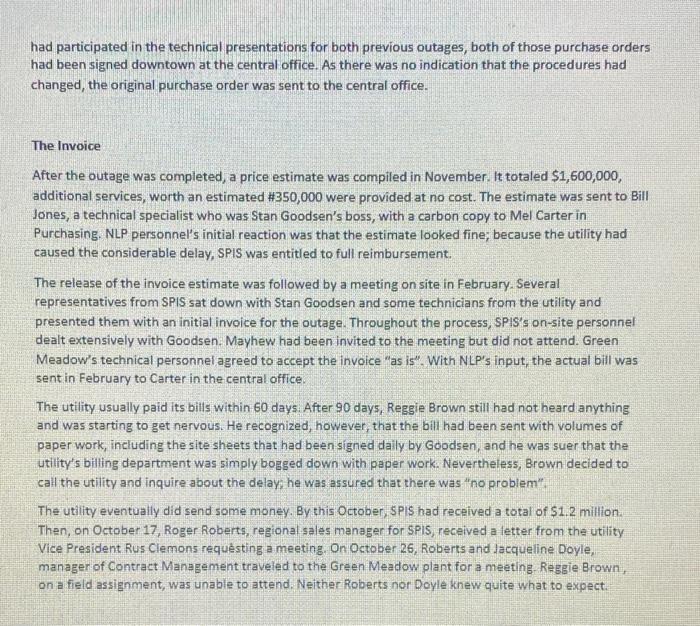
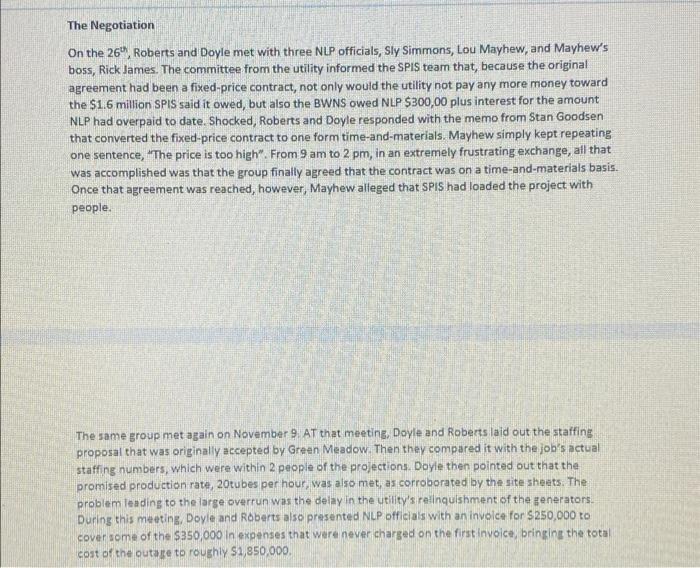
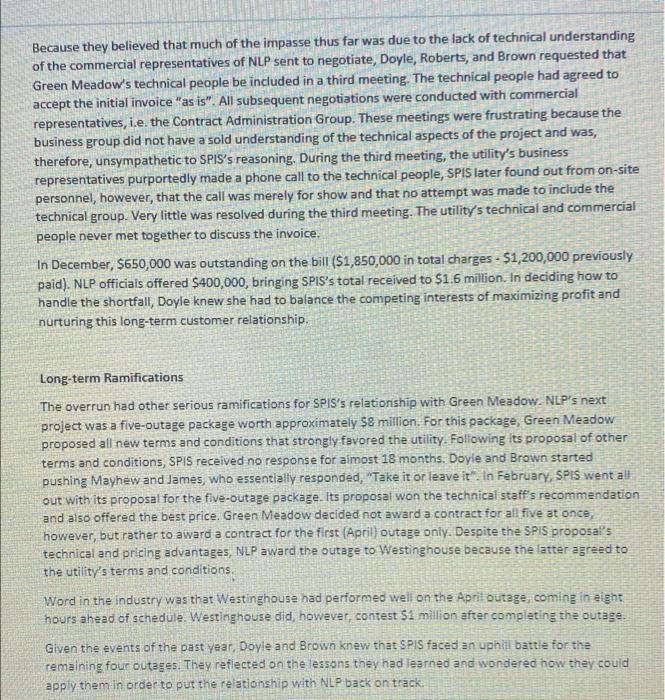
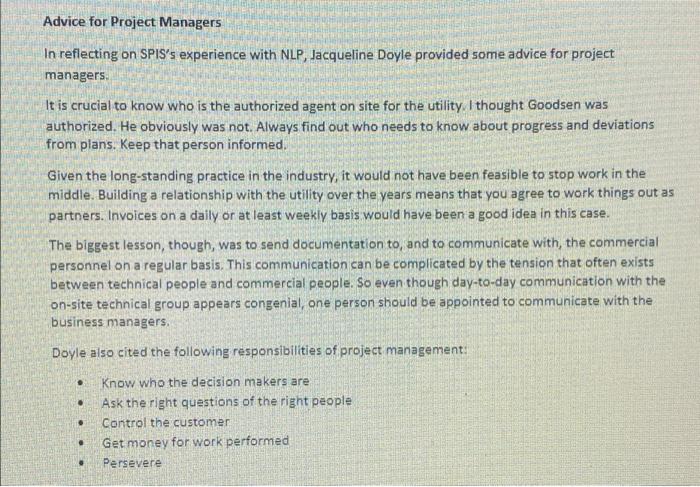
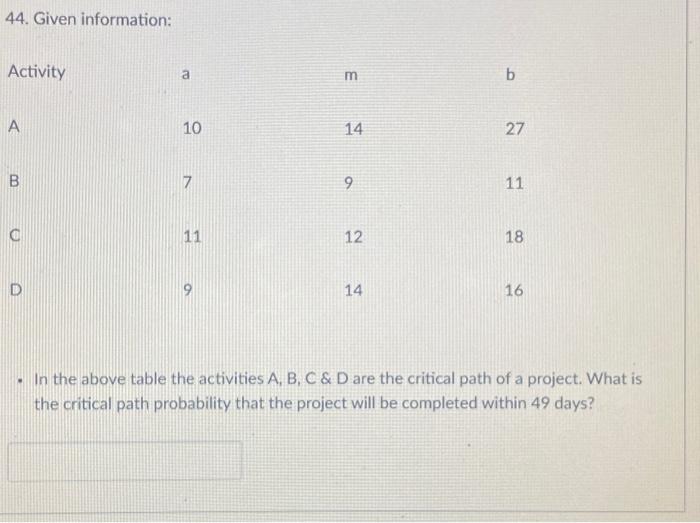
29. In the case study "The Project Manager/Customer Interface", which would not be a key skill required for an effective customer interface from the choices below: The ability to recognize scope creep and control it The ability to be a good communicator The ability to keep focus on the short-term view of the project The ability to identify problems early on and take action E.Filliben and J.L. Colley, Jr. Reggie Brown, B&W Nuclear Service Company's (BWNS) project manager for Nita Light and Power's (NLP) Green Meadow plant, reflected on the dilemma that had plagued him for over a year. His team had completed an outage for Green Meadow over a year ago last October. The project was originally designed as a fixed-price contract. Delays and an expanded scope, however, forced the outage to be changed to a time-and-materials job with a final price that was significantly higher than the original contract price. Now, it was December, well over a year after the completion of the outage, and the bill had still not been paid in full. Insisting that it was not responsible for the enormous overrun, the utility refused to pay what BWNS's Special Products and Integrated Services Division was charging. Brown knew that maintaining a good relationship with the customer had to take priority over getting the bill paid. Background The Special Products and Integrated Services Division (SPIS) had been working with Nita Light and Power (NLP) since 1983. Relations with the utility remained favourable since then as SPIS performed a wide variety of services for NLP. In the summer last year, NLP sought a fixed-price contract for work to be performed by SPIS. The focus of the work was imminent Fall refueling outage and steam-generator inspection. SPIS representatives worked with the utility to develop the fixed-price contract, which totaled approximately $500,000. The contract assumed that SPIS crews would work on all three of the utility's generators concurrently. There were, however, several early signs of potential problems. Reggie Brown had concerns about delays even before arriving on site in late August. He expected the badging process to take longer than the time allotted. Moreover, the SPIS team knew that it would need to relieve stress in the tight-radius U-bends frow 1 and 2) and perform additional roll inspection, none off which was contemplated at the time of the original request. Representatives approached Stan Goodsen, NLP's site manager, at the end of summer and explained that the outage could not be completed under the original terms in light of anticipated delays and increased work scope. Goodsen asked for a budget and a schedule and gave the go-ahead for a time-and-materials billing. Brown's fear of delay was realized. First, over Labour Day weekend, badging was completed and the equipment was staged as far as possible. The process of badging involved a series of tests, including the site-security and health-physics qualification, psychological assessment, background check, fingerprinting, and drug screening. The utility did not want to accept SPIC's badging, it wanted to have its own separate process, which was quite time-consuming. Second, because of a delay in the chemical- channelhead decontamination, the three generators were not turned over to SPIC personnel n time. The first generator was turned over 10 days after the date promised. The second one was turned over 12 days later, the third, 9 days after that, Recognizing that the cost of the work was going to exceed the contracted amount because of the utility's delay in turning over the generators, Brown, as project manager, made numerous attempts to clarify the situation early on and avert any problems down the road. First, he requested that some of the SPIS personnel be sent home while they were waiting for the other generators to become available. NLP officials refused, however, saying that the other 2 steam generators would be available shortly and that the field crew needed to be ready to go as soon as they were available. Second, Brown sent letters detailing the situation to the people identified on NLP's original purchase order as the utility's representatives. The only response was from on-site personnel like Goodsen, who gave repeated assurances the SPIS contract had been switched to time-and-materials. Initially, BWNS sent 40 engineers and technicians to start the work. When the project was in full swing, close to 100 BWNS personnel were on site. Although the original contract was for approximately $500,000 worth of work. The actual bill came to over $1,500,000. Some of the overrun was attributable to U-bend stress relief and added plug inspection, all part of the expanded scope. Much of the overrun, however was caused by under-utilization of the personnel who were on site waiting for initial access to the generators The outage was completed 44 days after it began, 22 days longer than originally anticipated (see Exhibit 1] Timeline August 31 September 1 September 11 September 23 September 23 October 2 October 14 Verbal okay from Goodsen to go with a time-and-material arrangement Utility shut down. Alle generators scheduled to be delivered. None ready First generators to SPIS Memo from Goodsen confirming 8/31 authorization Second generator to SPIS Third generator to SPIS Outage complete Green Meadow Purchasing Procedures Complicating the overrun situation was the fact the utility was in the process of converting its purchasing procedures from a centralized to a decentralized program. The Contract Administrative Group, located at NLP's corporate headquarters, was originally responsible for all initial contract negotiations; all added-scope issues such as delays had formerly been handled by the on-site technical people. Over the years the entire purchasing process had been quite informal, however, especially given SPIS's long term relationship with NLP. Some years ago, SPIS had, for example, completed a multimillion- dollar project at Green Meadow without any purchase order whatsoever. Now, under the new procedures, the individual generating plants would be responsible for handling the entire purchasing process. Unfortunately, SPIS was never adequately informed of the changes. Under NPL's new procedures, Lou Mayhew was assigned to the on-site Contract Administration Group. He was to be SPIS's main contact for contract negotiation. Because the SPIS's team had worked at Green Meadow on 2 previous outages and was not aware of the purchasing reorganization, it followed the same procedures it had used before. Although SPIS personnel knew that Mayhew existed because he had participated in the technical presentations for both previous outages, both of those purchase orders had been signed downtown at the central office. As there was no indication that the procedures had changed, the original purchase order was sent to the central office. The Invoice After the outage was completed, a price estimate was compiled in November. It totaled $1,600,000, additional services, worth an estimated #350,000 were provided at no cost. The estimate was sent to Bill Jones, a technical specialist who was Stan Goodsen's boss, with a carbon copy to Mel Carter in Purchasing. NLP personnel's initial reaction was that the estimate looked fine; because the utility had caused the considerable delay, SPIS was entitled to full reimbursement. The release of the invoice estimate was followed by a meeting on site in February. Several representatives from SPIS sat down with Stan Goodsen and some technicians from the utility and presented them with an initial invoice for the outage. Throughout the process, SPIS's on-site personnel dealt extensively with Goodsen. Mayhew had been invited to the meeting but did not attend. Green Meadow's technical personnel agreed to accept the invoice "as is". With NLP's input, the actual bill was sent in February to Carter in the central office. The utility usually paid its bills within 60 days. After 90 days, Reggie Brown still had not heard anything and was starting to get nervous. He recognized, however, that the bill had been sent with volumes of paper work, including the site sheets that had been signed daily by Goodsen, and he was suer that the utility's billing department was simply bogged down with paper work. Nevertheless, Brown decided to call the utility and inquire about the delay, he was assured that there was no problem". The utility eventually did send some money. By this October, Spis had received a total of $1.2 million Then, on October 17, Roger Roberts, regional sales manager for SPIS, received a letter from the utility Vice President Rus Clemons requesting a meeting. On October 26, Roberts and lacqueline Doyle, manager of Contract Management traveled to the Green Meadow plant for a meeting Reggie Brown, on a field assignment, was unable to attend. Neither Roberts nor Doyle knew quite what to expect. The Negotiation On the 26" Roberts and Doyle met with three NLP officials, Sly Simmons, Lou Mayhew, and Mayhew's boss, Rick James. The committee from the utility informed the SPIS team that, because the original agreement had been a fixed-price contract, not only would the utility not pay any more money toward the $1.6 million SPIS said it owed, but also the BWNS owed NLP $300,00 plus interest for the amount NLP had overpaid to date. Shocked, Roberts and Doyle responded with the memo from Stan Goodsen that converted the fixed-price contract to one form time-and-materials. Mayhew simply kept repeating one sentence, "The price is too high". From 9am to 2 pm, in an extremely frustrating exchange, all that was accomplished was that the group finally agreed that the contract was on a time-and-materials basis. Once that agreement was reached, however, Mayhew alleged that SPIS had loaded the project with people. The same group met again on November 9. At that meeting, Doyle and Roberts laid out the staffing proposal that was originally accepted by Green Meadow. Then they compared it with the job's actual staffing numbers, which were within 2 people of the projections. Doyle then pointed out that the promised production rate, 20tubes per hour, was also met, as corroborated by the site sheets. The problem leading to the large overrun was the delay in the utility's relinquishment of the generators. During this meeting, Doyle and Roberts also presented NLP officials with an invoice for $250,000 to cover some of the $350,000 in expenses that were never charged on the first invoice, bringing the total cost of the outage to roughly $1,850.000, Because they believed that much of the impasse thus far was due to the lack of technical understanding of the commercial representatives of NLP sent to negotiate, Doyle, Roberts, and Brown requested that Green Meadow's technical people be included in a third meeting. The technical people had agreed to accept the initial invoice "as is". All subsequent negotiations were conducted with commercial representatives, i.e. the Contract Administration Group. These meetings were frustrating because the business group did not have a sold understanding of the technical aspects of the project and was, therefore, unsympathetic to SPIS's reasoning. During the third meeting, the utility's business representatives purportedly made a phone call to the technical people, SPIS later found out from on-site personnel, however, that the call was merely for show and that no attempt was made to include the technical group. Very little was resolved during the third meeting. The utility's technical and commercial people never met together to discuss the invoice. In December, $650,000 was outstanding on the bill (51,850,000 in total charges - $1,200,000 previously paid). NLP officials offered $400,000, bringing SPIS's total received to $1.6 million. In deciding how to handle the shortfall, Doyle knew she had to balance the competing interests of maximizing profit and nurturing this long-term customer relationship. Long-term Ramifications The overrun had other serious ramifications for SPIS's relationship with Green Meadow. NLP's next project was a five-outage package worth approximately 58 million. For this package, Green Meadow proposed all new terms and conditions that strongly favored the utility. Following its proposal of other terms and conditions, SPIS received no response for almost 18 months. Doyle and Brown started pushing Mayhew and James, who essentially responded, "Take it or leave it". In February, SPIS went all out with its proposal for the five-outage package. Its proposal won the technical staff's recommendation and also offered the best price. Green Meadow decided not award a contract for all five at once, however, but rather to award a contract for the first (April) outage only. Despite the Spis proposal's technical and pricing advantages, NLP award the outage to Westinghouse because the latter agreed to the utility's terms and conditions Word in the industry was that Westinghouse had performed well on the April outage, coming in eight hours ahead of schedule. Westinghouse did, however, contest $1 million after completing the outage. Given the events of the past year, Doyle and Brown knew that SPIS faced an uphill battle for the remaining four outages. They reflected on the lessons they had learned and wondered how they could apply them in order to put the relationship with NLP back on track. Advice for Project Managers In reflecting on SPIS's experience with NLP, Jacqueline Doyle provided some advice for project managers It is crucial to know who is the authorized agent on site for the utility. I thought Goodsen was authorized. He obviously was not. Always find out who needs to know about progress and deviations from plans. Keep that person informed. Given the long-standing practice in the industry, it would not have been feasible to stop work in the middle. Building a relationship with the utility over the years means that you agree to work things out as partners. Invoices on a daily or at least weekly basis would have been a good idea in this case. The biggest lesson, though, was to send documentation to, and to communicate with, the commercial personnel on a regular basis. This communication can be complicated by the tension that often exists between technical people and commercial people. So even though day-to-day communication with the on-site technical group appears congenial, one person should be appointed to communicate with the business managers Doyle also cited the following responsibilities of project management: . . . Know who the decision makers are Ask the right questions of the right people Control the customer Get money for work performed Persevere . . 44. Given information: Activity a m 3 b A 10 14 27 B 7 9 11 C 11 12 18 D 14 16 In the above table the activities A, B, C & D are the critical path of a project. What is the critical path probability that the project will be completed within 49 days









 Study Help