







Question: 2nd part begin{tabular}{lcc} & A & B hline 1 & Data & Description 2 & Initial Investment cost & $5,000 3 &
2nd part
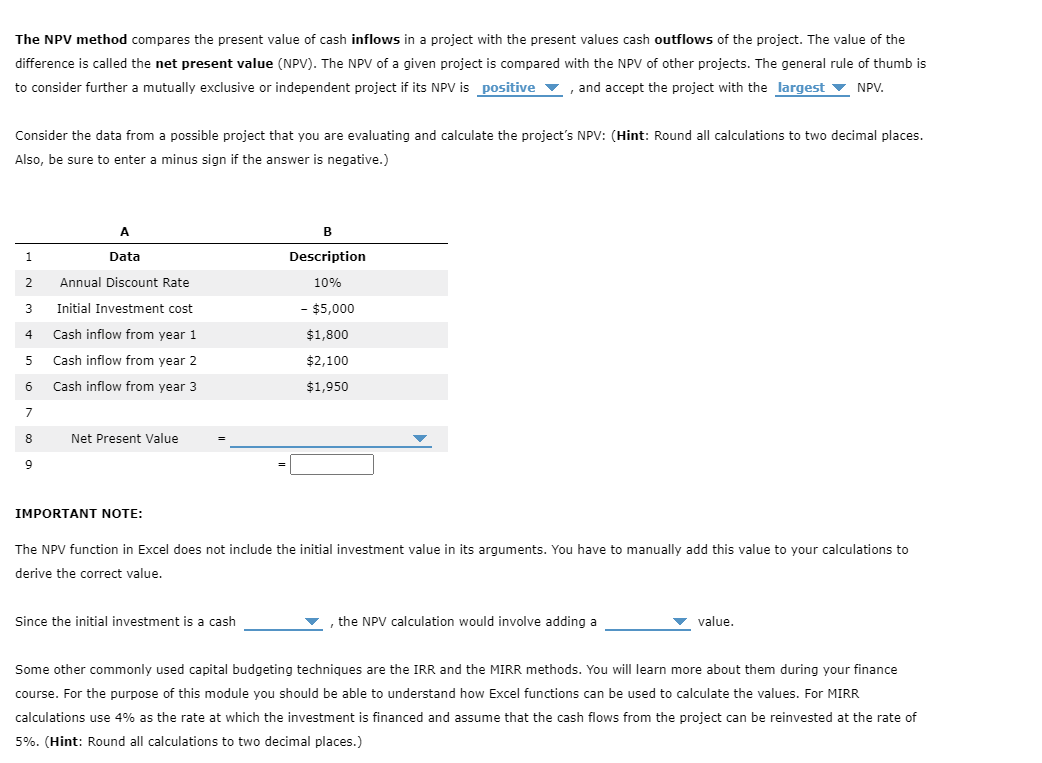
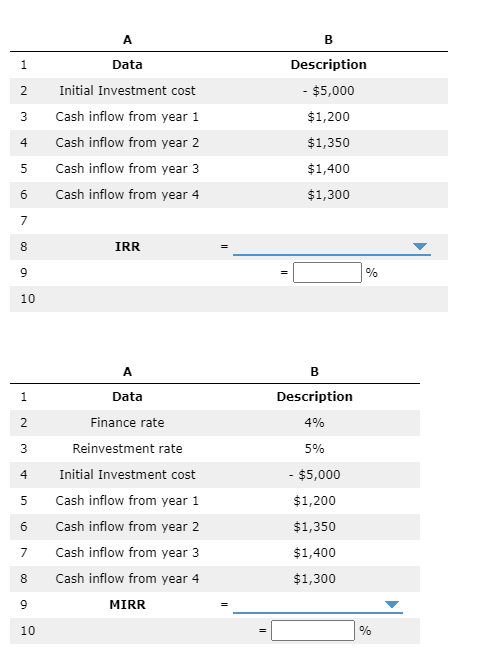
\begin{tabular}{lcc} & A & B \\ \hline 1 & Data & Description \\ 2 & Initial Investment cost & $5,000 \\ 3 & Cash inflow from year 1 & $1,200 \\ 4 & Cash inflow from year 2 & $1,350 \\ 5 & Cash inflow from year 3 & $1,400 \\ 6 & Cash inflow from year 4 & \\ 7 & & \\ 8 & IRR & \\ 9 & & \end{tabular} \begin{tabular}{lcc} & A & B \\ \hline 1 & Data & Description \\ 2 & Finance rate & 4% \\ 3 & Reinvestment rate & 5% \\ 4 & Initial Investment cost & $5,000 \\ 5 & Cash inflow from year 1 & $1,200 \\ 6 & Cash inflow from year 2 & $1,350 \\ 7 & Cash inflow from year 3 & $1,400 \\ 8 & Cash inflow from year 4 & $1,300 \\ 9 & MIRR & = \\ 10 & & = \end{tabular} The NPV method compares the present value of cash inflows in a project with the present values cash outflows of the project. The value of the difference is called the net present value (NPV). The NPV of a given project is compared with the NPV of other projects. The general rule of thumb is to consider further a mutually exclusive or independent project if its NPV is , and accept the project with the NPV. Consider the data from a possible project that you are evaluating and calculate the project's NPV: (Hint: Round all calculations to two decimal places. Also, be sure to enter a minus sign if the answer is negative.) IMPORTANT NOTE: The NPV function in Excel does not include the initial investment value in its arguments. You have to manually add this value to your calculations to derive the correct value. Since the initial investment is a cash , the NPV calculation would involve adding a value. Some other commonly used capital budgeting techniques are the IRR and the MIRR methods. You will learn more about them during your finance course. For the purpose of this module you should be able to understand how Excel functions can be used to calculate the values. For MIRR calculations use 4% as the rate at which the investment is financed and assume that the cash flows from the project can be reinvested at the rate of 5\%. (Hint: Round all calculations to two decimal places.)
Step by Step Solution
There are 3 Steps involved in it

Get step-by-step solutions from verified subject matter experts
 Study Help