







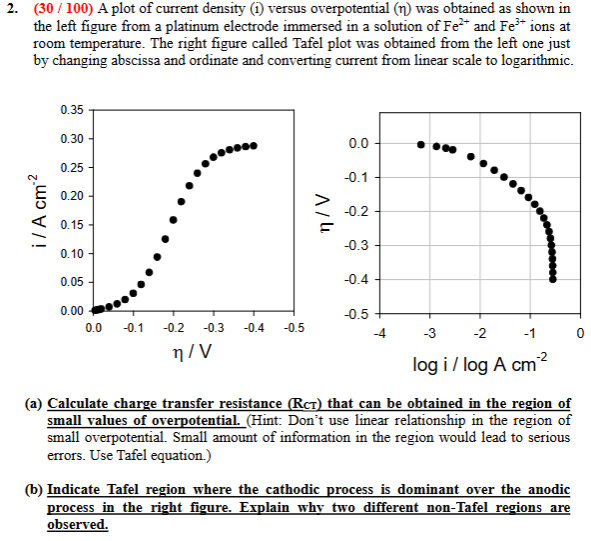
Question: ( 3 0 1 0 0 ) A plot of current density ( i ) versus overpotential ( ) was obtained as shown in the
A plot of current density i versus overpotential was obtained as shown in
the left figure from a platinum electrode immersed in a solution of and ions at
room temperature. The right figure called Tafel plot was obtained from the left one just
by changing abscissa and ordinate and converting current from linear scale to logarithmic.
IUY I IUY H CIII
a Calculate charge transfer resistance that can be obtained in the region of
small values of overpotential. Hint: Don't use linear relationship in the region of
small overpotential. Small amount of information in the region would lead to serious
errors. Use Tafel equation.
b Indicate Tafel region where the cathodic process is dominant over the anodic
process in the right figure. Explain why two different nonTafel regions are
observed. A plot of current density i versus overpotential eta was obtained as shown in the left figure from a platinum electrode immersed in a solution of Fe and Fe ions at room temperature. The right figure called Tafel plot was obtained from the left one just by changing abscissa and ordinate and converting current from linear scale to logarithmic. IUY I IUY H CIII a Calculate charge transfer resistance RCT that can be obtained in the region of small values of overpotential. Hint: Don't use linear relationship in the region of small overpotential. Small amount of information in the region would lead to serious errors. Use Tafel equation.b Indicate Tafel region where the cathodic process is dominant over the anodic process in the right figure. Explain why two different nonTafel regions are observed. Please be careful for unit conversion!
Step by Step Solution
There are 3 Steps involved in it
1 Expert Approved Answer
Step: 1 Unlock

Question Has Been Solved by an Expert!
Get step-by-step solutions from verified subject matter experts
Step: 2 Unlock
Step: 3 Unlock
 Study Help