







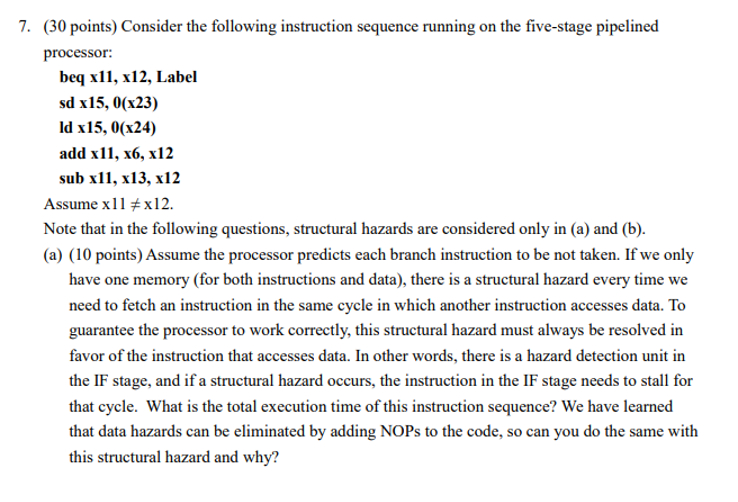
Question: ( 3 0 points ) Consider the following instruction sequence running on the five - stage pipelined processor: beq x 1 1 , x 1
points Consider the following instruction sequence running on the fivestage pipelined
processor:
beq x x Label
sd
ld
add
sub
Assume
Note that in the following questions, structural hazards are considered only in a and b
a points Assume the processor predicts each branch instruction to be not taken. If we only
have one memory for both instructions and data there is a structural hazard every time we
need to fetch an instruction in the same cycle in which another instruction accesses data. To
guarantee the processor to work correctly, this structural hazard must always be resolved in
favor of the instruction that accesses data. In other words, there is a hazard detection unit in
the IF stage, and if a structural hazard occurs, the instruction in the IF stage needs to stall for
that cycle. What is the total execution time of this instruction sequence? We have learned
that data hazards can be eliminated by adding NOPs to the code, so can you do the same with
this structural hazard and why? b points Assume we use the same processor in a What is the minimum number of cycles
you can achieve by adjusting the order of the instructions without losing the correctness?
Also give the new sequence of instructions after reordering.
c points Assuming Stall on Branch ie wait until the branch outcome is determined before
fetching next instruction what speedup is achieved on this instruction sequence if branch
outcomes are determined in the ID stage, relative to the execution where branch outcomes are
determined in the MEM stage?
d points Assume the processor predicts each branch instruction to be not taken. Also assume
each individual pipeline stage of IF ID EX MEM, and WB has the latency of
and respectively. If we change loadstore instructions to use a
register without an offset as the address, these instructions no longer need to use the ALU.
As a result, MEM and EX stages can be overlapped and the pipeline has only stages.
Assuming this change does not affect the clock period, what speedup is achieved in this
instruction sequence compared to the original fivestage one?
e points Given the pipeline stage latencies in d repeat the speedup calculation of d by
considering the possible change in the clock period as follows. When EX and MEM are
done in a single stage called EXMEM stage most of their work can be done in parallel. As
a result, the EXMEM stage now has a latency that is the larger of the original two, plus
needed for the work that could not be done in parallel.
Step by Step Solution
There are 3 Steps involved in it
1 Expert Approved Answer
Step: 1 Unlock

Question Has Been Solved by an Expert!
Get step-by-step solutions from verified subject matter experts
Step: 2 Unlock
Step: 3 Unlock
 Study Help