







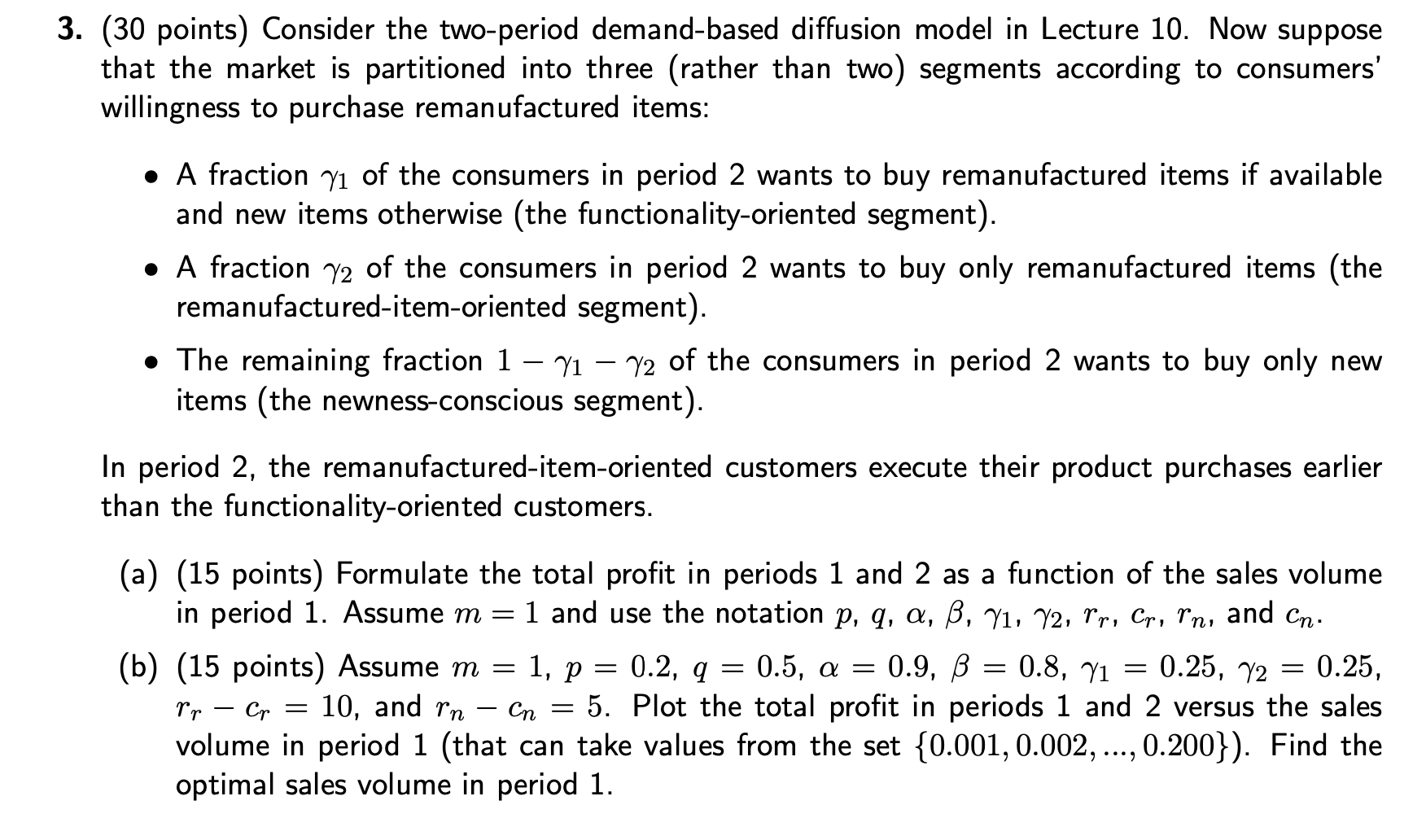
Question: ( 3 0 points ) Consider the two - period demand - based diffusion model in Lecture 1 0 . Now suppose that the market
points Consider the twoperiod demandbased diffusion model in Lecture Now suppose
that the market is partitioned into three rather than two segments according to consumers'
willingness to purchase remanufactured items:
A fraction of the consumers in period wants to buy remanufactured items if available
and new items otherwise the functionalityoriented segment
A fraction of the consumers in period wants to buy only remanufactured items the
remanufactureditemoriented segment
The remaining fraction of the consumers in period wants to buy only new
items the newnessconscious segment
In period the remanufactureditemoriented customers execute their product purchases earlier
than the functionalityoriented customers.
a points Formulate the total profit in periods and as a function of the sales volume
in period Assume and use the notation and
b points Assume
and Plot the total profit in periods and versus the sales
volume in period that can take values from the set dots, Find the
optimal sales volume in period
Step by Step Solution
There are 3 Steps involved in it
1 Expert Approved Answer
Step: 1 Unlock

Question Has Been Solved by an Expert!
Get step-by-step solutions from verified subject matter experts
Step: 2 Unlock
Step: 3 Unlock
 Study Help