







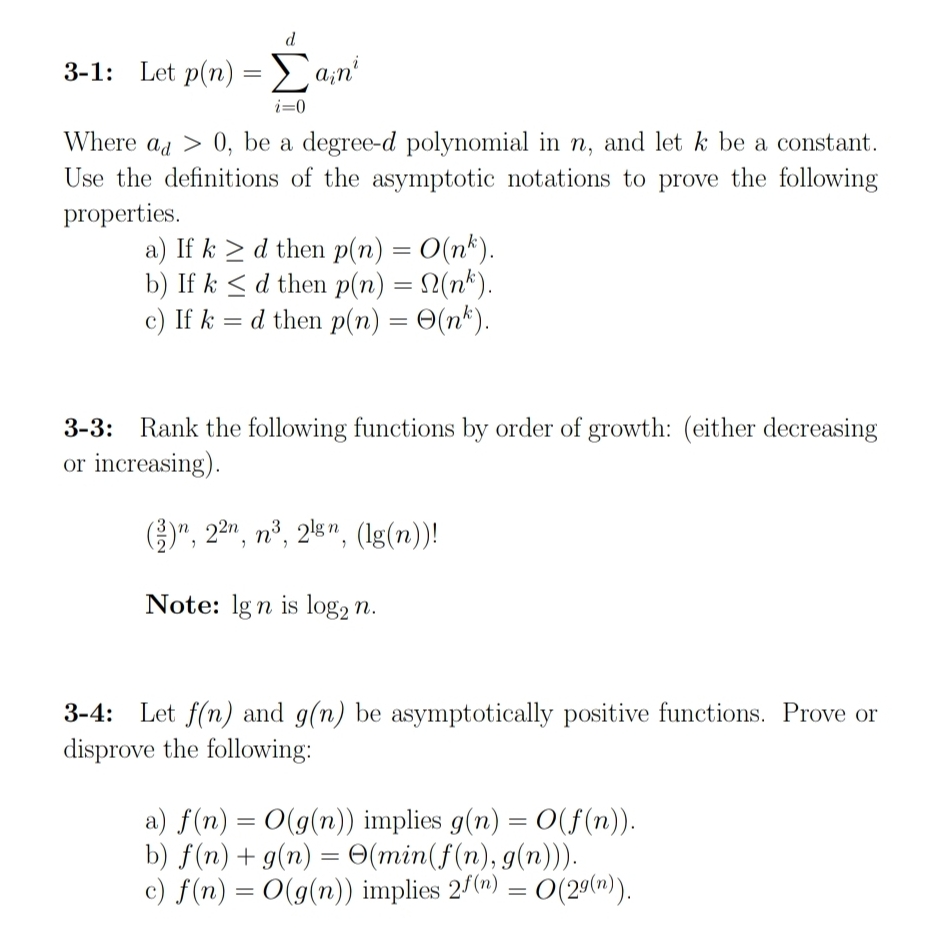
Question: 3 - 1 : , Let p ( n ) = i = 0 d a i n i Where a d > 0 ,
: Let
Where be a degree polynomial in and let be a constant. Use the definitions of the asymptotic notations to prove the following properties.
a If then
b If then
c If then
: Rank the following functions by order of growth: either decreasing or increasing
Note: is
: Let and be asymptotically positive functions. Prove or disprove the following:
a implies
b
c implies
Step by Step Solution
There are 3 Steps involved in it
1 Expert Approved Answer
Step: 1 Unlock

Question Has Been Solved by an Expert!
Get step-by-step solutions from verified subject matter experts
Step: 2 Unlock
Step: 3 Unlock
 Study Help