



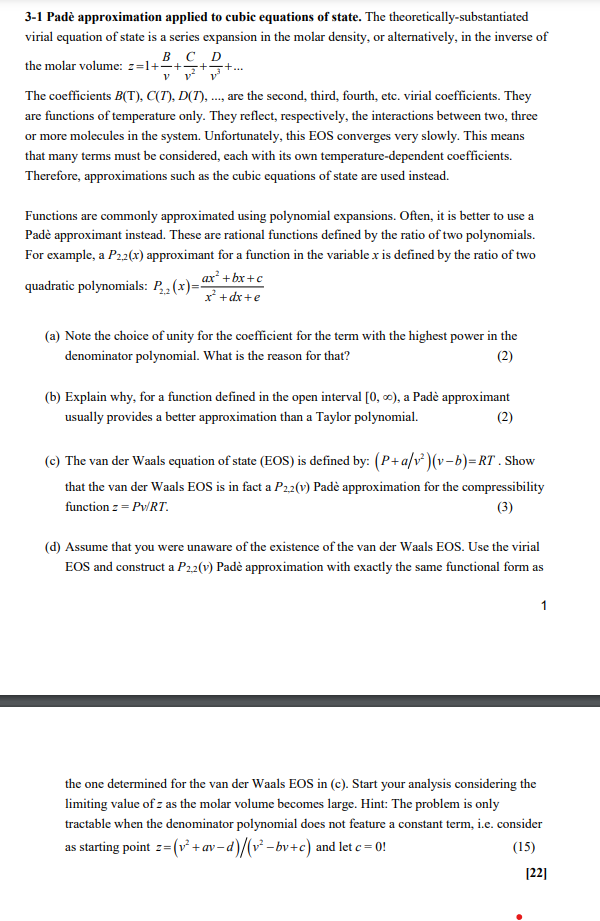
Question: 3 - 1 Pad approximation applied to cubic equations of state. The theoretically - substantiated virial equation of state is a series expansion in the
Pad approximation applied to cubic equations of state. The theoreticallysubstantiated
virial equation of state is a series expansion in the molar density, or alternatively, in the inverse of
the molar volume: dots
The coefficients dots, are the second, third, fourth, etc. virial coefficients. They
are functions of temperature only. They reflect, respectively, the interactions between two, three
or more molecules in the system. Unfortunately, this EOS converges very slowly. This means
that many terms must be considered, each with its own temperaturedependent coefficients.
Therefore, approximations such as the cubic equations of state are used instead.
Functions are commonly approximated using polynomial expansions. Often, it is better to use a
Pad approximant instead. These are rational functions defined by the ratio of two polynomials.
For example, a approximant for a function in the variable is defined by the ratio of two
quadratic polynomials:
c The van der Waals equation of state EOS is defined by: Show
that the van der Waals EOS is in fact a Pad approximation for the compressibility
function
d Assume that you were unaware of the existence of the van der Waals EOS. Use the virial
EOS and construct a Pad approximation with exactly the same functional form as
the one determined for the van der Waals EOS in c Start your analysis considering the
limiting value of as the molar volume becomes large. Hint: The problem is only
tractable when the denominator polynomial does not feature a constant term, ie consider
as starting point and let
Step by Step Solution
There are 3 Steps involved in it
1 Expert Approved Answer
Step: 1 Unlock

Question Has Been Solved by an Expert!
Get step-by-step solutions from verified subject matter experts
Step: 2 Unlock
Step: 3 Unlock