







Question: 3. (10 points) Consider the blending operation shown in the figure below. A stream with a time-varying concentration Co(t) [moles A/m] and a constant flow
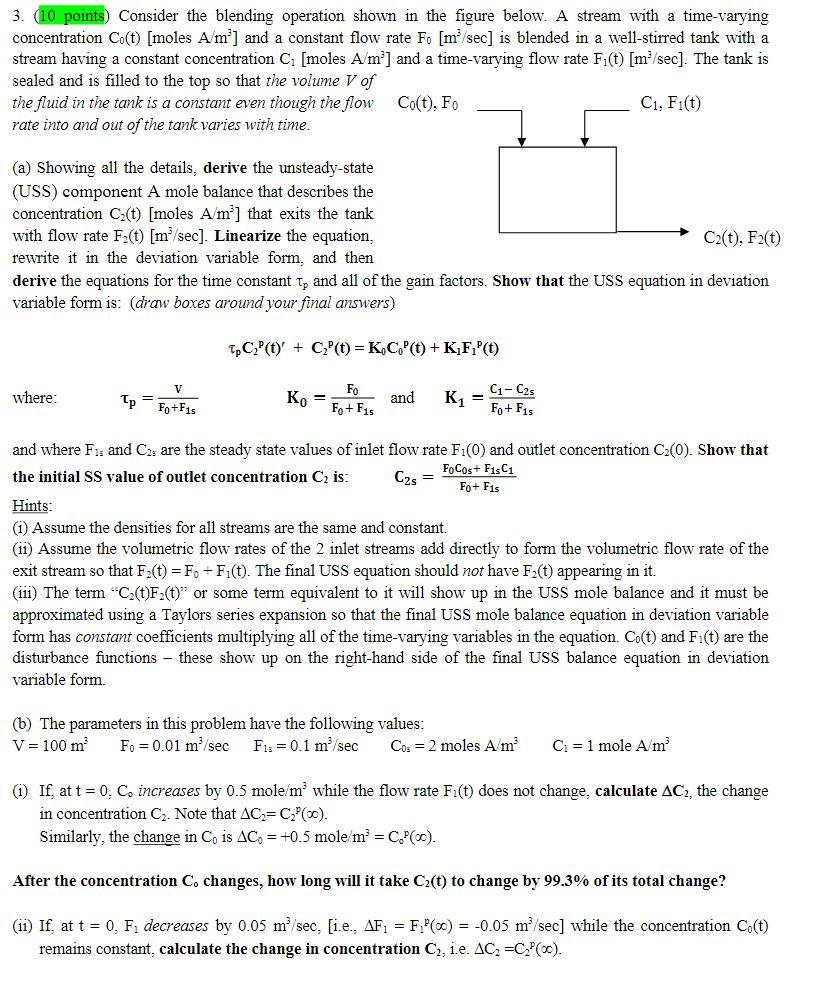
3. (10 points) Consider the blending operation shown in the figure below. A stream with a time-varying concentration Co(t) [moles A/m] and a constant flow rate Fo [m/sec) is blended in a well-stirred tank with a stream having a constant concentration C (moles A/m] and a time-varying flow rate Fi(t) [m/sec). The tank is sealed and is filled to the top so that the volume V of the fluid in the tank is a constant even though the flow Co(t), Fo C1, Fi(t) rate into and out of the tank varies with time. (a) Showing all the details, derive the unsteady-state (USS) component A mole balance that describes the concentration Cz(t) [moles A/m] that exits the tank with flow rate F2(t) [m/sec). Linearize the equation, Cz(t),F2(t) rewrite it in the deviation variable form, and then derive the equations for the time constant to and all of the gain factors. Show that the USS equation in deviation variable form is: (draw boxes around your final answers) TpCP(t + CP(t) =KCP(t) + KFP(t) where: = V Fo+F15 Ko = Fo Fo+Fis and K1 = C1-C2s Fo+ F1s and where F. and C2: are the steady state values of inlet flow rate F1(0) and outlet concentration C:(0). Show that the initial SS value of outlet concentration C2 is: FoCos+ F1sC1 Czs = Fo+ F1s Hints: (1) Assume the densities for all streams are the same and constant (11) Assume the volumetric flow rates of the 2 inlet streams add directly to form the volumetric flow rate of the exit stream so that F.(t) = Fo+F(1). The final USS equation should not have Fz(t) appearing in it. (111) The term "Cz(t)Fz(t)" or some term equivalent to it will show up in the USS mole balance and it must be approximated using a Taylors series expansion so that the final USS mole balance equation in deviation variable form has constant coefficients multiplying all of the time-varying variables in the equation. Co(t) and Fr(t) are the disturbance functions - these show up on the right-hand side of the final USS balance equation in deviation variable form (b) The parameters in this problem have the following values: V= 100 m Fo = 0.01 m/sec F1: = 0.1 m/sec Co. = 2 moles A/m Ci = 1 mole Am (1) If, at t = 0, Co increases by 0.5 mole m' while the flow rate Fi(t) does not change, calculate AC2, the change in concentration C. Note that AC = Cz?(). Similarly, the change in Co is AC, = +0.5 molem = C.P(). After the concentration C. changes, how long will it take Cz(t) to change by 99.3% of its total change? (11) If, at t = 0, F, decreases by 0.05 m/sec, (i.e., AF, = F:'(c) = -0.05 m/sec) while the concentration Co(t) remains constant, calculate the change in concentration C, i.e. AC2 =C2). 3. (10 points) Consider the blending operation shown in the figure below. A stream with a time-varying concentration Co(t) [moles A/m] and a constant flow rate Fo [m/sec) is blended in a well-stirred tank with a stream having a constant concentration C (moles A/m] and a time-varying flow rate Fi(t) [m/sec). The tank is sealed and is filled to the top so that the volume V of the fluid in the tank is a constant even though the flow Co(t), Fo C1, Fi(t) rate into and out of the tank varies with time. (a) Showing all the details, derive the unsteady-state (USS) component A mole balance that describes the concentration Cz(t) [moles A/m] that exits the tank with flow rate F2(t) [m/sec). Linearize the equation, Cz(t),F2(t) rewrite it in the deviation variable form, and then derive the equations for the time constant to and all of the gain factors. Show that the USS equation in deviation variable form is: (draw boxes around your final answers) TpCP(t + CP(t) =KCP(t) + KFP(t) where: = V Fo+F15 Ko = Fo Fo+Fis and K1 = C1-C2s Fo+ F1s and where F. and C2: are the steady state values of inlet flow rate F1(0) and outlet concentration C:(0). Show that the initial SS value of outlet concentration C2 is: FoCos+ F1sC1 Czs = Fo+ F1s Hints: (1) Assume the densities for all streams are the same and constant (11) Assume the volumetric flow rates of the 2 inlet streams add directly to form the volumetric flow rate of the exit stream so that F.(t) = Fo+F(1). The final USS equation should not have Fz(t) appearing in it. (111) The term "Cz(t)Fz(t)" or some term equivalent to it will show up in the USS mole balance and it must be approximated using a Taylors series expansion so that the final USS mole balance equation in deviation variable form has constant coefficients multiplying all of the time-varying variables in the equation. Co(t) and Fr(t) are the disturbance functions - these show up on the right-hand side of the final USS balance equation in deviation variable form (b) The parameters in this problem have the following values: V= 100 m Fo = 0.01 m/sec F1: = 0.1 m/sec Co. = 2 moles A/m Ci = 1 mole Am (1) If, at t = 0, Co increases by 0.5 mole m' while the flow rate Fi(t) does not change, calculate AC2, the change in concentration C. Note that AC = Cz?(). Similarly, the change in Co is AC, = +0.5 molem = C.P(). After the concentration C. changes, how long will it take Cz(t) to change by 99.3% of its total change? (11) If, at t = 0, F, decreases by 0.05 m/sec, (i.e., AF, = F:'(c) = -0.05 m/sec) while the concentration Co(t) remains constant, calculate the change in concentration C, i.e. AC2 =C2)
Step by Step Solution
There are 3 Steps involved in it

Get step-by-step solutions from verified subject matter experts
 Study Help