







Question: 3. (12 marks) In this problem, you'll compare Binary coded decimal (BCD) to our standard binary number representation for integers. BCD represents k decimal digits
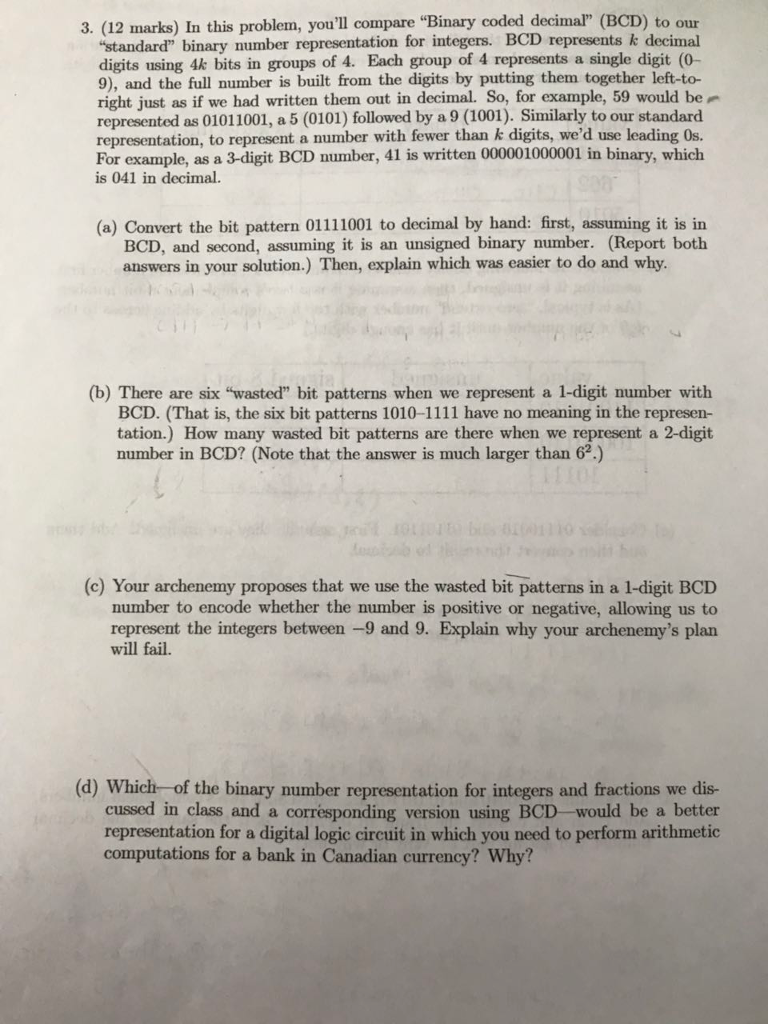
3. (12 marks) In this problem, you'll compare "Binary coded decimal (BCD) to our standard" binary number representation for integers. BCD represents k decimal digits using 4k bits in groups of 4. Each group of 4 represents a single digit (0- 9), and the full number is built from the digits by putting them together left-to- right just as if we had written them out in decimal. So, for example, 59 would be represented as 01011001, a 5 (0101) followed by a 9 (1001). Similarly to our standard representation, to represent a number with fewer than k digits, we'd use leading Os. For example, as a 3-digit BCD number, 41 is written 000001000001 in binary, which is 041 in decimal. (a) Convert the bit pattern 01111001 to decimal by hand: first, assuming it is in BCD, and second, assuming it is an unsigned binary number. (Report both answers in your solution.) Then, explain which was easier to do and why. (b) There are six "wasted" bit patterns when we represent a 1-digit number with BCD. (That is, the six bit patterns 1010-1111 have no meaning in the represen- tation.) How many wasted bit patterns are there when we represent a 2-digit number in BCD? (Note that the answer is much larger than 6.) (c) Your archenemy proposes that we use the wasted bit patterns in a 1-digit BCD number to encode whether the number is positive or negative, allowing us to represent the integers between -9 and 9. Explain why your archenemy's plan will fail. (d) Which of the binary number representation for integers and fractions we dis- cussed in class and a corresponding version using BCD-would be a better representation for a digital logic circuit in which you need to perform arithmetic computations for a bank in Canadian currency? Why
Step by Step Solution
There are 3 Steps involved in it

Get step-by-step solutions from verified subject matter experts
 Study Help