







Question: In this problem, you'll compare Binary coded decimal (BCD) to our standard binary number representation for integers. BCD represents k decimal digits using 4k bits
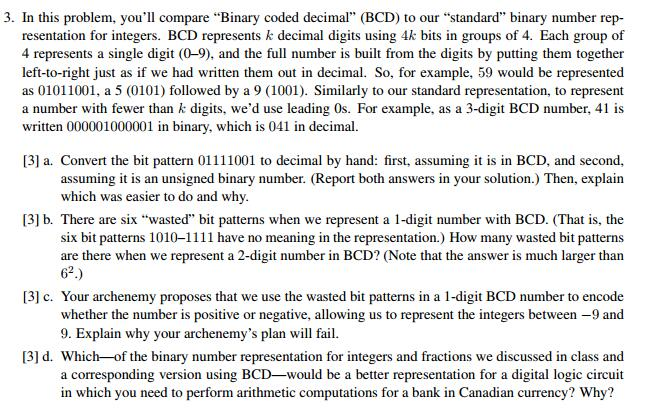
In this problem, you'll compare "Binary coded decimal" (BCD) to our "standard" binary number representation for integers. BCD represents k decimal digits using 4k bits in groups of 4. Each group of 4 represents a single digit (0-9), and the full number is built from the digits by putting them together left-to-right just as if we had written them out in decimal. So, for example, 59 would be represented as 01011001, a 5 (0101) followed by a 9 (1001). Similarly to our standard representation, to represent a number with fewer than k digits, we'd use leading 0s. For example, as a 3-digit BCD number, 41 is written 000001000001 in binary, which is 041 in decimal. [3] a. Convert the bit pattern 01111001 to decimal by hand: first, assuming it is in BCD, and second, assuming it is an unsigned binary number. (Report both answers in your solution.) Then, explain which was easier to do and why. [3] b. There are six "wasted'' bit patterns when we represent a 1-digit number with BCD. (That is, the six bit patterns 1010-1111 have no meaning in the representation.) How many wasted bit patterns are there when we represent a 2-digit number in BCD? (Note that the answer is much larger than 6^2.) [3] c. Your archenemy proposes that we use the wasted bit patterns in a 1-digit BCD number to encode whether the number is positive or negative, allowing us to represent the integers between -9 and 9. Explain why your archenemy's plan will fail. [3] d. Which of the binary number representation for integers and fractions we discussed in class and a corresponding version using BCD-would be a better representation for a digital logic circuit in which you need to perform arithmetic computations for a bank in Canadian currency? Why
Step by Step Solution
There are 3 Steps involved in it

Get step-by-step solutions from verified subject matter experts
 Study Help