


Question: 3. [18 points) Consider a retailer that uses the order-up-to model when ordering from its supplier. Orders are placed at the beginning of each week
3. [18 points) Consider a retailer that uses the
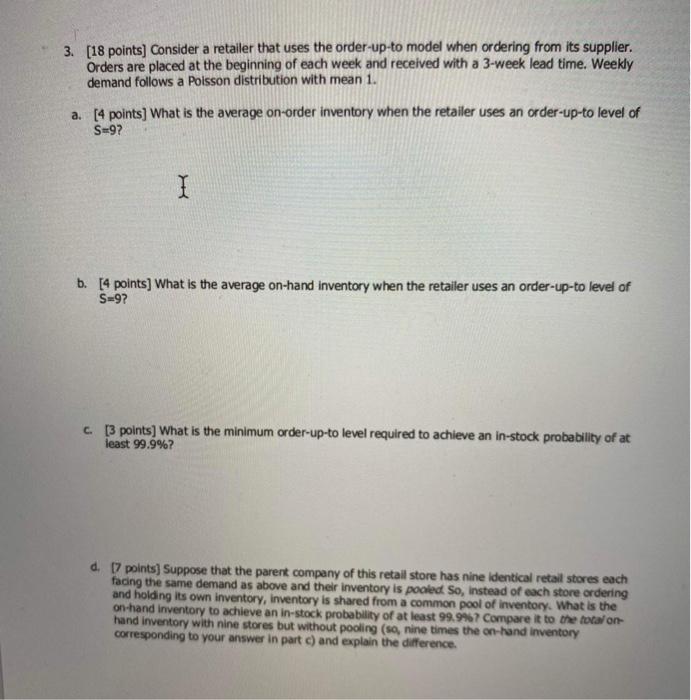
3. [18 points) Consider a retailer that uses the order-up-to model when ordering from its supplier. Orders are placed at the beginning of each week and received with a 3-week lead time. Weekly demand follows a Poisson distribution with mean 1. a. [4 points) What is the average on-order inventory when the retailer uses an order-up-to level of S=9? I b. [4 points) What is the average on-hand inventory when the retailer uses an order-up-to level of S=97 c. [3 points) What is the minimum order-up-to level required to achieve an in-stock probability of at least 99.9%? d. 17 points) Suppose that the parent company of this retail store has nine identical retail stores each facing the same demand as above and their inventory is pooled So, instead of each store ordering and holding its own inventory, inventory is shared from a common pool of Inventory. What is the on-hand Inventory to achieve an in-stock probability of at least 99.9%? Compare it to the total on hand inventory with nine stores but without pooling (so, nine times the on-hand inventory corresponding to your answer in part c) and explain the difference. 3. [18 points) Consider a retailer that uses the order-up-to model when ordering from its supplier. Orders are placed at the beginning of each week and received with a 3-week lead time. Weekly demand follows a Poisson distribution with mean 1. a. [4 points) What is the average on-order inventory when the retailer uses an order-up-to level of S=9? I b. [4 points) What is the average on-hand inventory when the retailer uses an order-up-to level of S=97 c. [3 points) What is the minimum order-up-to level required to achieve an in-stock probability of at least 99.9%? d. 17 points) Suppose that the parent company of this retail store has nine identical retail stores each facing the same demand as above and their inventory is pooled So, instead of each store ordering and holding its own inventory, inventory is shared from a common pool of Inventory. What is the on-hand Inventory to achieve an in-stock probability of at least 99.9%? Compare it to the total on hand inventory with nine stores but without pooling (so, nine times the on-hand inventory corresponding to your answer in part c) and explain the difference

Step by Step Solution

There are 3 Steps involved in it

1 Expert Approved Answer
Step: 1 Unlock blur-text-image

Question Has Been Solved by an Expert!

Get step-by-step solutions from verified subject matter experts

Step: 2 Unlock
Step: 3 Unlock

Students Have Also Explored These Related General Management Questions!