







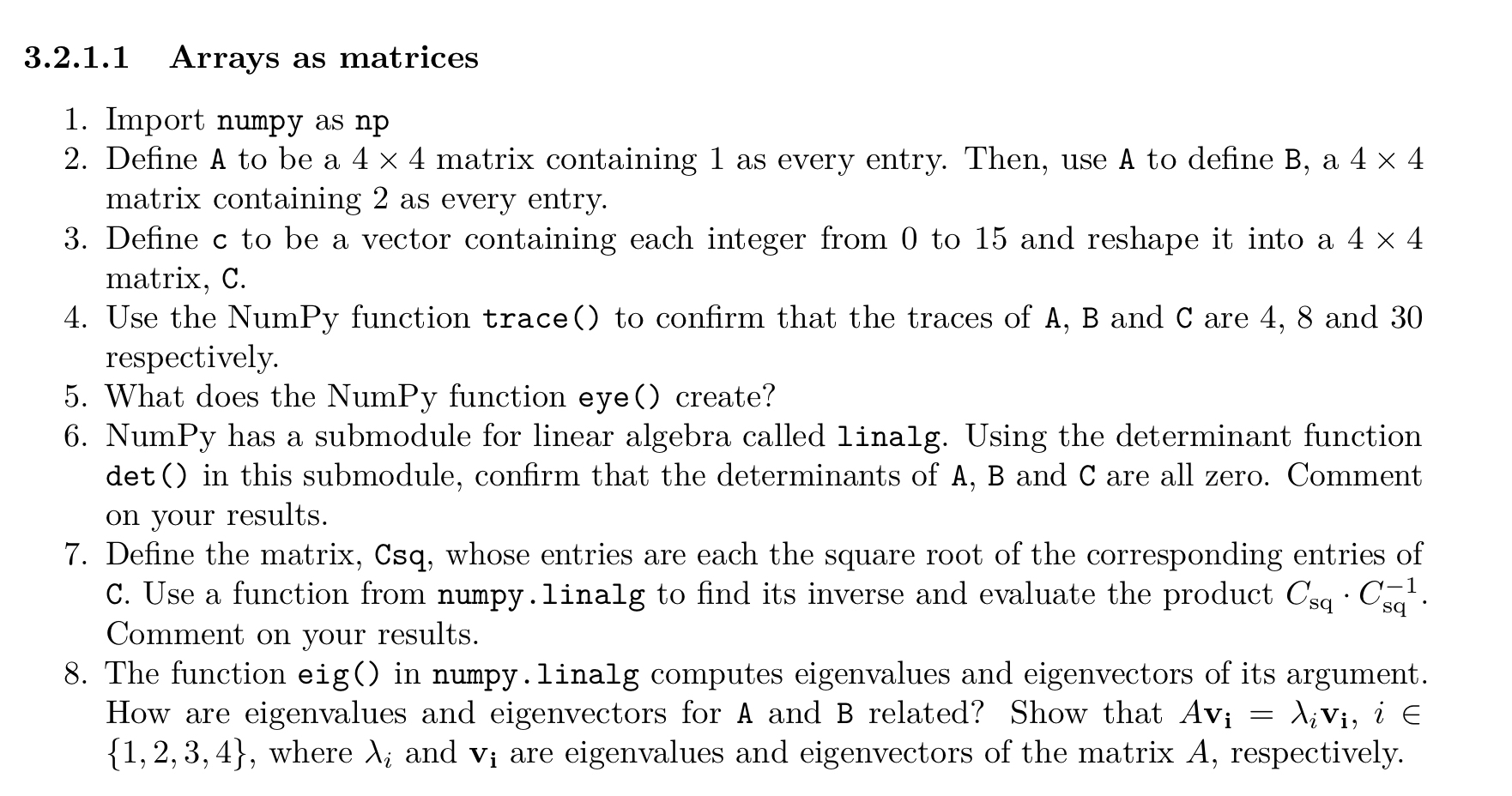
Question: 3 . 2 . 1 . 1 Arrays as matrices Import numpy as n p Define A to be a 4 4 matrix containing 1
Arrays as matrices
Import numpy as
Define A to be a matrix containing as every entry. Then, use A to define B a matrix containing as every entry.
Define c to be a vector containing each integer from to and reshape it into a matrix,
Use the NumPy function trace to confirm that the traces of A B and C are and respectively.
What does the NumPy function eye create?
NumPy has a submodule for linear algebra called linalg. Using the determinant function in this submodule, confirm that the determinants of A B and C are all zero. Comment on your results.
Define the matrix, Csq whose entries are each the square root of the corresponding entries of C Use a function from numpy. linalg to find its inverse and evaluate the product Comment on your results.
The function eig in numpy. linalg computes eigenvalues and eigenvectors of its argument. How are eigenvalues and eigenvectors for A and B related? Show that iin where and are eigenvalues and eigenvectors of the matrix respectively.
Step by Step Solution
There are 3 Steps involved in it
1 Expert Approved Answer
Step: 1 Unlock

Question Has Been Solved by an Expert!
Get step-by-step solutions from verified subject matter experts
Step: 2 Unlock
Step: 3 Unlock
 Study Help