







Question: 3.* 20 points) Consider the particle labeled A in Fig. 3 that approaches a uniform solid interface made of a lattice of atoms. The surface
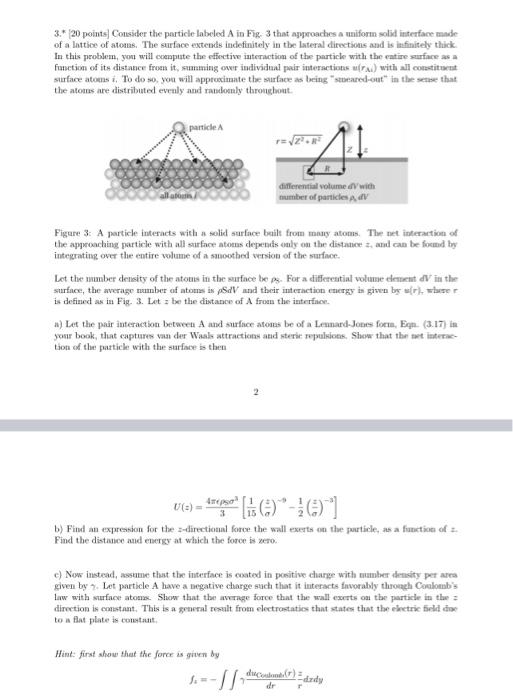
3.* 20 points) Consider the particle labeled A in Fig. 3 that approaches a uniform solid interface made of a lattice of atoms. The surface extends indefinitely in the lateral directions and is infinitely thick In this problem, you will compite the effective interaction of the particle with the entire surface as a function of its distance from it, summing over individual pair interactions with all constituent surface atoms i. To do so, you will approximate the surface as being strated-out" in the sense that the atores are distributed evenly and randomly throughout particle differential volume dy with number of particles AdV Figure 3: A particle interacts with a solid surface built from many atoms. The net interaction of the approaching particle with all surface atoms depends only on the distance and can be found by integrating over the entire volume of a stooted version of the surface. Let the number density of the atoms in the surface be ps. For a differential volume element d in the surface, the average number of atoms in pd and their interaction energy in given by the is defined as in Fig. 3. Let: be the distance of A from the interface *) Let the pair interaction between A and surface atoms be of a Leonard Jones form, Eon (3.17) in your book, that captures van der Waals attractions and sterir repulsions. Show that the winter tion of the particle with the surface is then 2 Artpol (100) 3 V:) b) Find an expression for the directional force the well exerts on the particle, as a function of 2. Find the distance and energy at which the force is neto. c) Now instead, state that the interface is coated in positive change withomber density per area given by Lot particle A have a negative charge said that it interacts favorably through Colomb's law with surface atoms. Show that the average force that the wall exets on the particle in the direction is constant. This is a general result from electrostatics that states that the electric field de to a flat plate is constant Hint: first show that the force is given by Sardy 5.-- // ducentana () dr
Step by Step Solution
There are 3 Steps involved in it

Get step-by-step solutions from verified subject matter experts
 Study Help