







Question: Consider two economies A and B. Let's call their currencies also A and B. In country A, US$100 can buy 20 cheeseburgers; in country
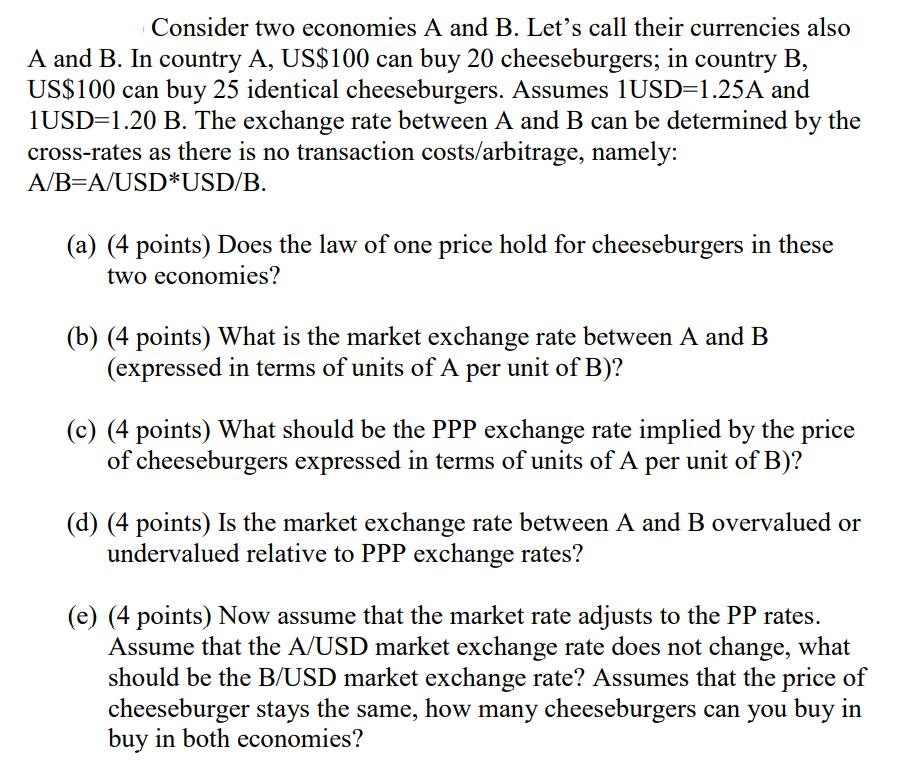
Consider two economies A and B. Let's call their currencies also A and B. In country A, US$100 can buy 20 cheeseburgers; in country B, US$100 can buy 25 identical cheeseburgers. Assumes 1USD=1.25A and 1USD=1.20 B. The exchange rate between A and B can be determined by the cross-rates as there is no transaction costs/arbitrage, namely: A/B=A/USD*USD/B. (a) (4 points) Does the law of one price hold for cheeseburgers in these two economies? (b) (4 points) What is the market exchange rate between A and B (expressed in terms of units of A per unit of B)? (c) (4 points) What should be the PPP exchange rate implied by the price of cheeseburgers expressed in terms of units of A per unit of B)? (d) (4 points) Is the market exchange rate between A and B overvalued or undervalued relative to PPP exchange rates? (e) (4 points) Now assume that the market rate adjusts to the PP rates. Assume that the A/USD market exchange rate does not change, what should be the B/USD market exchange rate? Assumes that the price of cheeseburger stays the same, how many cheeseburgers can you buy in buy in both economies?
Step by Step Solution
3.55 Rating (159 Votes )
There are 3 Steps involved in it
aNo the law of one price does not hold for cheeseburgers in these two economies This is because the exchange rate between A and B indicates that US100 can buy more cheeseburgers in country B 25 than i... View full answer

Get step-by-step solutions from verified subject matter experts
 Study Help