







Question: 3. (20 points) Suppose all workers have the same preferences represented by: U(w,x)=2w1/3x where w is the wage and x is the proportion of the
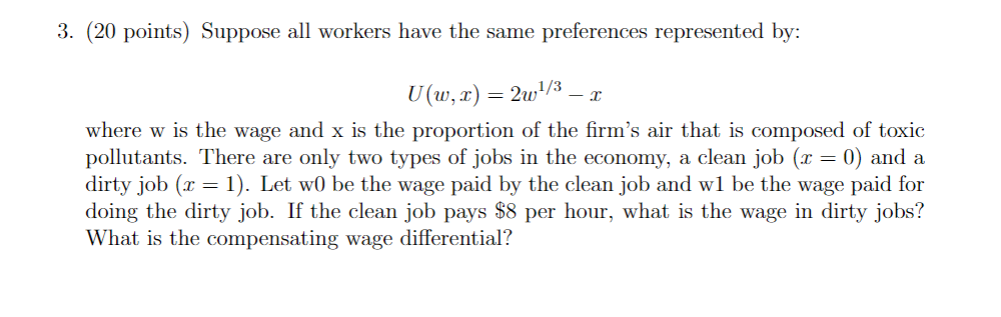
3. (20 points) Suppose all workers have the same preferences represented by: U(w,x)=2w1/3x where w is the wage and x is the proportion of the firm's air that is composed of toxic pollutants. There are only two types of jobs in the economy, a clean job (x=0) and a dirty job (x=1). Let w0 be the wage paid by the clean job and w1 be the wage paid for doing the dirty job. If the clean job pays $8 per hour, what is the wage in dirty jobs? What is the compensating wage differential? 3. (20 points) Suppose all workers have the same preferences represented by: U(w,x)=2w1/3x where w is the wage and x is the proportion of the firm's air that is composed of toxic pollutants. There are only two types of jobs in the economy, a clean job (x=0) and a dirty job (x=1). Let w0 be the wage paid by the clean job and w1 be the wage paid for doing the dirty job. If the clean job pays $8 per hour, what is the wage in dirty jobs? What is the compensating wage differential
Step by Step Solution
There are 3 Steps involved in it

Get step-by-step solutions from verified subject matter experts
 Study Help