



Question: 3. (25) Now consider Cornelius and Wheaton as consumers. Both derive utility not only from consuming what they can grow themselves, but also from the
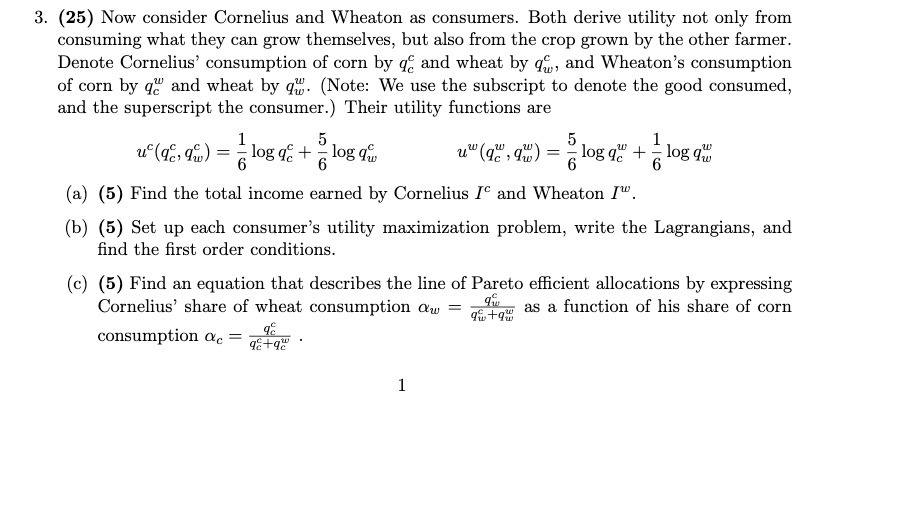
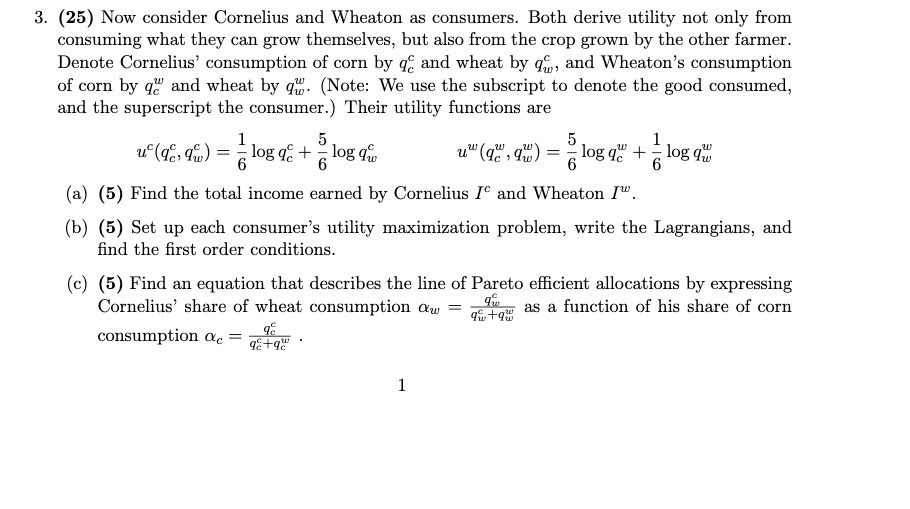
3. (25) Now consider Cornelius and Wheaton as consumers. Both derive utility not only from consuming what they can grow themselves, but also from the crop grown by the other farmer. Denote Cornelius' consumption of corn by q and wheat by q, and Wheaton's consumption of corn by q" and wheat by qu. (Note: We use the subscript to denote the good consumed, and the superscript the consumer.) Their utility functions are u"(q, q) = - log q + - log qu u" (q, qu ) = - log qc + log qu (a) (5) Find the total income earned by Cornelius /" and Wheaton I". (b) (5) Set up each consumer's utility maximization problem, write the Lagrangians, and find the first order conditions. (c) (5) Find an equation that describes the line of Pareto efficient allocations by expressing Cornelius' share of wheat consumption Qu =" qa toy as a function of his share of corn consumption ac =
Step by Step Solution
There are 3 Steps involved in it

Get step-by-step solutions from verified subject matter experts