



Question: 3. [3.25 p.) A monopolistic lender is dealing with two borrowers. He knows one of them is a H-type borrower, and the other is a
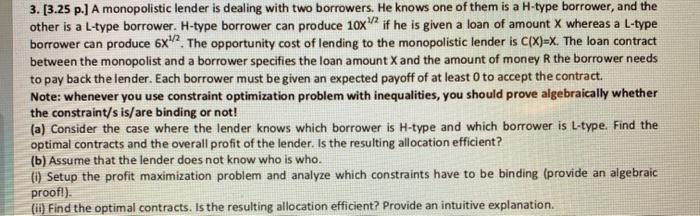
3. [3.25 p.) A monopolistic lender is dealing with two borrowers. He knows one of them is a H-type borrower, and the other is a L-type borrower. H-type borrower can produce 10x if he is given a loan of amount X whereas a L-type borrower can produce 6x2. The opportunity cost of lending to the monopolistic lender is C(X)=X. The loan contract between the monopolist and a borrower specifies the loan amount X and the amount of money R the borrower needs to pay back the lender. Each borrower must be given an expected payoff of at least 0 to accept the contract. Note: Whenever you use constraint optimization problem with inequalities, you should prove algebraically whether the constraint/s is/are binding or not! (a) Consider the case where the lender knows which borrower is H-type and which borrower is L-type. Find the optimal contracts and the overall profit of the lender. Is the resulting allocation efficient? (b) Assume that the lender does not know who is who. (1) Setup the profit maximization problem and analyze which constraints have to be binding provide an algebraic proof!). (ii) Find the optimal contracts. Is the resulting allocation efficient? Provide an intuitive explanation 3. [3.25 p.) A monopolistic lender is dealing with two borrowers. He knows one of them is a H-type borrower, and the other is a L-type borrower. H-type borrower can produce 10x if he is given a loan of amount X whereas a L-type borrower can produce 6x2. The opportunity cost of lending to the monopolistic lender is C(X)=X. The loan contract between the monopolist and a borrower specifies the loan amount X and the amount of money R the borrower needs to pay back the lender. Each borrower must be given an expected payoff of at least 0 to accept the contract. Note: Whenever you use constraint optimization problem with inequalities, you should prove algebraically whether the constraint/s is/are binding or not! (a) Consider the case where the lender knows which borrower is H-type and which borrower is L-type. Find the optimal contracts and the overall profit of the lender. Is the resulting allocation efficient? (b) Assume that the lender does not know who is who. (1) Setup the profit maximization problem and analyze which constraints have to be binding provide an algebraic proof!). (ii) Find the optimal contracts. Is the resulting allocation efficient? Provide an intuitive explanation
Step by Step Solution
There are 3 Steps involved in it

Get step-by-step solutions from verified subject matter experts