







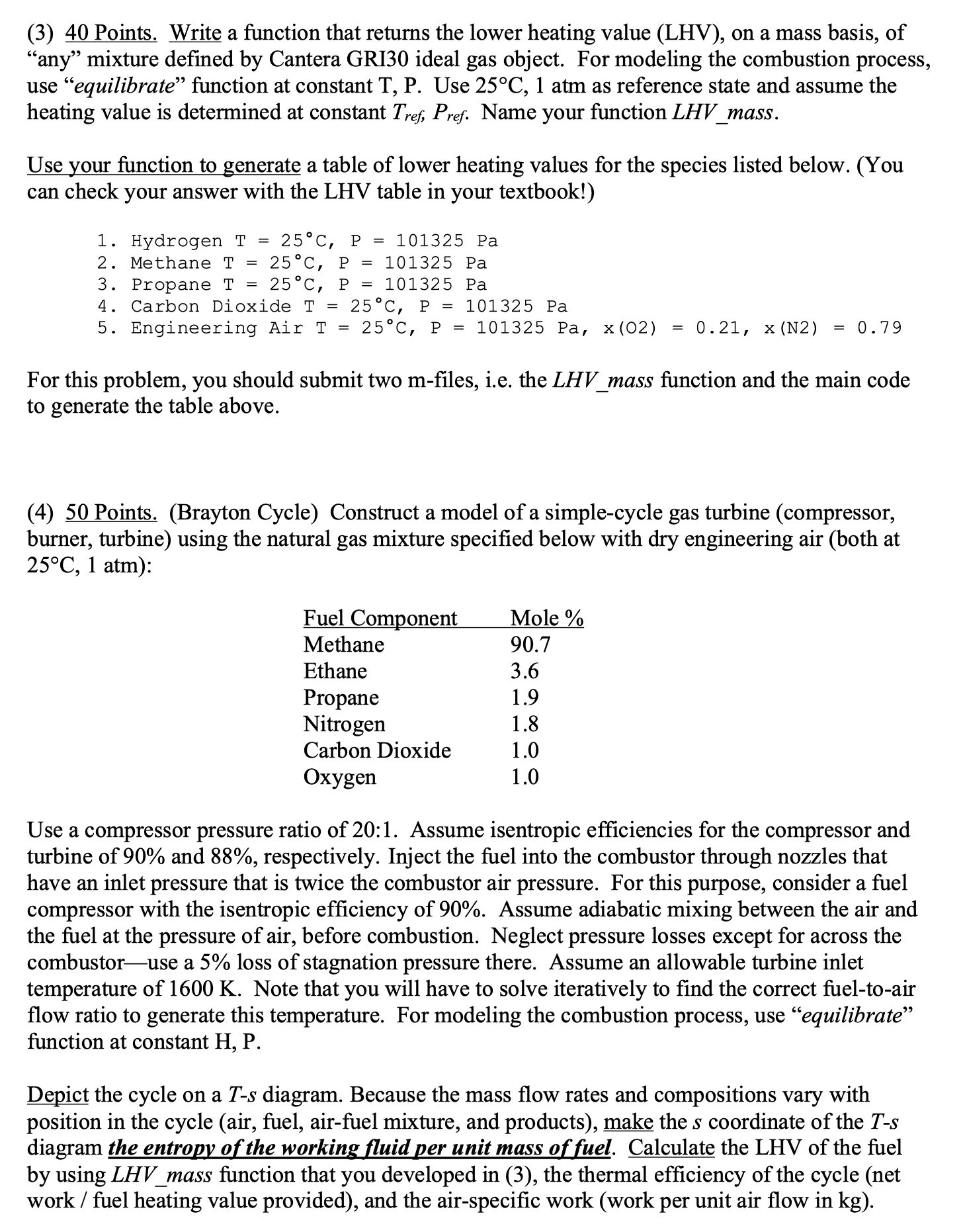
Question: ( 3 ) 4 0 Points. Write a function that returns the lower heating value ( LHV ) , on a mass basis, of any
Points. Write a function that returns the lower heating value LHV on a mass basis, of
"any" mixture defined by Cantera GRI ideal gas object. For modeling the combustion process,
use "equilibrate" function at constant T P Use @Catm as reference state and assume the
heating value is determined at constant TrefPref Name your function LHVmass
Use your function to generate a table of lower heating values for the species listed below. You
can check your answer with the LHV table in your textbook!
Hydrogen T
Methane T
Propane T
Carbon Dioxide T
Engineering Air T
For this problem, you should submit two m files, ie the LHV mass function and the main code
to generate the table above.
Points. Brayton Cycle Construct a model of a simplecycle gas turbine compressor
burner, turbine using the natural gas mixture specified below with dry engineering air both at
@Catm :
Use a compressor pressure ratio of : Assume isentropic efficiencies for the compressor and
turbine of and respectively. Inject the fuel into the combustor through nozzles that
have an inlet pressure that is twice the combustor air pressure. For this purpose, consider a fuel
compressor with the isentropic efficiency of Assume adiabatic mixing between the air and
the fuel at the pressure of air, before combustion. Neglect pressure losses except for across the
combustoruse a loss of stagnation pressure there. Assume an allowable turbine inlet
temperature of K Note that you will have to solve iteratively to find the correct fueltoair
flow ratio to generate this temperature. For modeling the combustion process, use "equilibrate"
function at constant H P
Depict the cycle on a Ts diagram. Because the mass flow rates and compositions vary with
position in the cycle air fuel, airfuel mixture, and products make the s coordinate of the Ts
diagram the entropy of the working fluid per unit mass of fuel. Calculate the LHV of the fuel
by using LHVmass function that you developed in the thermal efficiency of the cycle net
work fuel heating value provided and the airspecific work work per unit air flow in kg
for your information, these are the Matlab problem using cantera. Please write codes
Step by Step Solution
There are 3 Steps involved in it
1 Expert Approved Answer
Step: 1 Unlock

Question Has Been Solved by an Expert!
Get step-by-step solutions from verified subject matter experts
Step: 2 Unlock
Step: 3 Unlock
 Study Help