







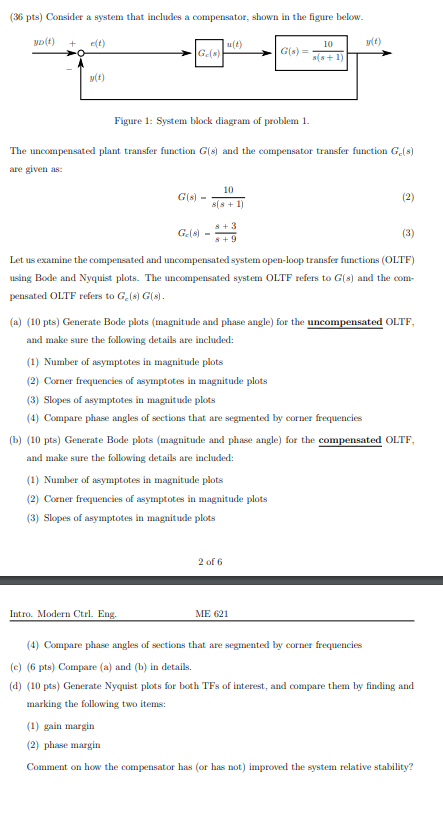
Question: ( 3 6 pts ) Consider a system that includes a compensator, shown in the figure below. The uncompensated plant transfer function ( G
pts Consider a system that includes a compensator, shown in the figure below.
The uncompensated plant transfer function Gs and the compensator transfer function Gcs are given as:
beginarrayl
Gsfracss
Gcsfracss
endarray
Let us examine the compensated and uncompensated system openloop transfer functions OLTF using Bode and Nyquist plots. The uncompensated system OLTF refers to Gs and the compensated OLTF refers to Gcs Gs
a pts Generate Bode plots magnitude and phase angle for the uncompensated OLTF, and make sure the following details are included:
Number of asymptotes in magnitude plots
Corner frequencies of asymptotes in magnitude plots
Slopes of asymptotes in magnitude plots
Compare phase angles of sections that are segmented by corner frequencies
b pts Generate Bode plots magnitude and phase angle for the compensated OLTF, and make sure the following details are included:
Number of asymptotes in magnitude plots
Corner frequencies of asymptotes in magnitude plots
Slopes of asymptotes in magnitude plots
Compare phase angles of sections that are segmented by corner frequencies
c pts Compare a and b in details.
d pts Generate Nyquist plots for both TFs of interest, and compare them by finding and marking the following two items:
gain margin
phase margin
Comment on how the compensator has or has not improved the system relative stability?
Step by Step Solution
There are 3 Steps involved in it
1 Expert Approved Answer
Step: 1 Unlock

Question Has Been Solved by an Expert!
Get step-by-step solutions from verified subject matter experts
Step: 2 Unlock
Step: 3 Unlock
 Study Help