







Question: 3. A 1.50 x 10 kg car, whose front is facing to the right (towards +r-axis) and whose engine is turned off and in neutral,
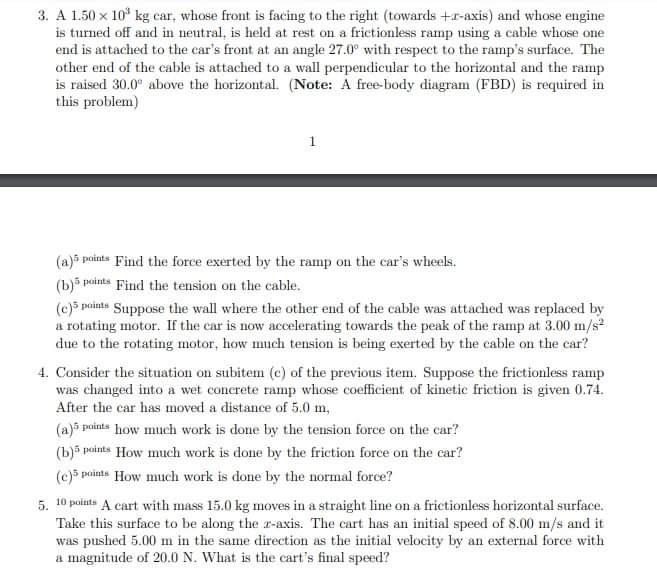
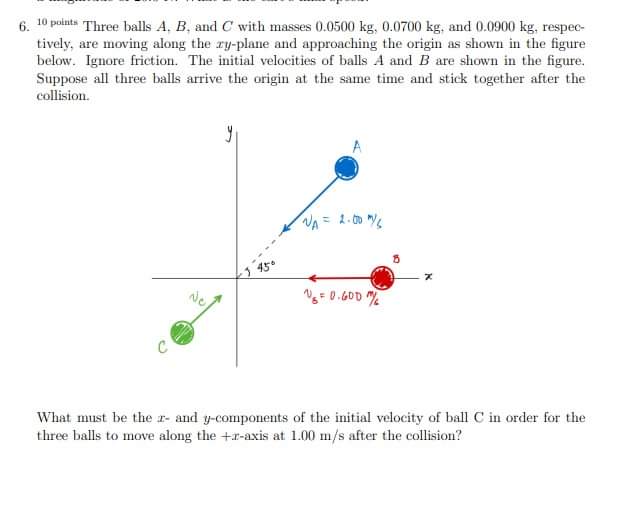
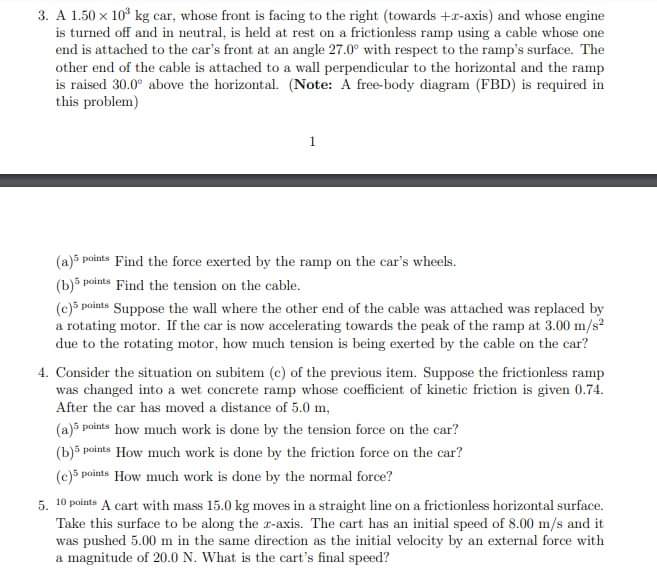
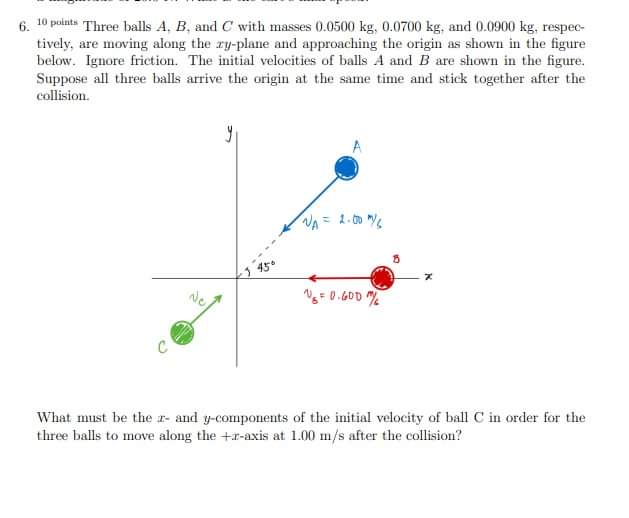
3. A 1.50 x 10" kg car, whose front is facing to the right (towards +r-axis) and whose engine is turned off and in neutral, is held at rest on a frictionless ramp using a cable whose one end is attached to the car's front at an angle 27.0" with respect to the ramp's surface. The other end of the cable is attached to a wall perpendicular to the horizontal and the ramp is raised 30.0" above the horizontal. (Note: A free-body diagram (FBD) is required in this problem) (a)5 points Find the force exerted by the ramp on the car's wheels. (b)5 points Find the tension on the cable. (e)s points Suppose the wall where the other end of the cable was attached was replaced by a rotating motor. If the car is now accelerating towards the peak of the ramp at 3.00 m/s' due to the rotating motor, how much tension is being exerted by the cable on the car? 4. Consider the situation on subitem (c) of the previous item. Suppose the frictionless ramp was changed into a wet concrete ramp whose coefficient of kinetic friction is given 0.74. After the car has moved a distance of 5.0 m, (a)5 points how much work is done by the tension force on the car? (b)5 points How much work is done by the friction force on the car? (c)5 points How much work is done by the normal force? 5. 10 polat's A cart with mass 15.0 kg moves in a straight line on a frictionless horizontal surface. Take this surface to be along the r-axis. The cart has an initial speed of 8.00 m/s and it was pushed 5.00 m in the same direction as the initial velocity by an external force with a magnitude of 20.0 N. What is the cart's final speed?6. 10 points Three balls A. B. and C with masses 0.0500 kg. 0.0700 kg, and 0.0900 kg, respec- tively, are moving along the ry-plane and approaching the origin as shown in the figure below. Ignore friction. The initial velocities of balls A and B are shown in the figure. Suppose all three balls arrive the origin at the same time and stick together after the collision. A VE = 0.6DD % What must be the r- and y-components of the initial velocity of ball C in order for the three balls to move along the +r-axis at 1.00 m/s after the collision
Step by Step Solution
There are 3 Steps involved in it

Get step-by-step solutions from verified subject matter experts
 Study Help