





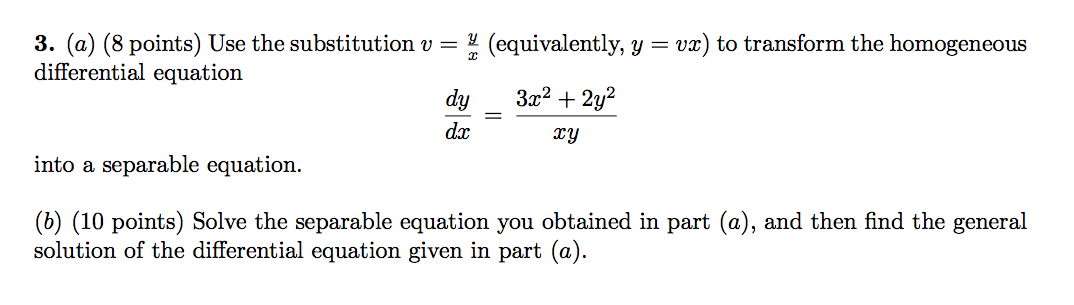
Question: 3. (a) (8 points) Use the substitution 1: = g (equivalently, y = om) to transform the homogeneous differential equation dy _ 3:32 + 23:2
3. (a) (8 points) Use the substitution 1: = g3. (a) (8 points) Use the substitution 1: = g3. (a) (8 points) Use the substitution 1: = g
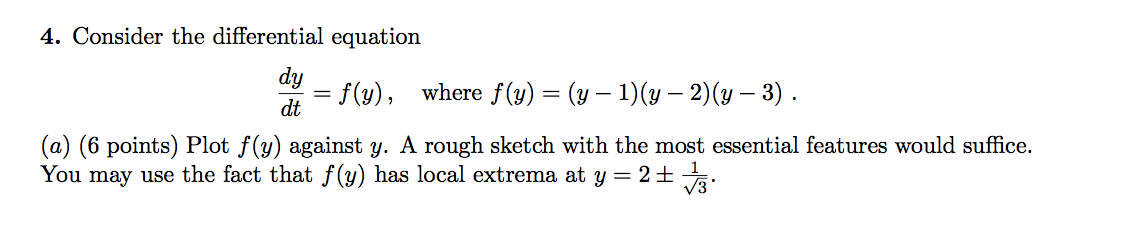
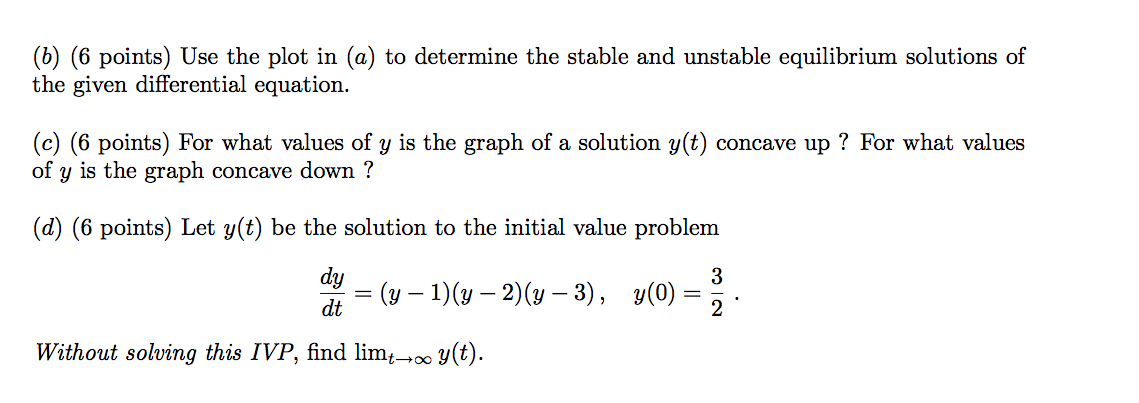
3. (a) (8 points) Use the substitution 1: = g (equivalently, y = om) to transform the homogeneous differential equation dy _ 3:32 + 23:2 d3? my into a separable equation. (:5) (10 points) Solve the separable equation you obtained in part (a), and then nd the general solution of the differential equation given in part (a). 4. Consider the differential equation dt dy _ f(y), where f(y) = (y -1)(y -2) (y - 3) . (a) (6 points) Plot f(y) against y. A rough sketch with the most essential features would suffice. You may use the fact that f(y) has local extrema at y = 2+(b) (6 points) Use the plot in (a) to determine the stable and unstable equilibrium solutions of the given differential equation. (c) (6 points) For what values of y is the graph of a solution y(t) concave up ? For what values of y is the graph concave down ? (d) (6 points) Let y(t) be the solution to the initial value problem dt dy = (y -1)(y - 2)(y - 3), y(0) = : Without solving this IVP, find limt-. y(t)
Step by Step Solution

There are 3 Steps involved in it

1 Expert Approved Answer
Step: 1 Unlock blur-text-image

Question Has Been Solved by an Expert!

Get step-by-step solutions from verified subject matter experts

Step: 2 Unlock
Step: 3 Unlock

Students Have Also Explored These Related Mathematics Questions!