







Question: 3. (a) A batch test is used to determine the first order decay rate of a pollutant. In the test, 60% removal of the pollutant
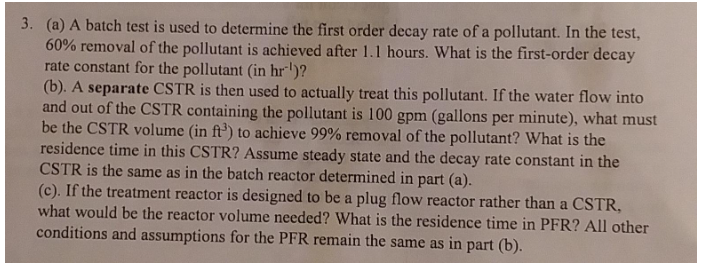
3. (a) A batch test is used to determine the first order decay rate of a pollutant. In the test, 60% removal of the pollutant is achieved after 1.1 hours. What is the first-order decay rate constant for the pollutant (in hr)? (b). A separate CSTR is then used to actually treat this pollutant. If the water flow into and out of the CSTR containing the pollutant is 100 gpm (gallons per minute), what must be the CSTR volume (in ft') to achieve 99% removal of the pollutant? What is the residence time in this CSTR? Assume steady state and the decay rate constant in the CSTR is the same as in the batch reactor determined in part (a). (c). If the treatment reactor is designed to be a plug flow reactor rather than a CSTR, what would be the reactor volume needed? What is the residence time in PFR? All other conditions and assumptions for the PFR remain the same as in part (b)
Step by Step Solution
There are 3 Steps involved in it

Get step-by-step solutions from verified subject matter experts
 Study Help