







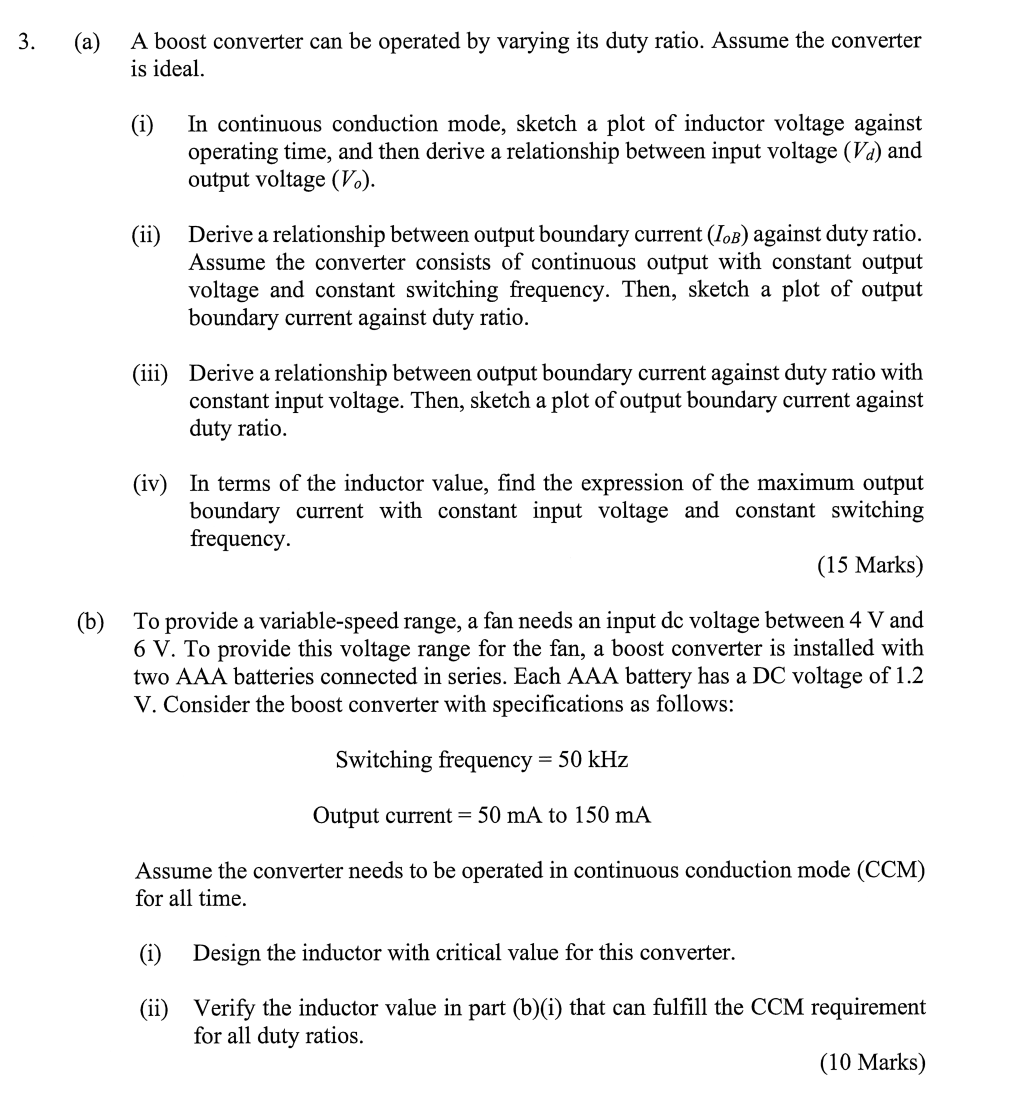
Question: 3 . ( a ) A boost converter can be operated by varying its duty ratio. Assume the converter is ideal. ( i ) In
a A boost converter can be operated by varying its duty ratio. Assume the converter is ideal.
i In continuous conduction mode, sketch a plot of inductor voltage against operating time, and then derive a relationship between input voltage Vd and output voltage Vo
ii Derive a relationship between output boundary current leftIo Bright against duty ratio. Assume the converter consists of continuous output with constant output voltage and constant switching frequency. Then, sketch a plot of output boundary current against duty ratio.
iii Derive a relationship between output boundary current against duty ratio with constant input voltage. Then, sketch a plot of output boundary current against duty ratio.
iv In terms of the inductor value, find the expression of the maximum output boundary current with constant input voltage and constant switching frequency.
Marks
b To provide a variablespeed range, a fan needs an input dc voltage between V and V To provide this voltage range for the fan, a boost converter is installed with two AAA batteries connected in series. Each AAA battery has a DC voltage of V Consider the boost converter with specifications as follows:
beginarrayl
text Switching frequency mathrmkHz
text Output current mathrm~mAtext to mathrm~mA
endarray
Assume the converter needs to be operated in continuous conduction mode CCM for all time.
i Design the inductor with critical value for this converter.
ii Verify the inductor value in part bi that can fulfill the CCM requirement for all duty ratios.
Step by Step Solution
There are 3 Steps involved in it
1 Expert Approved Answer
Step: 1 Unlock

Question Has Been Solved by an Expert!
Get step-by-step solutions from verified subject matter experts
Step: 2 Unlock
Step: 3 Unlock
 Study Help