







Question: 3 . ( a ) A loose sand sample with a critical state friction angle of ( 2 8 ^ { circ }
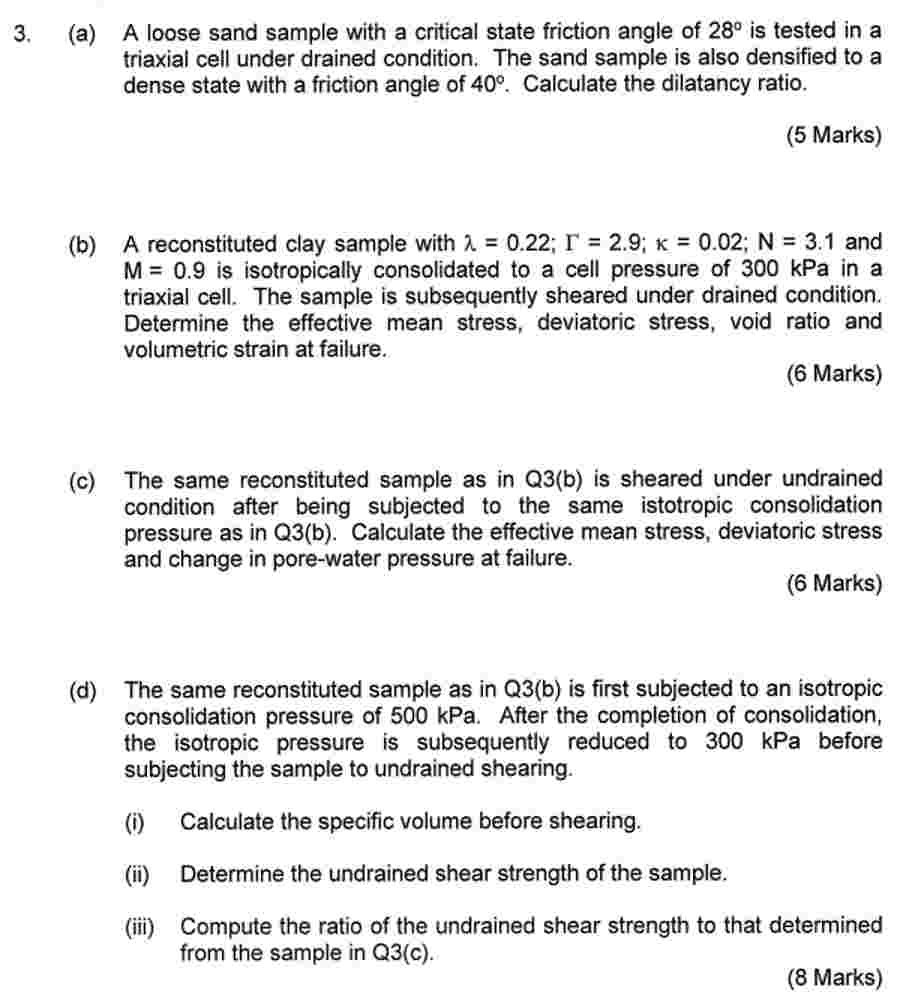
a A loose sand sample with a critical state friction angle of circ is tested in a triaxial cell under drained condition. The sand sample is also densified to a dense state with a friction angle of circ Calculate the dilatancy ratio.
Marks
b A reconstituted clay sample with lambda ; Gamma ; kappa ; mathrmN and mathrmM is isotropically consolidated to a cell pressure of kPa in a triaxial cell. The sample is subsequently sheared under drained condition. Determine the effective mean stress, deviatoric stress, void ratio and volumetric strain at failure.
Marks
c The same reconstituted sample as in Qb is sheared under undrained condition after being subjected to the same istotropic consolidation pressure as in Qb Calculate the effective mean stress, deviatoric stress and change in porewater pressure at failure.
Marks
d The same reconstituted sample as in Qb is first subjected to an isotropic consolidation pressure of kPa After the completion of consolidation, the isotropic pressure is subsequently reduced to kPa before subjecting the sample to undrained shearing.
i Calculate the specific volume before shearing.
ii Determine the undrained shear strength of the sample.
iii Compute the ratio of the undrained shear strength to that determined from the sample in Qc
Step by Step Solution
There are 3 Steps involved in it
1 Expert Approved Answer
Step: 1 Unlock

Question Has Been Solved by an Expert!
Get step-by-step solutions from verified subject matter experts
Step: 2 Unlock
Step: 3 Unlock
 Study Help