



Question: 3. A Hold-Up Problem. Suppose that Amtrak is choosing whether or not to build a new high-speed railroad on the east coast. Building the railroad
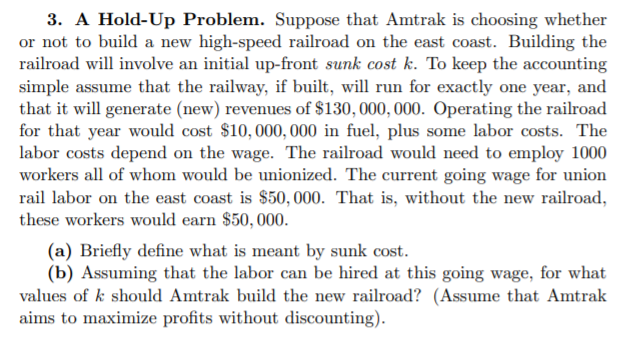
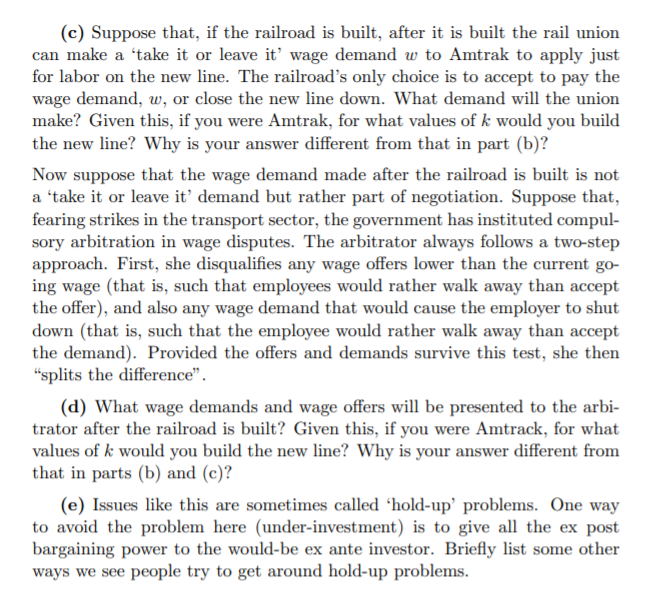
3. A Hold-Up Problem. Suppose that Amtrak is choosing whether or not to build a new high-speed railroad on the east coast. Building the railroad will involve an initial up-front sunk cost k. To keep the accounting simple assume that the railway, if built, will run for exactly one year, and that it will generate (new) revenues of $130, 000, 000. Operating the railroad for that year would cost $10, 000, 000 in fuel, plus some labor costs. The labor costs depend on the wage. The railroad would need to employ 1000 workers all of whom would be unionized. The current going wage for union rail labor on the east coast is $50, 000. That is, without the new railroad, these workers would earn $50, 000. (a) Briefly define what is meant by sunk cost. (b) Assuming that the labor can be hired at this going wage, for what values of k should Amtrak build the new railroad? (Assume that Amtrak aims to maximize profits without discounting).(e) Suppose that, if the railroad is built, after it is built the rail union can make a 'take it or leave it" wage demand is to Amtrak to apply just for labor on the new line. The railroad's only choice is to accept to pay the wage demand, to, or close the new line down. 'What demand will the union make? Given this, if you were Amtrak, for what values of i: would you build the new line? 1Why is your answer di'erent from that in part {b}? Now suppose that the wage demand made after the railroad is built is not a 'take it or leave it' demand but rather part of negotiation. Suppose that, fearing strikes in the transport sector, the government has instituted oompnl- sory arbitration in wage disputes. The arbitrator always follows a two-step approach. First, she disqualies any wage offers lower than the current go- ing wage {that is, such that employees would rather walk away than accept the oer), and also any wage demand that would cause the employer to shut down (that is, such that the employee would rather walk away than aeoept the demand). Provided the offers and demands survive this test, she then \"splits the difference". (:1) What wage demands and wage offers will he prmented to the arbi- trator after the railroad is built?I Given this, if you were Amtrack, for what values of it would you build the new line? Why is your answer different from that in parts (b) and (e)? (e) Issues like this are sometimes called 'hold-up' problems. One way to avoid the problem here {under-investment) is to give all the ex post bargaining power to the would-be ex ante investor. Briey list some other ways we see people try to get around hold-up problen'a
Step by Step Solution
There are 3 Steps involved in it

Get step-by-step solutions from verified subject matter experts